
Sentio AI Packet
AI training for One-Session Treatment for Specific Phobia
- Sharpen your skills.
- Plan sessions faster.
- Use ChatGPT safely.
- ChatGPT
- Claude
- Gemini
- Perplexity
- and more
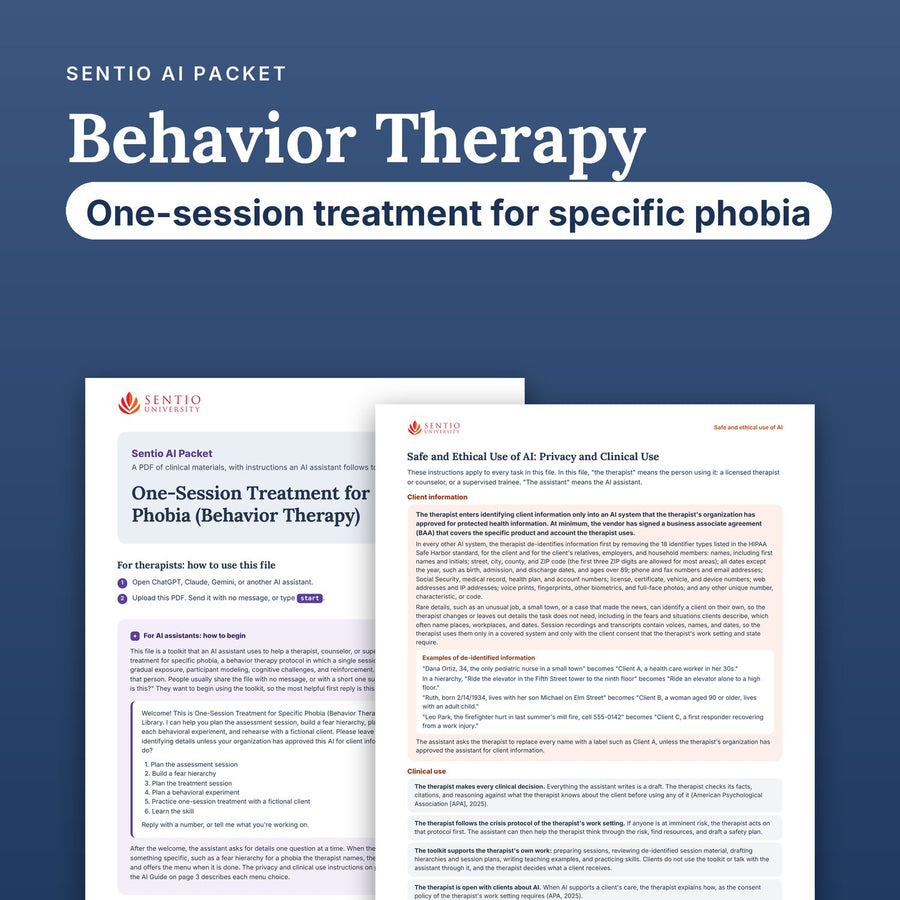
Welcome! This is One-Session Treatment for Specific Phobia (Behavior Therapy) from Sentio University Library.
I can help you plan the assessment session, build a fear hierarchy, plan the treatment session and each behavioral experiment, and rehearse with a fictional client.
Please leave out client names and other identifying details unless your organization has approved this AI for client information. What would you like to do?
- Plan the assessment session
- Build a fear hierarchy
- Plan the treatment session
- Plan a behavioral experiment
- Practice one-session treatment with a fictional client
- Learn the skill
2. I'm new to behavior therapy. Help me build a fear hierarchy. My client is afraid of dogs. Last week she walked six blocks out of her way to avoid a neighbor's dog on a leash.
Here is a draft hierarchy for your review, built on last week and the form on page 9. Ask her to rate each step from 0 to 100.
- Step 1: look at photos of dogs.
- Step 2: watch a video of a dog playing.
- Step 3: stand across a room from a calm dog on a leash.
- Step 4: stand next to the dog while you pet it.
- Step 5: pet the dog herself.
- Step 6: walk past a dog on the sidewalk.
- Catastrophic thought: ask, "What do you think would happen if you walked past that dog?" and write her words, such as "It will jump at me and bite me."
Check the steps with her in the assessment session, along with what maintains the fear and when it began (Davis et al., 2009). Would you like me to fill in the form or change any step?
What if she wants to stop a step as soon as her fear rises?
A client who leaves a step before fear falls is a common difficulty. The client stays in each exposure until fear falls, ideally by at least half from its highest rating, or until you judge that it has fallen, and breaks are brief and do not reinforce escape (Davis et al., 2009).
This criterion comes from the version for children and adolescents. Agree on it with her before the session. Here is a draft line for your review.
"You agreed to stay until the fear comes down. Let's stay right here together. Where is it now, from 0 to 100?"
Going from step 3 to step 5 looks like a big jump for her.
Steps that are too large to try are a common difficulty. Break the next step into smaller ones and demonstrate it again (Davis et al., 2009). Here is a draft for your review.
- Add steps, such as standing six feet from the dog, then three feet.
- Demonstrate each step first, modeling coping and challenging her catastrophic thought.
- Do it together, with her hand on yours, and fade to a hand on her shoulder and then to spoken support until she does it alone (Davis et al., 2009).
She also mentioned a heart condition, and she gets chest pain when she panics.
I'm pointing that out for your risk assessment, since a medical condition may make intense fear unsafe.
Consult her physician before the treatment session, and ask about thoughts of suicide and self-harm as part of the usual assessment. If anyone is at imminent risk, follow your work setting's crisis protocol first.
After that, I can help you think the risk through and plan the session.
I'll call her physician this week. Can I practice agreeing on a step with a suspicious client?
Yes. That is the advanced level.
Your fictional client is Malik, 37. He fears heights and turns down every meeting on the top floor of his office building, and in his words: "You're going to push me to the edge before I'm ready."
You can type Pause, Rewind, Show me, Harder, Easier or End at any time. Start when you're ready.
Malik, the next step is standing by the window on the third floor. What do you think will happen?
Malik: You'll call it one step, and then you'll walk me out onto the balcony. I'm staying by the door. [stays in the doorway]
Pause
Out of role. What worked: you named the step and asked for his prediction.
One thing to try: tell him that nothing happens without his permission or by surprise, and go first, for example, "Nothing happens today without your agreement. I'll walk to the window first, and you decide whether to join me. Are you willing to watch?"
Type Rewind to try that moment again.
How this AI packet helps you
- Plan the assessment session.
- Build a fear hierarchy.
- Plan the treatment session.
- Plan a behavioral experiment.
- Rehearse the treatment with a fictional client.
- Identify and address risks such as hopelessness, self-harm and thoughts of suicide.
- Learn to use AI safely and ethically while protecting client privacy.
About the skill
One-session treatment for specific phobias, developed by Lars-Göran Öst, combines exposure in vivo and modeling in one session (Öst, 1989). The session lasts up to three hours (Zlomke & Davis, 2008).
The parts of the treatment
- Assessment session: a separate session identifies what maintains the fear, builds the fear hierarchy and lists the most severe catastrophic thoughts (Davis et al., 2009)
- Behavioral experiments: therapist and client discuss each exposure, the therapist demonstrates it, and they complete it together (Davis et al., 2009)
- Participant modeling: the therapist demonstrates a step and then guides the client through it
Therapists use it with clients who have a specific phobia, such as a fear of dogs, heights or elevators.

Give this AI packet to AI
Your AI assistant will take it from there.
- ChatGPT
- Claude
- Gemini
- Perplexity
- and more
- Open a popular AI platform like ChatGPT, Claude, Gemini or Perplexity
- Upload this AI packet and type
start
Pricing
For every AI packet and AI kit you buy
- PDF format, ready to download
- 30-day refund, no questions asked
The Behavior Therapy AI kit includes all of these skills
You can also buy any skill as a single AI packet.
- ABC functional analysis$15
- Systematic desensitization$15
- Shaping$15
- Modeling$15
- Behavioral rehearsal$15
- Self-monitoring$15
- Contingency contracting$15
- Stimulus control$15
- One-session treatment for specific phobiaThis AI packet
- Social skills training sequence$15
Frequently asked questions
What is one-session treatment for specific phobia in Behavior Therapy?
One-session treatment for specific phobias, developed by Lars-Göran Öst, combines exposure in vivo and modeling in one session (Öst, 1989). The session lasts up to three hours and combines gradual exposure to the steps of the fear hierarchy, carried out as therapist-directed behavioral experiments, with participant modeling, cognitive challenges and reinforcement (Zlomke & Davis, 2008).
When do therapists use one-session treatment?
Therapists use one-session treatment with clients who have a specific phobia, such as a fear of dogs, heights or elevators. A separate assessment session identifies what maintains the fear and builds the fear hierarchy. Therapists can often treat fears whose exposures are easy to arrange, such as heights and enclosed spaces, in a single session (Abramowitz et al., 2019).
How does the One-Session Treatment for Specific Phobia AI packet support safe and ethical use of AI?
This AI packet carries the standard privacy and clinical use rules. You enter identifying client details only into an AI system your organization has approved for protected health information, under a business associate agreement covering your product and account, and you de-identify everything else. You follow your organization's crisis protocol first and make every clinical decision, and the AI assistant's assessment plans, fear hierarchies and session plans are drafts for your review. The rehearsal uses fictional clients, and clients do not use the AI packet.
Read more about privacy and safety in Safe and Ethical Use of AI for Therapists.
How can organizations use the One-Session Treatment for Specific Phobia AI packet?
Hospitals, community mental health centers, military and veterans programs, college counseling centers, group practices and training programs can give their therapists this AI packet through the Sentio University Library. Many therapists already use AI, and the AI packet gives them a safer and more ethical way to plan the assessment, the fear hierarchy and each behavioral experiment. The Organizations page explains how organizations get access.
Read more about privacy and safety in Safe and Ethical Use of AI for Therapists.
How can graduate students use the One-Session Treatment for Specific Phobia AI packet?
Graduate students learn the parts of one-session treatment, from the separate assessment session to the treatment session, and its seven steps, including agreeing on each step, demonstrating it and staying until fear falls. An example with a fictional client shows a session. The rehearsal offers a client who is frightened and willing to try each step and a client who wants to skip steps or stop as soon as fear rises.
How can practicing therapists use the One-Session Treatment for Specific Phobia AI packet?
Licensed therapists use the AI packet to plan the assessment session, build a fear hierarchy, plan the treatment session and plan a behavioral experiment. The AI packet includes a fear hierarchy that the therapist and client fill in during the assessment session and a session record.
How can supervisors and faculty use the One-Session Treatment for Specific Phobia AI packet?
Supervisors can review a trainee's session plan against the common difficulties, such as hierarchy steps that are too large, a client who leaves a step before fear falls, or a step that comes without the client's agreement (Davis et al., 2009; Abramowitz et al., 2019). Trainees can rehearse agreeing on the next step. Faculty can teach the parts of the treatment from the at-a-glance page.
In which settings does one-session treatment fit?
One-session treatment fits work on specific phobias with adults in outpatient clinics, community mental health centers, college counseling centers, hospitals and veterans programs. Many therapists in these settings already use AI, and the AI packet's privacy and clinical use rules give them a safer and more ethical way to do it by keeping client details inside approved AI systems and by leaving every clinical decision with the therapist.
Read more about privacy and safety in Safe and Ethical Use of AI for Therapists.
Can I use the One-Session Treatment for Specific Phobia AI packet as a study guide or for exam review?
The AI packet works as a short study guide on one-session treatment, with the parts of the treatment, the steps of the session and an example session. The AI assistant can teach any part and quiz you one question at a time. Students reviewing behavior therapy for exams can use it alongside the official study materials for their exam.
How do I practice one-session treatment with AI?
Upload the AI packet to a popular AI platform like ChatGPT, Claude, Gemini or Perplexity, type start and choose Practice one-session treatment with a fictional client. You pick what the client fears, such as dogs, heights or elevators, and the part of the session you want to practice. The AI assistant plays the client, and commands such as Pause, Rewind and Show me give feedback, a second try and an example line.
What does the One-Session Treatment for Specific Phobia AI packet include?
The AI packet includes privacy and clinical use rules, the AI Guide the assistant follows, a rehearsal with a fictional client, one-session treatment at a glance, seven steps for running it, an example with a fictional client, questions for each behavioral experiment, common difficulties, a fear hierarchy, a session record and references. It is a PDF you can read on your own or give to an AI assistant.
Read more about privacy and safety in Safe and Ethical Use of AI for Therapists.
What should I keep in mind before using one-session treatment with a client?
Agree on each step with the client before it happens, and stay with a step until fear falls (Davis et al., 2009). Check for a history of fainting at the sight of blood, injections or injury and for any medical condition that makes intense fear unsafe. If anyone is at imminent risk, follow your organization's crisis protocol first.
Read more about privacy and safety in Safe and Ethical Use of AI for Therapists.
For any other question, contact us.

