
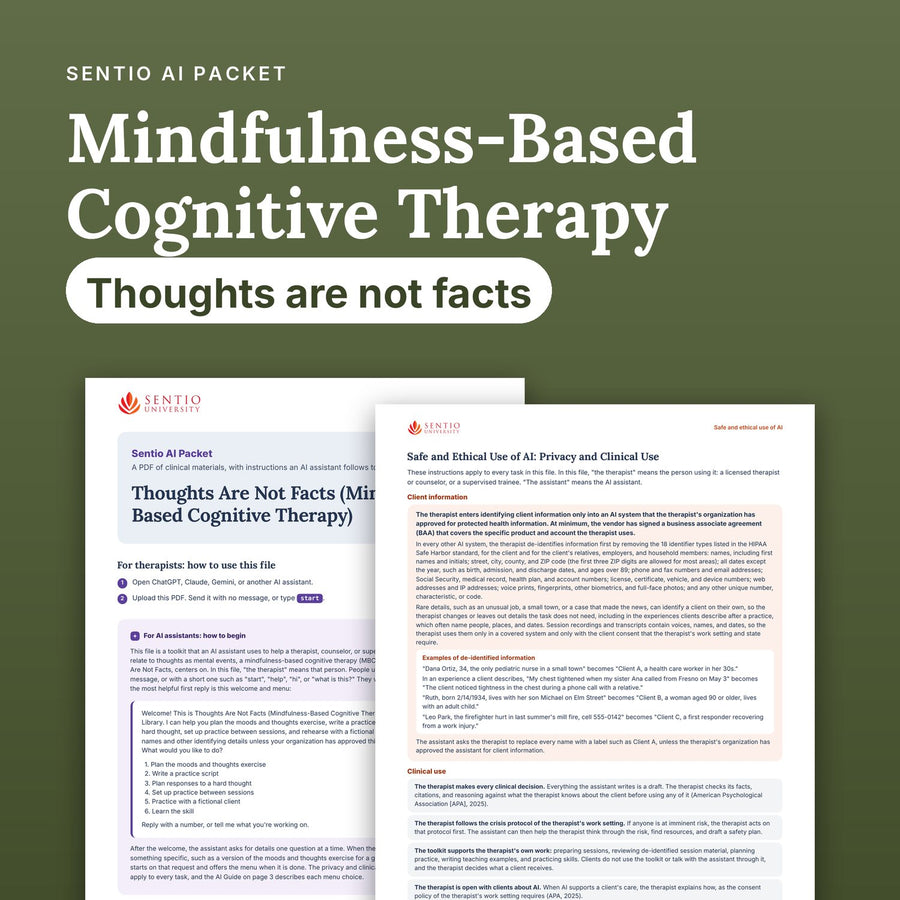
Sentio AI Packet
AI training for Thoughts Are Not Facts
- Sharpen your skills.
- Plan sessions faster.
- Use ChatGPT safely.
- ChatGPT
- Claude
- Gemini
- Perplexity
- and more
Welcome! This is Thoughts Are Not Facts (Mindfulness-Based Cognitive Therapy) from Sentio University Library. I can help you plan the moods and thoughts exercise, write a practice script, plan responses to a hard thought, set up practice between sessions, and rehearse with a fictional client.
Please leave out client names and other identifying details unless your organization has approved this AI for client information. What would you like to do?
- Plan the moods and thoughts exercise
- Write a practice script
- Plan responses to a hard thought
- Set up practice between sessions
- Practice with a fictional client
- Learn the skill
3. I'm new to MBCT. Help me plan responses to a hard thought. A client in my group gets hooked by "I'll never fit in" after social events.
Here is a draft plan for your review. Each option starts with a breathing space (Segal et al., 2013; Zuo & Segal, 2022).
- Breathing space first: when the thought shows up, she takes a breathing space before anything else.
- Watch it: she notices the thought arriving, staying for a while, and passing.
- Note it as a mental event: "I'm having the thought that I'll never fit in."
- Write it down: she writes the thought word for word and looks at it on the page.
- Turn to the feeling: she asks what mood is here with the thought and how she might take care of herself right now.
- Action step: afterward, she may consider a small step.
Would you like me to fill in the session plan or adapt the thoughts record for her?
When I tried this, she said, "But it's true. Look at how that party went." I started listing the times she did fit in.
Arguing about whether the thought is true is a common difficulty (Segal et al., 2013). MBCT has clients notice and accept negative thoughts as passing events in the mind, so leave the content undisputed and turn to the process of thinking and the mood behind it (Segal & Ferguson, 2018). Here is a draft line for your review.
"That thought feels very true after the party. Let's take a breathing space and notice the mood that's here with it."
She also uses noting to push the thought away, and she gets discouraged when it comes back.
That is a common difficulty too (Segal et al., 2013). Present noting as a way to watch a thought arise and fade, including thoughts that return. Here is a draft line for your review.
"Thoughts often come back. Each time it returns, you can note it again and watch it come and go."
In the group she said, "Some nights I think everyone would be better off without me."
I'm pointing that sentence out for your risk assessment, since it may express thoughts of suicide.
Check in with her and ask about thoughts of suicide and self-harm. If anyone is at imminent risk, follow your work setting's crisis protocol first.
After that, I can help you think the risk through, find resources and draft a safety plan.
I'll speak with her today. Can I practice? Intermediate level.
Yes. At the intermediate level, the client argues that the thought is a fact.
Your fictional client is Priya, 36, who felt left out at a family dinner. In her words: "I'll never fit in anywhere, and I can prove it."
You can type Pause, Rewind, Show me, Harder, Easier or End at any time. Start when you're ready.
Priya, as you think about the dinner, what thought is here?
Priya: That I'll never fit in. And that's a fact. Everyone talked around me all night. [crosses arms]
Pause
Out of role. What worked: you asked about the thought with curiosity.
One thing to try: acknowledge the mood and invite her to note the thought, for example, "It feels like a fact right now. Try saying, 'I'm having the thought that I'll never fit in,' and see what you notice."
Type Rewind to try that moment again.
How this AI packet helps you
- Plan the moods and thoughts exercise.
- Write a practice script.
- Plan responses to a hard thought.
- Set up practice between sessions.
- Rehearse with a fictional client.
- Identify and address risks such as hopelessness, self-harm and thoughts of suicide.
- Learn to use AI safely and ethically while protecting client privacy.
About the skill
In mindfulness-based cognitive therapy (MBCT), clients learn to relate to thoughts as mental events that come and go, including thoughts that feel true in a low mood (Williams, 2008). Session 6, Thoughts Are Not Facts, gives this the most attention: clients see negative moods as passing states of mind and negative thinking as a product of those states (Segal et al., 2013).
Ways of relating to thoughts
- Watch them: the client watches thoughts come and go, like any other event
- See them as mental events: the client notes "I'm having the thought that..."
- Write them down: putting a thought on paper gives some distance from it
- Turn to the feeling: the client turns with compassion to the feelings behind the thought
Cognitive therapy targets the content of negative thoughts, and MBCT has clients notice and accept them as passing events in the mind (Segal & Ferguson, 2018).

Give this AI packet to AI
Your AI assistant will take it from there.
- ChatGPT
- Claude
- Gemini
- Perplexity
- and more
- Open a popular AI platform like ChatGPT, Claude, Gemini or Perplexity
- Upload this AI packet and type
start
Pricing
For every AI packet and AI kit you buy
- PDF format, ready to download
- 30-day refund, no questions asked
The MBCT AI kit includes all of these skills
You can also buy any skill as a single AI packet.
- Three-minute breathing spaceGet it free
- Doing mode and being mode$15
- Thoughts are not factsThis AI packet
- Exploring difficulty$15
- Pleasant and unpleasant events calendars$15
- Relapse signature and action plan$15
- Inquiry after practice$15
- Walking down the street$15
Frequently asked questions
What does thoughts are not facts mean in mindfulness-based cognitive therapy?
In MBCT, clients learn to relate to thoughts as mental events that come and go, including thoughts that feel true in a low mood (Williams, 2008). Clients see negative moods as passing states of mind and negative thinking as a product of those states (Segal et al., 2013). Labeling experience as a process lets a person step back, or decenter, and decentering gives the direct experience that thoughts are not facts (Dimidjian & Linehan, 2009; Fruzzetti et al., 2019).
When do therapists teach thoughts are not facts?
Therapists teach the skill with the moods and thoughts exercise, starting from a practice and a breathing space. The therapist avoids arguing about whether a thought is true and takes care that the teaching does not dismiss the client's experience. People who are actively suicidal or currently misusing substances are not accepted into the program, and people with untreated trauma are advised to seek other treatment (Segal & Ferguson, 2018; Zuo & Segal, 2022).
Read more about privacy and safety in Safe and Ethical Use of AI for Therapists.
How does the thoughts are not facts AI packet support safe and ethical use of AI?
This AI packet carries the standard privacy and clinical use rules. You enter identifying client details only into an AI system your organization has approved for protected health information, under a business associate agreement covering your product and account, and you de-identify everything else. You follow your organization's crisis protocol first and make every clinical decision, and the AI assistant's exercise plans, practice scripts and planned responses to a hard thought are drafts for your review. The rehearsal uses fictional clients, and clients do not use the AI packet.
Read more about privacy and safety in Safe and Ethical Use of AI for Therapists.
How can organizations use the thoughts are not facts AI packet?
Hospitals, community mental health centers, college counseling centers, military and veterans programs, group practices and training programs can give their therapists the thoughts are not facts AI packet through the Sentio University Library. Many therapists already use AI, and the AI packet gives them a safer and more ethical way to plan the moods and thoughts exercise and write a practice script. The Organizations page explains how organizations get access.
Read more about privacy and safety in Safe and Ethical Use of AI for Therapists.
How can graduate students use the thoughts are not facts AI packet?
Graduate students learn how MBCT treats thoughts as mental events and eight steps for teaching the skill, from starting with a practice to setting practice between sessions. An example with a fictional client shows a session. The rehearsal offers a client who notices thoughts readily and a client who argues that the thought is a fact.
How can practicing therapists use the thoughts are not facts AI packet?
Licensed therapists use the AI packet to plan the moods and thoughts exercise, write a practice script, plan responses to a hard thought and set up practice between sessions. The AI packet includes prompts for relating to thoughts, a thoughts as events record for the client and a session plan.
How can supervisors and faculty use the thoughts are not facts AI packet?
Supervisors can review a trainee's teaching against the common difficulties, such as arguing about whether the thought is true, a teaching that comes across as dismissing the client's experience, or a client who uses noting to push a thought away. Trainees can rehearse leading the moods and thoughts exercise or answering a client who insists the thought is true. Faculty can teach decentering from the at-a-glance page.
In which settings does teaching thoughts are not facts fit?
Relating to thoughts as mental events fits settings that run groups for adults with recurrent depression, including hospitals, community mental health centers, college counseling centers and group practices. Many therapists in these settings already use AI, and the AI packet's privacy and clinical use rules give them a safer and more ethical way to do it by keeping a client's hard thoughts inside approved AI systems and by leaving the choice of response to each thought with the client and the therapist.
Read more about privacy and safety in Safe and Ethical Use of AI for Therapists.
Can I use the thoughts are not facts AI packet as a study guide or for exam review?
The AI packet works as a short study guide on thoughts as mental events, with decentering, the moods and thoughts exercise, the steps and an example session. The AI assistant can teach any part and quiz you one question at a time. Students reviewing MBCT for exams can use it alongside the official study materials for their exam.
How do I practice teaching thoughts are not facts with AI?
Upload the AI packet to a popular AI platform like ChatGPT, Claude, Gemini or Perplexity, type start and choose Practice with a fictional client. You pick the thought the client brings, such as a belief about letting people down or about a low mood that will not lift, and the step you want to practice. The AI assistant plays the client, and commands such as Pause, Rewind and Show me give feedback, a second try and an example line.
What does the thoughts are not facts AI packet include?
The AI packet includes privacy and clinical use rules, the AI Guide the assistant follows, a rehearsal with a fictional client, thoughts are not facts at a glance, eight steps for teaching the skill, an example with a fictional client, prompts for relating to thoughts, common difficulties, a thoughts as events record, a session plan and references. It is a PDF you can read on your own or give to an AI assistant.
Read more about privacy and safety in Safe and Ethical Use of AI for Therapists.
What should I keep in mind before teaching thoughts are not facts to a client?
Begin with a breathing space, use slow prompts and leave the truth of a thought unargued. Take care that the teaching respects the client's experience. When a client's mood drops sharply or the practice stirs up thoughts of suicide or self-harm, follow your organization's crisis protocol first.
Read more about privacy and safety in Safe and Ethical Use of AI for Therapists.
For any other question, contact us.

