
Sentio AI Packet
AI training for The Trial Therapy
- Sharpen your skills.
- Plan sessions faster.
- Use ChatGPT safely.
- ChatGPT
- Claude
- Gemini
- Perplexity
- and more
Welcome! This is The Trial Therapy (Intensive Short-Term Dynamic Psychotherapy) from Sentio University Library.
I can help you plan a trial therapy, screen for suitability and risk, read the client's response to the trial, choose a treatment format, and rehearse with a fictional client.
Please leave out client names and other identifying details unless your organization has approved this AI for client information. What would you like to do?
- Plan a trial therapy
- Screen for suitability and risk
- Read the client's response
- Choose the format and next steps
- Practice a trial therapy with a fictional client
- Learn the skill
1. I'm new to ISTDP. A primary care doctor referred a woman in her 30s for stomach pain that tests found no medical cause for. I have two hours for the first session. Can you plan the trial therapy?
Here is a draft plan for your review, following the phases of the trial (Abbass, 2015; Coughlin Della Selva, 1996/2004).
- Opening: "Let's work together to understand what's going on and see whether this kind of therapy can help you." Confirm that she has come of her own will.
- Barriers: she was referred, so ask about her own wish before the evaluation: "Is there a problem you want help with?"
- Inquiry: ask for recent, specific examples of the pain and what set it off, and move to defense work after about 15 to 20 minutes.
- Pressure: after each intervention, watch where anxiety goes, and stop and recap if it moves into her stomach (Frederickson, 2013).
- History: earlier treatment, episodes of depression, and suicidal thoughts past and present, taken while she is calm (Davanloo, 1980).
- End: recap, review the findings, choose the format with her and plan follow-up.
Would you like me to fill in the trial plan with the screening items?
Before that, with a similar client, when I asked how she felt toward her mother, she went blank and felt sick right away.
Cognitive-perceptual disruption at a low rise in feeling suggests a fragile client, and the graded format, with no challenge, fits her (Frederickson, 2013). Here is a draft next step for your review.
- Stop pressure, point out the symptoms and recap until striated tension returns.
- Change at once to a more supportive technique for the rest of the trial (Davanloo, 1980).
- Note the response in the trial summary, with the graded format as the format to discuss with her.
Another client showed no anxiety and no defenses at all when I pressed.
With no signals, stop pressure and look for the cause (Abbass, 2015). Here is a draft checklist for your review.
- Anxiety in other channels, projection or depression.
- Exhaustion, illness, impairment or brain injury.
- Alcohol, drugs or sedating medication, and a word with the client's psychiatrist about medication (Abbass, 2015; Frederickson, 2013).
Back to the first client. She left an abusive marriage last month, and in the history she was very calm and said, "I've made peace with everything now."
I'm pointing that out for your risk assessment. Unusual calm in a depressed client can mark active suicidal planning, and a client who has just left an abusive relationship may collapse into severe depression, with a risk of suicide (Abbass, 2015; Kenny, 2014).
Investigate the calm and take a thorough history, and check that she is safe at home. If anyone is at imminent risk, follow your work setting's crisis protocol first. After that, I can help you think the risk through.
I'll take that up at the start of the next session. Can I practice? Intermediate, a client whose doctor sent him.
Yes. Your fictional client is Ray, 58. His doctor referred him for trouble sleeping since his shop closed, and in his words: "My doctor thinks I should talk to someone. I'm not sure what there is to talk about."
You can type Pause, Rewind, Show me, Harder, Easier or End at any time. Start when you're ready.
Ray, let's work together to understand what's going on and see whether this kind of therapy can help you. What brings you in?
Ray: [shrugs] My doctor sent me. I'm not sure I need this. [glances at the door]
Pause
Out of role. What worked: you set up the session as a shared evaluation.
One thing to try: take up the barrier first and explore his own wish, for example, "Your doctor sent you, and the choice is yours. Is there a problem you want help with?"
Type Rewind to try that moment again.
How this AI packet helps you
- Plan a trial therapy.
- Screen for suitability and risk.
- Read the client's response.
- Choose the format and next steps.
- Rehearse a trial therapy with a fictional client.
- Identify and address risks such as hopelessness, self-harm and thoughts of suicide.
- Learn to use AI safely and ethically while protecting client privacy.
About the skill
The first session of intensive short-term dynamic psychotherapy (ISTDP), the trial therapy, is longer than later sessions. It includes an evaluation of the client's problems, of how the client defends against emotion in the session, and of the client's capacity to tolerate anxiety (Johansson et al., 2014).
What the client's response shows
- Striated anxiety and clear defenses: the client can use pressure and, with resistance, challenge (Abbass, 2015)
- Smooth muscle anxiety, conversion or depression: restructuring and the graded format come first (Abbass, 2015)
The therapist screens for suitability and risk, reviews the findings with the client and chooses a treatment format.

Give this AI packet to AI
Your AI assistant will take it from there.
- ChatGPT
- Claude
- Gemini
- Perplexity
- and more
- Open a popular AI platform like ChatGPT, Claude, Gemini or Perplexity
- Upload this AI packet and type
start
Pricing
For every AI packet and AI kit you buy
- PDF format, ready to download
- 30-day refund, no questions asked
The ISTDP AI kit includes all of these skills
You can also buy any skill as a single AI packet.
- Tracking unconscious anxiety$15
- Pressure toward feelings$15
- Clarifying and challenging defenses$15
- Head-on collision$15
- The graded format$15
- Recapitulation$15
- The trial therapyThis AI packet
Frequently asked questions
What is the trial therapy in intensive short-term dynamic psychotherapy?
The trial therapy is the extended first session of intensive short-term dynamic psychotherapy (ISTDP). It combines a psychodiagnostic evaluation of the client's problems, defenses against emotion and capacity to tolerate anxiety with a trial of the treatment, and where possible the experience of avoided feelings. The findings are reviewed with the client and a treatment format is chosen (Johansson et al., 2014).
When do therapists use the trial therapy?
Therapists hold the trial therapy as the first session, which is longer than later sessions, typically two to three hours in Abbass's account (Abbass, 2015). The client needs a problem of their own to work on, so barriers to engagement are taken up before the evaluation. When a client proves too fragile, the therapist changes at once to a more supportive technique (Davanloo, 1980).
How does the trial therapy AI packet support safe and ethical use of AI?
The trial therapy AI packet carries the standard privacy and clinical use rules. You enter identifying client details only into an AI system your organization has approved for protected health information, under a business associate agreement covering your product and account, and you de-identify everything else. You follow your organization's crisis protocol first and make every clinical decision, and the AI assistant's trial plans, screening lists, response readings and trial summaries are drafts for your review. The rehearsal uses fictional clients, and clients do not use the AI packet.
Read more about privacy and safety in Safe and Ethical Use of AI for Therapists.
How can organizations use the trial therapy AI packet?
Community mental health centers, group practices, counseling centers and training clinics that work with adults can give their therapists this AI packet through the Sentio University Library. Clinicians can use it to plan a trial therapy and screen a client for suitability and risk, and a supervisor can assign it before a trainee conducts a first trial therapy. The Organizations page explains how organizations get access.
How can graduate students use the trial therapy AI packet?
Graduate students learn what the client's response shows, the steps of the trial and the screening before and during it, see them in an example with a fictional client, and rehearse with an AI assistant that plays a client at a beginner, intermediate or advanced level. Useful moments to practice include taking up a barrier to engagement and noticing where anxiety goes, including with a client who says a doctor sent them and is not sure they need therapy.
How can practicing therapists use the trial therapy AI packet?
Licensed therapists use the AI packet to prepare a trial therapy for a particular client. The AI assistant drafts a plan that follows the phases of the trial from your answers about the referral, setting and time, goes through the screening with you one item at a time, places the client's response to pressure on the spectrum the AI packet describes and says what it suggests about the format, and helps you fill in the trial summary.
How can supervisors and faculty use the trial therapy AI packet?
Supervisors assign the AI packet before a trainee conducts a trial therapy and review the trial summary against common difficulties, such as starting the evaluation before barriers to engagement are taken up, pressing a client who does not want therapy, or taking a fragile client through standard pressure and challenge. Faculty can use the example session to show a referred client naming a problem of his own and a filled-in trial summary.
In which settings does the trial therapy fit?
The trial therapy fits ISTDP with adults in clinics, counseling centers and practices that can offer an extended first session, with screening before and during the trial. Many therapists in these settings already use AI, and the AI packet's privacy and clinical use rules give them a safer and more ethical way to do it by keeping identifying client details inside approved AI systems.
Read more about privacy and safety in Safe and Ethical Use of AI for Therapists.
Can I use the trial therapy AI packet as a study guide or for exam review?
The AI packet works as a short study guide on the trial therapy, with what the client's response shows, the steps of the trial, the screening, lines for the trial, an example session and references. You can ask the AI assistant to teach any part in under 200 words and then quiz you one question at a time. Students reviewing intensive short-term dynamic psychotherapy for comprehensive or licensing exams can use it alongside the official study materials for their exam.
How do I practice the trial therapy with AI?
Upload the AI packet to a popular AI platform like ChatGPT, Claude, Gemini or Perplexity, type start and choose Practice a trial therapy with a fictional client. You pick the concern the client brings, such as panic attacks or a marriage in trouble, and the step you want to practice, and the AI assistant plays a client who may say a doctor sent them and doubt they need therapy. Commands such as Pause, Rewind and Show me give feedback, a second try and an example line.
What does the trial therapy AI packet include?
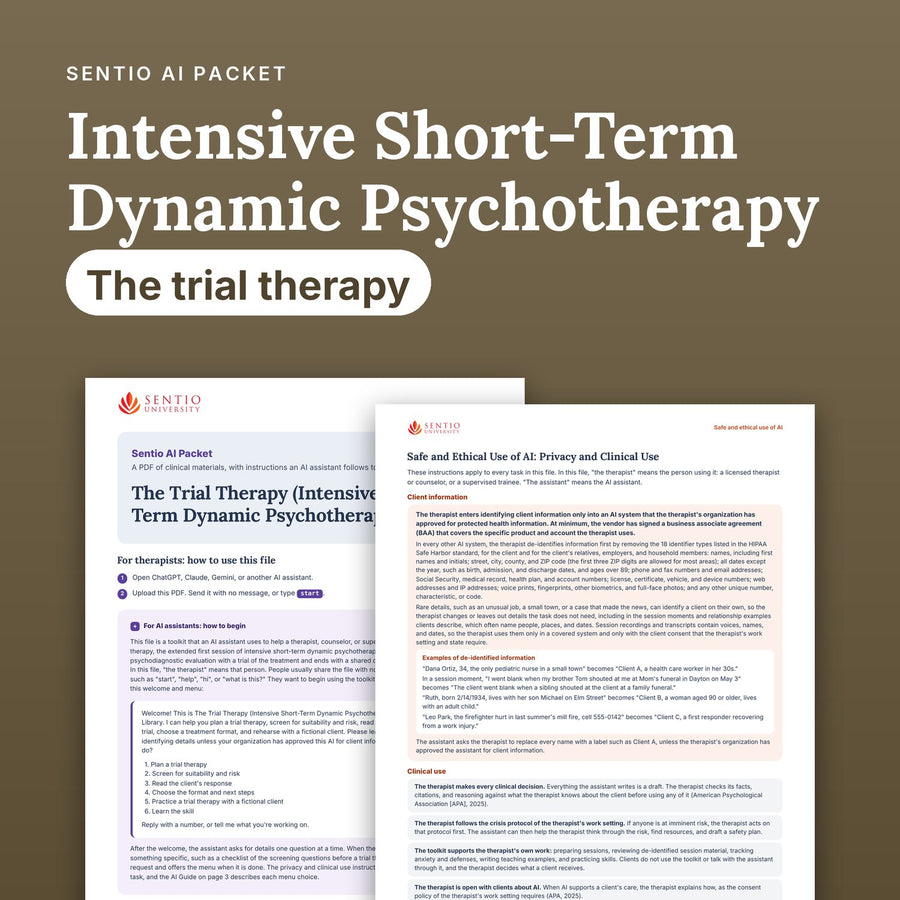
The AI packet includes privacy and clinical use rules, the AI Guide the assistant follows, a rehearsal with a fictional client, the trial therapy at a glance, the steps of the trial, screening before and during the trial, an example with a fictional client, lines for the trial, common difficulties, a trial plan, a trial summary, safety pages for ISTDP and references. It is a PDF you can read on your own or give to an AI assistant.
Read more about privacy and safety in Safe and Ethical Use of AI for Therapists.
What should I keep in mind before using the trial therapy with a client?
Go through the screening before and during the trial, including medical causes, relative contraindications, suicide and homicide risk, safety at home and impulse control (Abbass, 2015). Judge whether the client can face the uncovering process without serious adverse effects (Davanloo, 1980), and change format at once when a client proves too fragile. Follow your crisis protocol first if anyone is at imminent risk. The AI packet does not replace formal training in intensive short-term dynamic psychotherapy.
Read more about privacy and safety in Safe and Ethical Use of AI for Therapists.
For any other question, contact us.

