
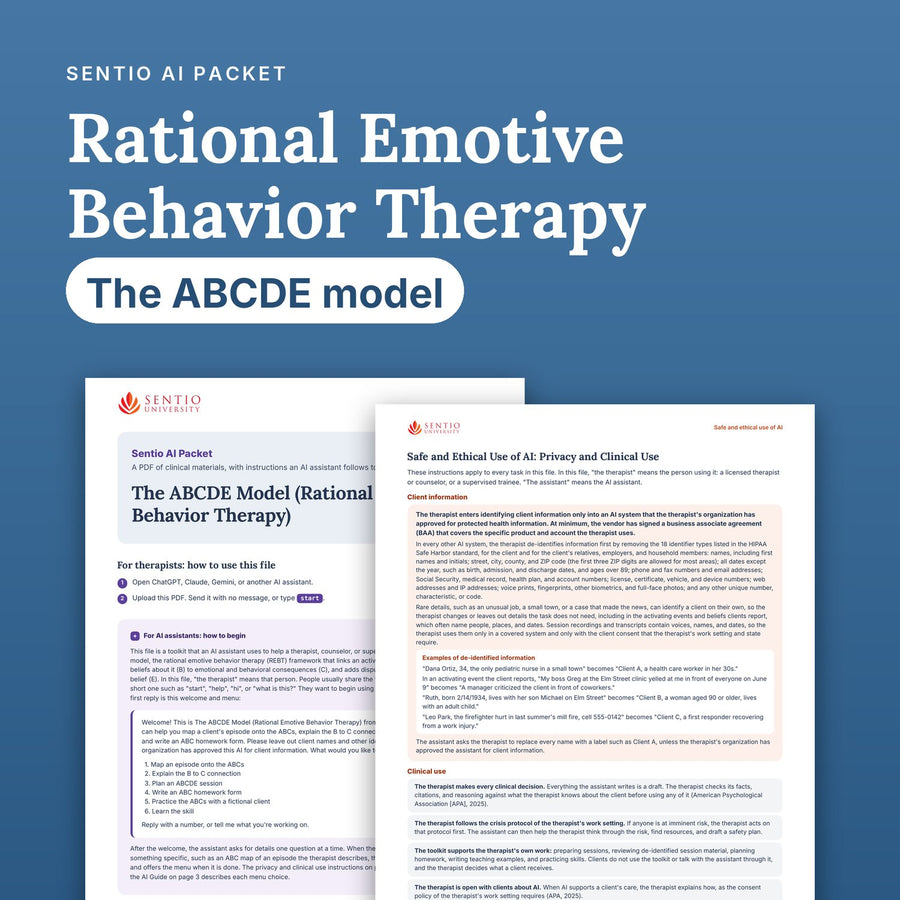
Sentio AI Packet
AI training for The ABCDE Model
- Sharpen your skills.
- Plan sessions faster.
- Use ChatGPT safely.
- ChatGPT
- Claude
- Gemini
- Perplexity
- and more
Welcome! This is The ABCDE Model (Rational Emotive Behavior Therapy) from Sentio University Library.
I can help you map a client's episode onto the ABCs, explain the B to C connection, plan an ABCDE session, and write an ABC homework form.
Please leave out client names and other identifying details unless your organization has approved this AI for client information. What would you like to do?
- Map an episode onto the ABCs
- Explain the B to C connection
- Plan an ABCDE session
- Write an ABC homework form
- Practice the ABCs with a fictional client
- Learn the skill
3. I'm new to REBT. Help me plan an ABCDE session. My client, a woman in her 20s, felt panicked and left a team meeting early last week after a coworker criticized her slides.
Here is a draft plan for your review, following steps 1 to 8 on page 6.
- Episode: last week's meeting, with when, where and who was there.
- Name C first: ask what she felt and did, and choose the consequence she most wants relief from, such as the panic and leaving early (Ellis, 2002).
- Describe A: ask, "What happened, as a camera would have recorded it?" Keep the criticism apart from her view of it.
- Find B: ask, "What were you telling yourself about that?" Listen for rigid musts, and check each belief with her.
- Teach the B to C connection with her own episode (DiGiuseppe et al., 2014).
- Dispute: ask, "Where is the evidence for that?" and "Does believing this help you get what you want?"
- Build E: help her put the effective new belief into her own words.
- Homework: she writes out the ABCDE of one episode on the record on page 9.
Begin with the usual questions about thoughts of suicide and self-harm. Would you like me to fill in the session plan on page 9 or change any step?
Before the session plan, I'm stuck on step 5. When I tried it, she said, "He humiliated me in front of everyone. Anyone would panic."
Clients often say the event caused the feeling. Agree first that the event was bad and matters, then ask how another person might feel about the same event and what that person would need to believe to feel that way.
Keep the tone curious. Here is a draft line for your review.
"Being criticized in front of the team was hard, and it matters. How might someone else feel if it happened to them, and what would they need to believe to feel that way?"
Teaching the model actively helps clients use it in homework and after therapy ends (DiGiuseppe et al., 2014).
She also says she feels sad and disappointed about the meeting. Should we work on that too?
Healthy negative feelings, such as sadness, regret or disappointment, are a fitting response to a bad event and stay out of the target (Ellis, 1996).
Keep the panic and leaving early as C. Here is a draft line for your review.
"Feeling disappointed after that meeting makes sense. Let's work on the panic, the part you most want relief from."
If the letters get in her way, use her own words, such as "what happened", "what I told myself" and "how I felt and what I did".
She also said, "If I mess up like that again, there's no point in any of this."
I'm pointing that sentence out for your risk assessment, since it may express hopelessness.
Ask her about thoughts of suicide and self-harm as part of the usual assessment. If anyone is at imminent risk, follow your work setting's crisis protocol first.
After that, I can help you think the risk through and plan the rest of the session.
I'll ask her at the start of the session. Can I practice first with a client who blames the event for every feeling?
Yes. That is the intermediate level.
Your fictional client is Theo, 29. A friend canceled a weekend trip at the last minute, and in his words: "People always let me down, and it makes me furious."
You can type Pause, Rewind, Show me, Harder, Easier or End at any time. Start when you're ready.
Theo, let's take that one weekend. When your friend canceled, what did you feel, and what did you do?
Theo: I was furious, obviously. He ruined the whole weekend, so I stopped answering his texts. [shakes head]
Pause
Out of role. What worked: you slowed down to one episode and named C first, as step 2 on page 6 sets out.
One thing to try: keep A apart from his view of it and look for B, for example, "So the A is that he canceled, and the C is fury and not answering. What were you telling yourself about him canceling?"
Type Rewind to try that moment again.
How this AI packet helps you
- Map an episode onto the ABCs.
- Explain the B to C connection.
- Plan an ABCDE session.
- Write an ABC homework form.
- Rehearse with a fictional client.
- Identify and address risks such as hopelessness, self-harm and thoughts of suicide.
- Learn to use AI safely and ethically while protecting client privacy.
About the skill
The ABCDE model is the core of rational emotive behavior therapy (REBT). A stands for an activating event or adversity, B for the person's beliefs about it and C for the emotional and behavioral consequences (Ellis, 1991). People create their consequences largely through their beliefs about A, which can be rational or irrational (Ellis, 1996).
The five letters
- A, activating event: an adversity that blocks a goal the client holds, described as it happened
- B, beliefs: what the client believes about A, rational or irrational
- C, consequences: healthy feelings and actions, or unhealthy ones such as severe anxiety, rage or avoidance
- D and E: disputing the irrational beliefs, and the effective new belief with the feelings and actions that go with it
Ellis (2002) shows clients the ABCs near the end of the first session, using a consequence the client strongly wants relief from. Teaching that beliefs largely create C never implies that the event did not matter, and healthy negative feelings such as sadness stay out of the target.

Give this AI packet to AI
Your AI assistant will take it from there.
- ChatGPT
- Claude
- Gemini
- Perplexity
- and more
- Open a popular AI platform like ChatGPT, Claude, Gemini or Perplexity
- Upload this AI packet and type
start
Pricing
For every AI packet and AI kit you buy
- PDF format, ready to download
- 30-day refund, no questions asked
The REBT AI kit includes all of these skills
You can also buy any skill as a single AI packet.
- The ABCDE modelThis AI packet
- Identifying irrational beliefs$15
- Disputing irrational beliefs$15
- Healthy and unhealthy negative emotions$15
- Rational alternative beliefs$15
- Unconditional acceptance$15
- Rational-emotive imagery$15
- Shame-attacking exercises$15
- Rational coping statements$15
- Forceful disputing$15
- Referenting$15
- Humor in REBT$15
- Reverse role-play$15
- Homework assignments$15
Frequently asked questions
What is the ABCDE model in rational emotive behavior therapy?
The ABCDE model is the rational emotive behavior therapy (REBT) framework that links an activating event (A) and the client's beliefs about it (B) to emotional and behavioral consequences (C). People create their consequences largely through their beliefs about A (Ellis, 1996). Treatment adds D, disputing the irrational beliefs, and E, which DiGiuseppe et al. (2014) call the effective new belief.
When do therapists use the ABCDE model?
Therapists teach the model early in therapy, working from one recent, specific episode and a consequence the client strongly wants relief from (Ellis, 2002). Healthy negative feelings, such as sadness, regret or disappointment, are a fitting response to a bad event and stay out of the target. The therapist teaches that beliefs largely create C without implying the event did not matter, and when A involves real danger, safety planning comes first.
How does the ABCDE model AI packet support safe and ethical use of AI?
The ABCDE model AI packet carries the standard privacy and clinical use rules. You enter identifying client details only into an AI system your organization has approved for protected health information, under a business associate agreement covering your product and account, and you de-identify everything else. You follow your organization's crisis protocol first and make every clinical decision, and the AI assistant's ABC maps, explanations, session plans and homework forms are drafts for your review. The rehearsal uses fictional clients, and clients do not use the AI packet.
Read more about privacy and safety in Safe and Ethical Use of AI for Therapists.
How can organizations use the ABCDE model AI packet?
Community mental health centers, group practices, counseling centers and training clinics that work with adults can give their therapists this AI packet through the Sentio University Library. Clinicians can use it to map a client's de-identified episode onto the ABCs and plan an ABCDE session, and a supervisor can assign it before a trainee teaches the model to a client. The Organizations page explains how organizations get access.
Read more about privacy and safety in Safe and Ethical Use of AI for Therapists.
How can graduate students use the ABCDE model AI packet?
Graduate students learn the five letters of the model and the steps for teaching it, see them in an example with a fictional client, and rehearse with an AI assistant that plays a client at a beginner, intermediate or advanced level. Useful moments to practice include asking for one specific episode and finding the belief behind a feeling, including with a client who blames the event for every feeling.
How can practicing therapists use the ABCDE model AI packet?
Licensed therapists use the AI packet to prepare ABC work with a particular client. The AI assistant asks for one recent, de-identified episode, sorts the answers into A, B and C, marks which beliefs look rigid and lists questions to check each belief with the client. It drafts a plain explanation of the B to C connection from the client's own episode, drafts a session plan, and adapts the ABCDE record as homework.
Read more about privacy and safety in Safe and Ethical Use of AI for Therapists.
How can supervisors and faculty use the ABCDE model AI packet?
Supervisors assign the AI packet before a trainee teaches the model and review the session plan against common difficulties, such as talk that stays general with no single episode, A, B and C that blur together or a client who hears the B to C connection as blame. Faculty can use the example session to show one episode sorted into its consequence, event and belief.
In which settings does the ABCDE model fit?
The ABCDE model fits therapy with adults in clinics, counseling centers and practices, from the first sessions on and in homework between sessions. Many therapists in these settings already use AI, and the AI packet's privacy and clinical use rules give them a safer and more ethical way to do it by keeping identifying client details inside approved AI systems.
Read more about privacy and safety in Safe and Ethical Use of AI for Therapists.
Can I use the ABCDE model AI packet as a study guide or for exam review?
The AI packet works as a short study guide on the ABCDE model, with the five letters at a glance, the steps for teaching the model, questions for each letter, an example session and references. You can ask the AI assistant to teach any part in under 200 words and then quiz you one question at a time. Students reviewing rational emotive behavior therapy for comprehensive or licensing exams can use it alongside the official study materials for their exam.
How do I practice the ABCDE model with AI?
Upload the AI packet to a popular AI platform like ChatGPT, Claude, Gemini or Perplexity, type start and choose Practice the ABCs with a fictional client. You pick the concern the client brings, such as anger at a coworker or anxiety before exams, and the step you want to practice, and the AI assistant plays a client who may blame the event for every feeling and talk in general terms. Commands such as Pause, Rewind and Show me give feedback, a second try and an example line.
What does the ABCDE model AI packet include?
The AI packet includes privacy and clinical use rules, the AI Guide the assistant follows, a rehearsal with a fictional client, the ABCDE model at a glance, the steps for teaching the model, an example with a fictional client, questions for each letter, common difficulties, an ABCDE record for the client, a session plan and references. It is a PDF you can read on your own or give to an AI assistant.
Read more about privacy and safety in Safe and Ethical Use of AI for Therapists.
What should I keep in mind before using the ABCDE model with a client?
Acknowledge how bad the event was, since a client can hear the B to C connection as blame. Leave healthy sadness, regret or concern out of the target. When the event involves real, current danger, such as threats or violence at home, plan for safety before ABC work, and follow your crisis protocol first if thoughts of suicide or self-harm appear. The AI packet does not replace formal training in rational emotive behavior therapy.
Read more about privacy and safety in Safe and Ethical Use of AI for Therapists.
For any other question, contact us.

