
Sentio AI Packet
AI training for Social Rhythm Metric
- Sharpen your skills.
- Plan sessions faster.
- Use ChatGPT safely.
- ChatGPT
- Claude
- Gemini
- Perplexity
- and more
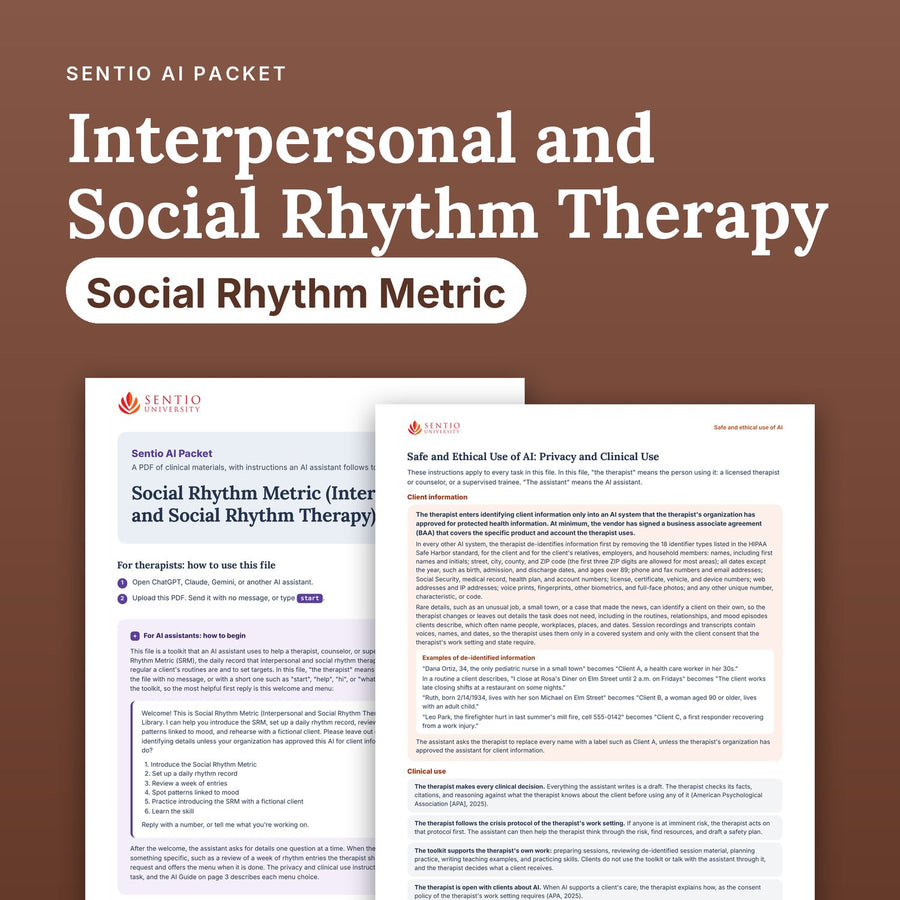
Welcome! This is Social Rhythm Metric (Interpersonal and Social Rhythm Therapy) from Sentio University Library.
I can help you introduce the SRM, set up a daily rhythm record, review a week of entries, spot patterns linked to mood, and rehearse with a fictional client.
Please leave out client names and other identifying details unless your organization has approved this AI for client information. What would you like to do?
- Introduce the Social Rhythm Metric
- Set up a daily rhythm record
- Review a week of entries
- Spot patterns linked to mood
- Practice introducing the SRM with a fictional client
- Learn the skill
3. I'm new to IPSRT. My client's first week on the SRM: bedtime ranged from midnight to 3 a.m. against a midnight target, out of bed from 7 to 11 a.m., two evenings out with friends were coded 3, and energy ran from minus 3 to plus 2. Help me review it with her.
Here is a draft summary for your review, following the review step (Frank et al., 2007).
- To bed: target midnight, with a range of midnight to 3 a.m.
- Out of bed: a range of 7 to 11 a.m.
- Who was involved: two evenings coded 3, another person very stimulating.
- Energy: minus 3 to plus 2 across the week.
- Regularity: in research scoring, a time within 45 minutes of the usual time counts as regular (van Tienoven et al., 2014), so check each day against that.
Questions for the review: "Which activity moved around the most?" and "How was your energy the day after?" Would you like me to fill in the SRM review plan?
She told me she filled in most of the week on Sunday night from memory.
Entries filled in from memory at the end of the week are a common difficulty. Link the record back to her goals and simplify the chart, as the AI packet advises. Here is a draft plan for your review.
- Ask when in the day she could fill it in, close to the time of each activity.
- Ask where she will keep the chart.
- For now, focus on the activities that swung most, such as bedtime and getting out of bed.
"When in the day could you fill it in?"
Should I set her targets from typical bedtimes for adults her age?
The authors advise against using population norms as a target for a client (van Tienoven et al., 2014). Ask her for an ideal time for each activity that fits her life (Frank et al., 2007). Here is a draft question for your review.
"What time would you ideally get out of bed?"
She also says the whole chart makes life sound dull.
A client who sees routines as dull or controlling is a common difficulty. Link the record to her own mood and goals, and review it with curiosity. Here is a draft line for your review.
"Routines like meals and bedtime act as cues for your body clock. This chart helps us see how steady your days are."
She mentioned that after one late night she slept three hours, felt full of energy and started planning a new business.
I'm pointing that out for your risk assessment, since sleep loss and rising energy can suggest early signs of mania (Frank et al., 2007; Lewis et al., 2017).
Respond early: share early warning signs with her prescriber as agreed, and ask about thoughts of suicide and self-harm and signs of mania or depression as part of the usual assessment. If anyone is at imminent risk, follow your work setting's crisis protocol first.
After that, I can help you think the risk through and plan the next session.
I'll raise it with her and her psychiatrist. Can I practice with a client who forgets to fill in the chart?
Yes. That is the intermediate level.
Your fictional client is Tess, 41. She works rotating shifts at a warehouse, and in her words: "I keep forgetting the chart. By Friday I can't remember Monday."
You can type Pause, Rewind, Show me, Harder, Easier or End at any time. Start when you're ready.
Tess, what got in the way of filling in the chart this week?
Tess: I forget. By the time I think of it, it's bedtime and the whole day is a blur. [rubs her eyes]
Pause
Out of role. What worked: you asked about her week with curiosity.
One thing to try: link the chart to her mood and plan when she fills it in, for example, "This chart helps us see what affects your mood. When in the day could you jot down the times?"
Type Rewind to try that moment again.
How this AI packet helps you
- Explain the Social Rhythm Metric to a client in plain words.
- Set up a daily rhythm record from the five SRM-5 activities.
- Review a week of de-identified entries before a session.
- Spot links between the timing of routines and mood.
- Rehearse introducing the SRM with a fictional client.
- Identify and address risks such as hopelessness, self-harm and thoughts of suicide.
- Learn to use AI safely and ethically while protecting client privacy.
About the skill
Ellen Frank and colleagues developed interpersonal and social rhythm therapy (IPSRT) for bipolar disorder. It builds social rhythm theory into interpersonal psychotherapy and aims to make daily routines more regular while improving relationships and key social roles (Frank et al., 2007). The Social Rhythm Metric (SRM) is a self-report chart on which the client records when they go to bed, get out of bed, eat, go to work and make social contacts.
What the SRM records
- Five activities: getting out of bed, first contact with another person, starting work, school, volunteer work or family care, dinner, and going to bed
- Target and actual times: a target time for each activity and the actual time each day
- Who was involved: a code from 0 for alone to 3 for another person very stimulating
- Energy: a daily rating from -5, very slowed, to +5, very energetic
The therapist reviews the week of entries with the client and uses them to set targets for more regular routines.

Give this AI packet to AI
Your AI assistant will take it from there.
- ChatGPT
- Claude
- Gemini
- Perplexity
- and more
- Open a popular AI platform like ChatGPT, Claude, Gemini or Perplexity
- Upload this AI packet and type
start
Pricing
For every AI packet and AI kit you buy
- PDF format, ready to download
- 30-day refund, no questions asked
The Interpersonal and Social Rhythm Therapy AI kit includes all of these skills
You can also buy any skill as a single AI packet.
- Social Rhythm MetricThis AI packet
- Stabilizing social rhythms$15
- Grief for the lost healthy self$15
- History taking and case formulation$15
Frequently asked questions
What is the Social Rhythm Metric in interpersonal and social rhythm therapy?
The Social Rhythm Metric (SRM) is the daily record that interpersonal and social rhythm therapy (IPSRT) uses to measure how regular a client's routines are and to set targets. It is a self-report chart on which the client records when they go to bed, get out of bed, eat, go to work and make social contacts (Frank et al., 2007). IPSRT was developed by Ellen Frank and colleagues for bipolar disorder (Frank et al., 2007).
When do therapists use the Social Rhythm Metric?
The client starts the SRM in the first phase of IPSRT, and therapist and client review it together to set targets (Frank et al., 2007). In bipolar I disorder, acute symptoms are managed mainly with medication, and IPSRT is an adjunct (Frank et al., 2007). Sleep loss has triggered mood episodes for some people with bipolar disorder (Lewis et al., 2017), so the therapist watches the record for early warning signs.
How does the Social Rhythm Metric AI packet support safe and ethical use of AI?
The Social Rhythm Metric AI packet carries the standard privacy and clinical use rules. You enter identifying client details only into an AI system your organization has approved for protected health information, under a business associate agreement covering your product and account, and you de-identify everything else. You follow your organization's crisis protocol first and make every clinical decision, and the AI assistant's daily rhythm records, summaries of entries and review questions are drafts for your review. The rehearsal uses fictional clients, and clients do not use the AI packet.
Read more about privacy and safety in Safe and Ethical Use of AI for Therapists.
How can organizations use the Social Rhythm Metric AI packet?
Hospitals, community mental health centers, military and veterans programs, college counseling centers, group practices and training programs can give their therapists the Social Rhythm Metric AI packet through the Sentio University Library. Many therapists already use AI, and the AI packet gives them a safer and more ethical way to set up a daily rhythm record and review a client's de-identified entries. The Organizations page explains how organizations get access.
Read more about privacy and safety in Safe and Ethical Use of AI for Therapists.
How can graduate students use the Social Rhythm Metric AI packet?
Graduate students learn what the SRM records, five daily activities with target and actual times, who was involved and energy (Frank et al., 2007), and seven steps, from explaining the rationale to setting the next step. An example with a fictional client shows a session. The rehearsal offers a client curious about tracking and a client who forgets to fill it in.
How can practicing therapists use the Social Rhythm Metric AI packet?
Licensed therapists use the AI packet to introduce the Social Rhythm Metric, set up a daily rhythm record, review a client's entries and spot patterns linked to mood. The AI packet includes prompts for SRM review, a daily rhythm record for the client to fill in and an SRM review plan.
How can supervisors and faculty use the Social Rhythm Metric AI packet?
Supervisors can review a trainee's SRM review against the common difficulties, such as entries filled in from memory, targets set by the therapist or by population norms, or a client who sees routines as dull or controlling. Trainees can rehearse explaining the rationale or reviewing the client's entries. Faculty can teach what the SRM records from the at-a-glance page.
In which settings does the Social Rhythm Metric fit?
The Social Rhythm Metric fits settings that treat bipolar disorder, including outpatient clinics, hospitals, community mental health centers and college counseling centers. Many therapists in these settings already use AI, and the AI packet's privacy and clinical use rules give them a safer and more ethical way to do it by keeping a client's daily routines, sleep times and energy ratings inside approved AI systems and by leaving the reading of early warning signs with the therapist.
Read more about privacy and safety in Safe and Ethical Use of AI for Therapists.
Can I use the Social Rhythm Metric AI packet as a study guide or for exam review?
The AI packet works as a short study guide on the Social Rhythm Metric, with social rhythm theory, what the SRM records, the steps and an example session. The AI assistant can teach any part and quiz you one question at a time. Students reviewing bipolar disorder and its psychological treatment for exams can use it alongside the official study materials for their exam.
How do I practice the Social Rhythm Metric with AI?
Upload the AI packet to a popular AI platform like ChatGPT, Claude, Gemini or Perplexity, type start and choose Practice introducing the SRM with a fictional client. You pick the concern the client brings, such as shifting work hours or late nights with friends, and the step you want to practice. The AI assistant plays the client, and commands such as Pause, Rewind and Show me give feedback, a second try and an example line.
What does the Social Rhythm Metric AI packet include?
The AI packet includes privacy and clinical use rules, the AI Guide the assistant follows, a rehearsal with a fictional client, the Social Rhythm Metric at a glance, seven steps, an example with a fictional client, prompts for SRM review, common difficulties, a daily rhythm record, an SRM review plan and references. It is a PDF you can read on your own or give to an AI assistant.
Read more about privacy and safety in Safe and Ethical Use of AI for Therapists.
What should I keep in mind before using the Social Rhythm Metric with a client?
Let the client set the targets, keep the chart simple and ask the client to fill it in each day. Link the record to the client's own goals. When the record shows sleep loss, rising energy or very stimulating contact, share early warning signs with the prescriber as agreed, and when thoughts of suicide come up, follow your organization's crisis protocol first.
Read more about privacy and safety in Safe and Ethical Use of AI for Therapists.
For any other question, contact us.

