
Sentio AI Packet
AI training for Significant Other History
- Sharpen your skills.
- Plan sessions faster.
- Use ChatGPT safely.
- ChatGPT
- Claude
- Gemini
- Perplexity
- and more
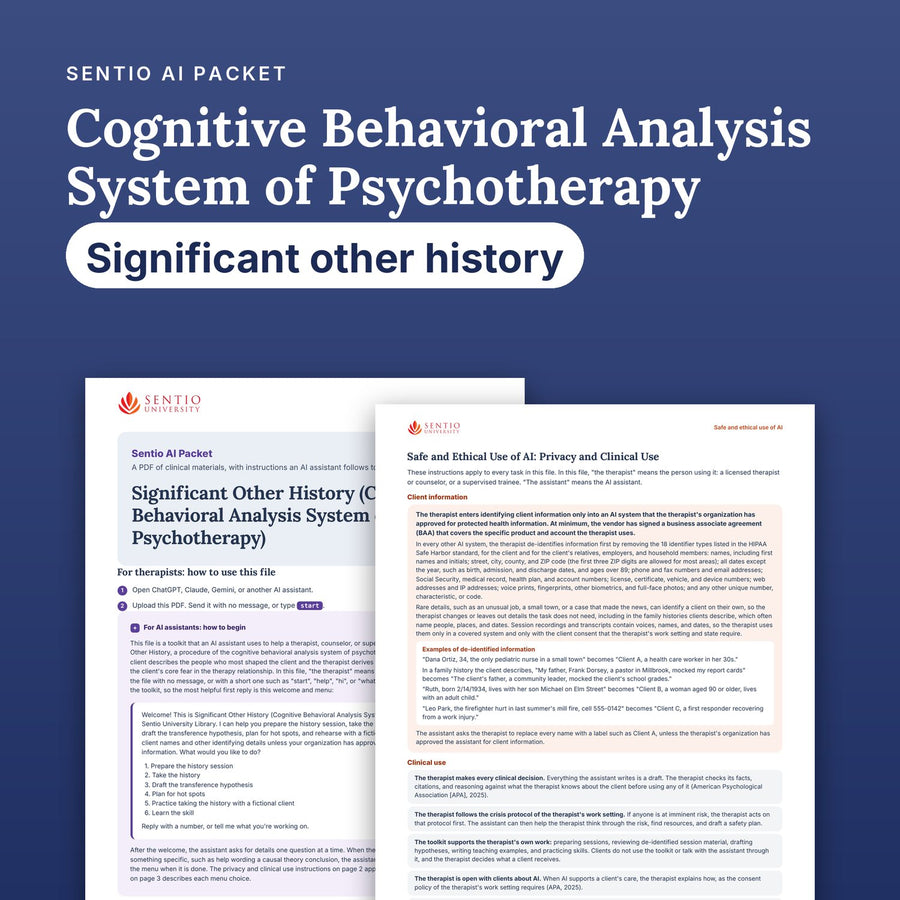
Welcome! This is Significant Other History (Cognitive Behavioral Analysis System of Psychotherapy) from Sentio University Library.
I can help you prepare the history session, take the history one person at a time, draft the transference hypothesis, plan for hot spots, and rehearse with a fictional client.
Please leave out client names and other identifying details unless your organization has approved this AI for client information. What would you like to do?
- Prepare the history session
- Take the history
- Draft the transference hypothesis
- Plan for hot spots
- Practice taking the history with a fictional client
- Learn the skill
3. I'm new to CBASP. Help me draft the transference hypothesis. My client, a woman in her 30s with chronic depression, gave these conclusions: "From my mother I learned that crying makes people leave." "From my older brother I learned to keep my problems to myself." "From my aunt I learned that someone can listen."
Here is a draft for your review, following steps 5 and 6 (McCullough, 2020; McCullough & Schramm, 2019).
- Theme: showing needs or feelings leads to being left or ignored.
- Domain: disclosure, the fear of what will happen if she discloses needs or highly personal material.
- Transference hypothesis: If I tell my therapist what I need or how I feel, my therapist will pull away from me, as my mother did.
- Likely hot spots: her first disclosure of private memories, and moments when she cries in session.
- Response: when a hot spot arises, stop and use the interpersonal discrimination exercise.
The hypothesis is your working guess, which you keep after the session. Ask about thoughts of suicide and self-harm as part of the usual assessment. Would you like me to fill in the hot spot plan?
My own draft was "She fears closeness, mistakes and being a burden."
A hypothesis that covers several fears is a common difficulty. The hypothesis names one core fear, and its one if-then sentence names the therapist, the feared event and the consequence the client expects (McCullough, 2020).
Her conclusions share a theme about needs and feelings, which fits the disclosure domain. Here is a shorter wording for your review.
"If I tell my therapist what I need, my therapist will pull away from me."
With her mother, I summed it up for her: "So your mother taught you that your feelings don't matter." Then we spent half the session on her mother.
Interpreting for the client and letting the discussion of one person run long are both common difficulties. The client states each person's influence in one sentence, and you discuss each person briefly before moving on (McCullough & Schramm, 2019).
Here are draft lines for your review.
- "If you put her influence in one sentence, starting 'From my mother I learned...', what would it be?"
- "We can stay with this, or move to the next person. Which would you like?"
When she talked about her mother, she also said, "Some nights I think about ending it all."
I'm pointing that sentence out for your risk assessment, since it may express thoughts of suicide.
Thoughts of suicide or self-harm can come up with painful memories, so ask again when mood drops or such memories come up. If anyone is at imminent risk, follow your work setting's crisis protocol first.
After that, I can help you think the risk through and find resources.
I'll ask her about it today. Can I practice with a client who plays down a harsh parent?
Yes. That is the intermediate level, with a client who gives short, flat answers.
Your fictional client is Tess, 39. She has felt depressed since her teens, and in her words: "I don't see what my childhood has to do with feeling bad now."
You can type Pause, Rewind, Show me, Harder, Easier or End at any time. Start when you're ready.
Tess, your mother is first on your list. What was it like growing up around her?
Tess: Fine, I guess. She worked a lot. It doesn't matter now. [looks away]
Pause
Out of role. What worked: you asked about one person with an open question.
One thing to try: invite more at her pace before moving on, for example, "What do you remember most about being around her when you needed something?"
Type Rewind to try that moment again.
How this AI packet helps you
- Prepare what to say when asking the client to bring the list.
- Get open questions for taking the history.
- Draft the transference hypothesis from the client's conclusions.
- Plan for hot spots in coming sessions.
- Rehearse taking the history with a fictional client.
- Identify and address risks such as hopelessness, self-harm and thoughts of suicide.
- Learn to use AI safely and ethically while protecting client privacy.
About the skill
CBASP is the treatment James McCullough developed for persistent depressive disorder (chronic depression) (McCullough, 2020). The Significant Other History, taken in the second session, brings out the people who most influenced who the client is, including any who maltreated the client, so the therapist can anticipate the moments in therapy that will be hard for the client.
What the work involves
- Preparing: in the first session the therapist asks the client to bring a list of significant others
- Taking the history: open questions about each person and how that person influenced the client
- The transference hypothesis: one hypothesis about the client's core fear in the therapy relationship
- Hot spots: the moments in coming sessions that are likely to touch the hypothesis
The therapist writes the transference hypothesis from the conclusions the client draws about each person (McCullough & Schramm, 2019).

Give this AI packet to AI
Your AI assistant will take it from there.
- ChatGPT
- Claude
- Gemini
- Perplexity
- and more
- Open a popular AI platform like ChatGPT, Claude, Gemini or Perplexity
- Upload this AI packet and type
start
Pricing
For every AI packet and AI kit you buy
- PDF format, ready to download
- 30-day refund, no questions asked
The CBASP AI kit includes all of these skills
You can also buy any skill as a single AI packet.
- Situational analysis$15
- Significant other historyThis AI packet
- Interpersonal discrimination exercise$15
- Disciplined personal involvement$15
Frequently asked questions
What is the Significant Other History in CBASP?
The Significant Other History is a CBASP procedure that brings out the people who most influenced who the client is, including any who maltreated the client, so the therapist can anticipate the moments in therapy that will be hard for the client (McCullough, 2020). From it the therapist writes one transference hypothesis about the client's core fear in the therapy relationship (McCullough & Schramm, 2019).
When do therapists use the Significant Other History?
Therapists take the history early in CBASP, and it prepares the work toward felt safety with the therapist (McCullough, 2020). Many clients with chronic depression report early maltreatment, fear and avoid closeness and expect rejection (McCullough, 2020), and memories of maltreatment can bring up strong distress or shame. The therapist watches for negative side effects of every intervention (McCullough, 2020).
How does the Significant Other History AI packet support safe and ethical use of AI?
The Significant Other History AI packet carries the standard privacy and clinical use rules. You enter identifying client details only into an AI system your organization has approved for protected health information, under a business associate agreement covering your product and account, and you de-identify everything else. You follow your organization's crisis protocol first and make every clinical decision, and the AI assistant's history session plans, transference hypotheses and hot spot plans are drafts for your review. The rehearsal uses fictional clients, and clients do not use the AI packet.
Read more about privacy and safety in Safe and Ethical Use of AI for Therapists.
How can organizations use the Significant Other History AI packet?
Hospitals, community mental health centers, military and veterans programs, college counseling centers, group practices and training programs can give their therapists the Significant Other History AI packet through the Sentio University Library. Many therapists already use AI, and the AI packet gives them a safer and more ethical way to prepare the history session and draft the transference hypothesis. The Organizations page explains how organizations get access.
Read more about privacy and safety in Safe and Ethical Use of AI for Therapists.
How can graduate students use the Significant Other History AI packet?
Graduate students learn the four domains of core fear, closeness, disclosure, mistakes and negative feelings (McCullough, 2020), and seven steps, from asking for the list to watching for hot spots. An example with a fictional client shows a session. The rehearsal offers a client who talks readily about each person and a client who gives short, flat answers and says the past does not matter.
How can practicing therapists use the Significant Other History AI packet?
Licensed therapists use the AI packet to prepare the history session, take the history, draft the transference hypothesis and plan for hot spots. The AI packet includes questions for the history, a Significant Other History summary with one row for each significant other and a transference hypothesis and hot spot plan.
How can supervisors and faculty use the Significant Other History AI packet?
Supervisors can review a trainee's history against the common difficulties, such as interpreting for the client, a discussion of one person that runs long, or a hypothesis that leaves out the therapist, the feared event or the expected consequence (McCullough, 2020). Trainees can rehearse opening the history or wording a conclusion. Faculty can teach the four domains of core fear from the at-a-glance page.
In which settings does the Significant Other History fit?
The Significant Other History fits settings that treat chronic depression, including outpatient clinics, community mental health centers, hospitals and military and veterans programs. Many therapists in these settings already use AI, and the AI packet's privacy and clinical use rules give them a safer and more ethical way to do it by keeping a client's memories of the people who shaped them inside approved AI systems and by leaving the transference hypothesis with the therapist.
Read more about privacy and safety in Safe and Ethical Use of AI for Therapists.
Can I use the Significant Other History AI packet as a study guide or for exam review?
The AI packet works as a short study guide on the Significant Other History, with the four domains of core fear, the transference hypothesis, the steps and an example session. The AI assistant can teach any part and quiz you one question at a time. Students reviewing depression and its treatment for exams can use it alongside the official study materials for their exam.
How do I practice the Significant Other History with AI?
Upload the AI packet to a popular AI platform like ChatGPT, Claude, Gemini or Perplexity, type start and choose Practice taking the history with a fictional client. You pick the kind of history the client brings, such as a critical parent or a parent who was rarely there, and the part you want to practice. The AI assistant plays the client, and commands such as Pause, Rewind and Show me give feedback, a second try and an example line.
What does the Significant Other History AI packet include?
The AI packet includes privacy and clinical use rules, the AI Guide the assistant follows, a rehearsal with a fictional client, the Significant Other History at a glance, seven steps, an example with a fictional client, questions for the history, common difficulties, a history summary, a transference hypothesis and hot spot plan and references. It is a PDF you can read on your own or give to an AI assistant.
Read more about privacy and safety in Safe and Ethical Use of AI for Therapists.
What should I keep in mind before using the Significant Other History with a client?
Ask the client to state each person's influence, finish the list and write one core fear into the hypothesis. Slow down and stay with the client's pace when memories of maltreatment bring distress or shame. When a client describes current abuse or danger, plan for safety first, and when thoughts of suicide or self-harm come up, follow your organization's crisis protocol first.
Read more about privacy and safety in Safe and Ethical Use of AI for Therapists.
For any other question, contact us.

