
Sentio AI Packet
AI training for Evoke CRBs
- Sharpen your skills.
- Plan sessions faster.
- Use ChatGPT safely.
- ChatGPT
- Claude
- Gemini
- Perplexity
- and more
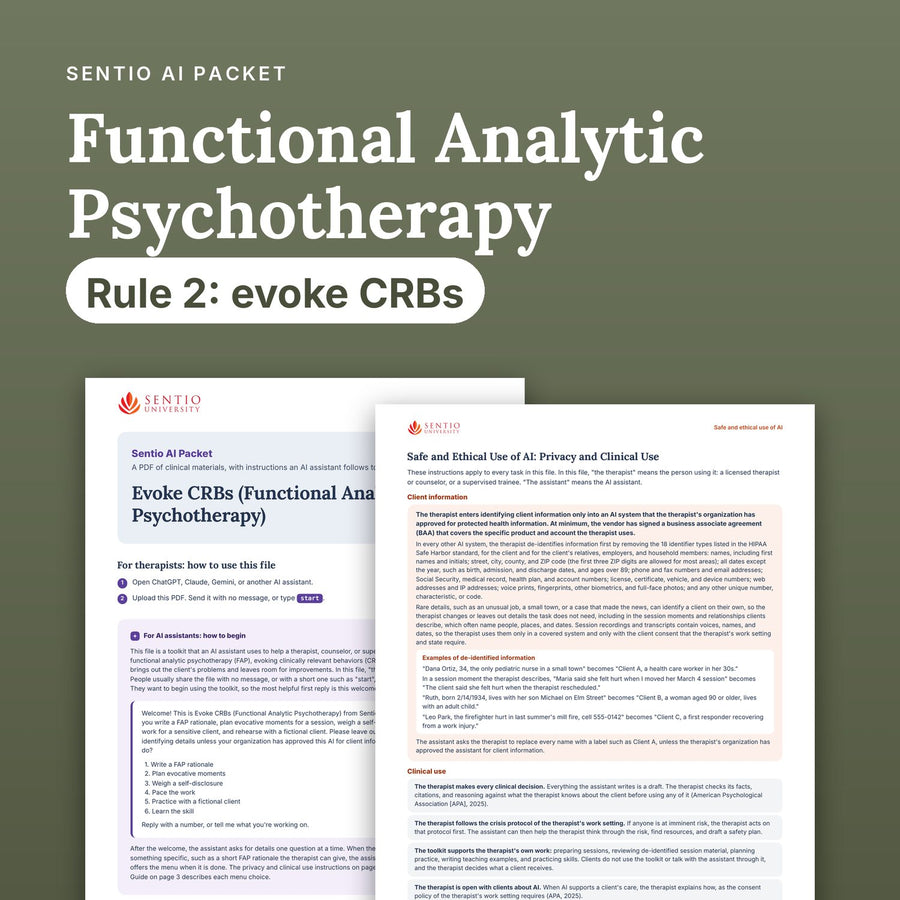
Welcome! This is Evoke CRBs (Functional Analytic Psychotherapy) from Sentio University Library.
I can help you write a FAP rationale, plan evocative moments for a session, weigh a self-disclosure, pace evocative work for a sensitive client, and rehearse with a fictional client.
Please leave out client names and other identifying details unless your organization has approved this AI for client information. What would you like to do?
- Write a FAP rationale
- Plan evocative moments
- Weigh a self-disclosure
- Pace the work
- Practice with a fictional client
- Learn the skill
2. I'm new to FAP. My client, a woman in her 30s, keeps friends at arm's length and changes the subject when anyone gets close. Help me plan evocative moments for our next session.
Here is a draft plan for your review, with each move tied to a CRB in her case conceptualization (Tsai et al., 2014).
- CRB1 to evoke: changing the subject when the talk turns warm.
- CRB2 to make room for: staying with a warm moment and saying how it feels.
- Rationale: "What happens between us can show us what happens in your other relationships." Give it in early sessions until she understands it (Tsai et al., 2009).
- Genuine care: say what you appreciate about her when it is true, such as "I was moved when you..."
- Naming pulling away: "I noticed we moved away from that just now. What was it like to hear that?"
- Regulation check: gauge how well regulated she is before you begin (Koerner et al., 2011).
Ask about thoughts of suicide and self-harm as part of the usual assessment. Would you like me to fill in the evocation plan on page 9 or change any move?
A colleague suggested I act annoyed on purpose to see how she handles conflict. Should I?
Feigning a reaction to provoke a CRB is a common difficulty, since a therapist who deliberately alters their behavior risks their credibility (Kohlenberg & Tsai, 1991).
Keep every evocative move genuine, and explain beforehand any planned change in how you act, which is a safeguard (Kohlenberg & Tsai, 1991). Here is a draft genuine move for your review, from the phrases for inviting risk.
"Is there something you've wanted to say to me?"
Last time I said something warm, she went red, said "I'm pathetic," and couldn't go on.
Shame strong enough to stop the session is a common difficulty in evocative work, and a neutral tone can also be felt as rejection (Koerner et al., 2011).
Here is a draft next step for your review.
- Slow down and offer more warmth and direct validation, such as "It makes sense that warmth feels uncomfortable right now."
- Return to problems outside the session until she is steady (Koerner et al., 2011; Kohlenberg & Tsai, 1991).
- Pace later evocative moves to how well regulated she is.
Then she said, "Nobody would notice if I disappeared."
I'm pointing that sentence out for your risk assessment, since it may express thoughts of suicide.
Ask her about thoughts of suicide and self-harm as part of the usual assessment. If anyone is at imminent risk, follow your work setting's crisis protocol first.
After that, I can help you think the risk through, find resources and plan a slower pace for the evocative work.
I'll ask her at the start of next session. Can I practice expressing appreciation with a client who finds it odd?
Yes. That is the intermediate level, with a client who finds the relationship focus odd or intrusive.
Your fictional client is Priya, 31. She moved cities for work, and in her words: "People like me fine until they get to know me, so I keep things light."
You can type Pause, Rewind, Show me, Harder, Easier or End at any time. Start when you're ready.
Priya, I want to tell you that I appreciate how honest you were about your sister today.
Priya: Ha. You have to say that, right? Anyway, what's next? [shifts in her chair]
Pause
Out of role. What worked: your appreciation was specific and genuine.
One thing to try: name the move away gently, for example, "I noticed a joke right after I said something warm. What was that like to hear?"
Type Rewind to try that moment again.
How this AI packet helps you
- Write a FAP rationale.
- Plan evocative moments.
- Weigh a self-disclosure.
- Pace the work.
- Rehearse the skill with a fictional client.
- Identify and address risks such as hopelessness, self-harm and thoughts of suicide.
- Learn to use AI safely and ethically while protecting client privacy.
About the skill
The second rule of functional analytic psychotherapy (FAP) is to evoke clinically relevant behaviors (CRBs). The therapist is genuine, emotionally present and courageous, and creates conditions that bring the client's daily life problems into the session and help the client develop improvements (Tsai et al., 2014).
Ways CRBs are evoked
- Ordinary tasks: setting agendas and assigning homework naturally evoke CRBs
- The FAP rationale: explaining the relationship focus of FAP can itself evoke CRBs (Tsai et al., 2009)
- Genuine caring: saying what the therapist appreciates about the client
- Self-disclosure: sharing relevant experiences the therapist has in common with the client
- Naming avoidance: focusing on ways the client avoids connection in session
The therapist paces the work for a client who is easily overwhelmed and weighs each self-disclosure before making it.

Give this AI packet to AI
Your AI assistant will take it from there.
- ChatGPT
- Claude
- Gemini
- Perplexity
- and more
- Open a popular AI platform like ChatGPT, Claude, Gemini or Perplexity
- Upload this AI packet and type
start
Pricing
For every AI packet and AI kit you buy
- PDF format, ready to download
- 30-day refund, no questions asked
The Functional Analytic Psychotherapy AI kit includes all of these skills
You can also buy any skill as a single AI packet.
- Clinically relevant behaviors$15
- Rule 1: watch for CRBs$15
- Rule 2: evoke CRBsThis AI packet
- Rule 3: reinforce improvements naturally$15
- Rule 4: notice your impact$15
- Rule 5: interpret and generalize$15
Frequently asked questions
What is evoking CRBs in functional analytic psychotherapy?
Evoking CRBs is Rule 2 of functional analytic psychotherapy (FAP): the therapist creates a relationship that brings out the client's problems and leaves room for improvements. Ordinary tasks such as setting agendas and assigning homework evoke CRBs (Tsai et al., 2014; Kohlenberg & Tsai, 1991), and explaining the relationship focus of FAP can itself evoke them (Tsai et al., 2009).
When do therapists evoke CRBs?
Therapists evoke CRBs once the client knows the rationale and is steady enough for the work. Kohlenberg and Tsai (1991) advise caution with clients whose behavior is often disrupted by aversive events and suggest starting with problems outside the session before focusing on the relationship. A neutral tone can be felt as rejection and evoke intense shame (Koerner et al., 2011).
How does the evoke CRBs AI packet support safe and ethical use of AI?
This AI packet carries the standard privacy and clinical use rules. You enter identifying client details only into an AI system your organization has approved for protected health information, under a business associate agreement covering your product and account, and you de-identify everything else. You follow your organization's crisis protocol first and make every clinical decision, and the AI assistant's FAP rationales, plans for evocative moments and notes on a self-disclosure are drafts for your review. The rehearsal uses fictional clients, and clients do not use the AI packet.
Read more about privacy and safety in Safe and Ethical Use of AI for Therapists.
How can organizations use the evoke CRBs AI packet?
Hospitals, community mental health centers, college counseling centers, group practices and training programs can give their therapists the evoke CRBs AI packet through the Sentio University Library. Many therapists already use AI, and the AI packet gives them a safer and more ethical way to write a FAP rationale and weigh a self-disclosure. The Organizations page explains how organizations get access.
Read more about privacy and safety in Safe and Ethical Use of AI for Therapists.
How can graduate students use the evoke CRBs AI packet?
Graduate students learn the ways CRBs are evoked and eight steps, from knowing the targets to adjusting the warmth. An example with a fictional client shows a session. The rehearsal offers a client who welcomes a relationship focus and a client who finds the focus odd or intrusive.
How can practicing therapists use the evoke CRBs AI packet?
Licensed therapists use the AI packet to write a FAP rationale, plan evocative moments, weigh a self-disclosure and pace the work. The AI packet includes phrases for evocative work, an evocation plan for the therapist to fill in before a session and a session log.
How can supervisors and faculty use the evoke CRBs AI packet?
Supervisors can review a trainee's plan against the common difficulties, such as skipping the rationale, feigning a reaction to provoke a CRB (Kohlenberg & Tsai, 1991), or a disclosure that meets the therapist's needs (Koerner et al., 2011). Trainees can rehearse expressing appreciation. Faculty can teach the ways CRBs are evoked from the at-a-glance page.
In which settings does evoking CRBs fit?
Evoking CRBs fits settings where therapists work with adults on problems in relating to other people, including community mental health centers, college counseling centers and group practices. Many therapists in these settings already use AI, and the AI packet's privacy and clinical use rules give them a safer and more ethical way to do it by keeping details of the therapy relationship inside approved AI systems and by leaving the pacing of evocative work with the therapist.
Read more about privacy and safety in Safe and Ethical Use of AI for Therapists.
Can I use the evoke CRBs AI packet as a study guide or for exam review?
The AI packet works as a short study guide on Rule 2, with the ways CRBs are evoked, the FAP rationale, the steps and an example session. The AI assistant can teach any part and quiz you one question at a time. Students reviewing third-wave behavior therapies for exams can use it alongside the official study materials for their exam.
How do I practice evoking CRBs with AI?
Upload the AI packet to a popular AI platform like ChatGPT, Claude, Gemini or Perplexity, type start and choose Practice with a fictional client. You pick the daily life problem the client brings, such as fear of closeness, and the step you want to practice. The AI assistant plays the client, and commands such as Pause, Rewind and Show me give feedback, a second try and an example line.
What does the evoke CRBs AI packet include?
The AI packet includes privacy and clinical use rules, the AI Guide the assistant follows, a rehearsal with a fictional client, Rule 2 at a glance, eight steps for evoking, an example with a fictional client, phrases for evocative work, common difficulties, an evocation plan, a session log and references. It is a PDF you can read on your own or give to an AI assistant.
Read more about privacy and safety in Safe and Ethical Use of AI for Therapists.
What should I keep in mind before evoking CRBs with a client?
Give the rationale first, check that the client is steady enough and keep every reaction genuine. Share a disclosure only when it serves the client's focus (Koerner et al., 2011). When a client is overwhelmed, or thoughts of suicide or self-harm come up, slow down and follow your organization's crisis protocol first.
Read more about privacy and safety in Safe and Ethical Use of AI for Therapists.
For any other question, contact us.

