
Sentio AI Packet
AI training for Watch for CRBs
- Sharpen your skills.
- Plan sessions faster.
- Use ChatGPT safely.
- ChatGPT
- Claude
- Gemini
- Perplexity
- and more
Welcome! This is Watch for CRBs (Functional Analytic Psychotherapy) from Sentio University Library.
I can help you prepare a watch list for a client, review a session for CRBs, use your own reactions as information, plan consultation, and rehearse with a fictional client.
Please leave out client names and other identifying details unless your organization has approved this AI for client information. What would you like to do?
- Prepare a watch list
- Review a session
- Use your own reactions
- Plan consultation
- Practice with a fictional client
- Learn the skill
1. I'm new to FAP. My client, a man in his 30s, avoids conflict and lets resentment build until he leaves a relationship. Help me prepare a watch list for our next session.
Here is a draft watch list for your review, built from his daily life problem and the situations that often evoke CRBs (Kohlenberg & Tsai, 1991; Tsai et al., 2009).
- Daily life problem: avoids conflict and lets resentment build.
- CRB1s to watch for: agrees with everything you say, goes quiet after a disagreement, or cancels after a hard session.
- CRB2s to watch for: tells you he disagrees, even awkwardly, or says something you did annoyed him.
- Evoking situations: a fee change, a therapist mistake, a silence and the end of the session.
- Your likely reactions: notice whether you feel shut out or bored with him.
Ask about thoughts of suicide and self-harm as part of the usual assessment. Would you like me to fill in the watch plan on page 9 or change any line?
Last session I followed the story of his week and noticed afterward that he checked his phone each time I asked about our work together.
Attending to content and missing what the client does in the room is a common difficulty (Tsai et al., 2014). Look at what comes before and after a behavior.
Here is a draft plan for next session, for your review.
- When an evoking situation arises, such as a question about the relationship, look more closely at his reaction (Tsai et al., 2009).
- Listen for hidden meanings, and ask whether a story may also be about the therapy relationship (Tsai et al., 2009).
- After the session, log each possible CRB in the record on page 9.
By the end I felt irritated with him. Does that mean the phone checking is a CRB1?
Taking your own reaction as proof is a common difficulty (Tsai et al., 2009). Your reactions are accurate to the degree they match how people in his life respond.
Here is a draft question for your review, to check that barometer.
"When you pick up your phone while friends are talking with you, how do they react?"
Ongoing peer consultation can also help you check that your reactions match how others would respond (Tsai et al., 2009).
He also said, "Sometimes I think it would be easier for everyone if I weren't around."
I'm pointing that sentence out for your risk assessment, since it may express thoughts of suicide.
Ask him about thoughts of suicide and self-harm as part of the usual assessment. If anyone is at imminent risk, follow your work setting's crisis protocol first. If he seems overwhelmed, slow down, offer more warmth and direct validation, and return to problems outside the session until he is steady (Koerner et al., 2011; Kohlenberg & Tsai, 1991).
After that, I can help you think the risk through and find resources.
I'll ask him first thing next session. Can I practice noticing a CRB near the end of a session?
Yes. That is the intermediate level, with a client whose CRBs are brief and subtle.
Your fictional client is Marcus, 33. He avoids arguments with his partner, and in his words: "I go along with things until one day I'm done."
You can type Pause, Rewind, Show me, Harder, Easier or End at any time. Start when you're ready.
We have about ten minutes left. How has today been for you?
Marcus: Fine. Good, really. Actually, could we wrap up a little early? [glances at the door]
Pause
Out of role. What worked: you asked how the session was for him.
One thing to try: notice that endings may evoke a CRB and probe gently, for example, "Sure. Before we stop, I'm curious what makes leaving early feel better today."
Type Rewind to try that moment again.
How this AI packet helps you
- Prepare a watch list.
- Review a session.
- Use your own reactions.
- Plan consultation.
- Rehearse the skill with a fictional client.
- Identify and address risks such as hopelessness, self-harm and thoughts of suicide.
- Learn to use AI safely and ethically while protecting client privacy.
About the skill
The first rule of functional analytic psychotherapy (FAP) is to watch for clinically relevant behaviors (CRBs): in-session instances of the client's daily life problems (CRB1s) and improvements (CRB2s) (Tsai et al., 2014). The developers call this rule the core of FAP.
What watching involves
- Know what to look for: the case conceptualization predicts the CRB1s and CRB2s for this client
- Look at context: the therapist attends to what comes before and after a behavior and to its history
- Spot clumsy improvements: a CRB2 can first look off-putting
- Read function: arriving late can be a CRB2 for a client who is compulsively on time and a CRB1 for a client who is late to everything
The therapist's own reactions to the client are also a source of information, checked against how other people in the client's life react.

Give this AI packet to AI
Your AI assistant will take it from there.
- ChatGPT
- Claude
- Gemini
- Perplexity
- and more
- Open a popular AI platform like ChatGPT, Claude, Gemini or Perplexity
- Upload this AI packet and type
start
Pricing
For every AI packet and AI kit you buy
- PDF format, ready to download
- 30-day refund, no questions asked
The Functional Analytic Psychotherapy AI kit includes all of these skills
You can also buy any skill as a single AI packet.
- Clinically relevant behaviors$15
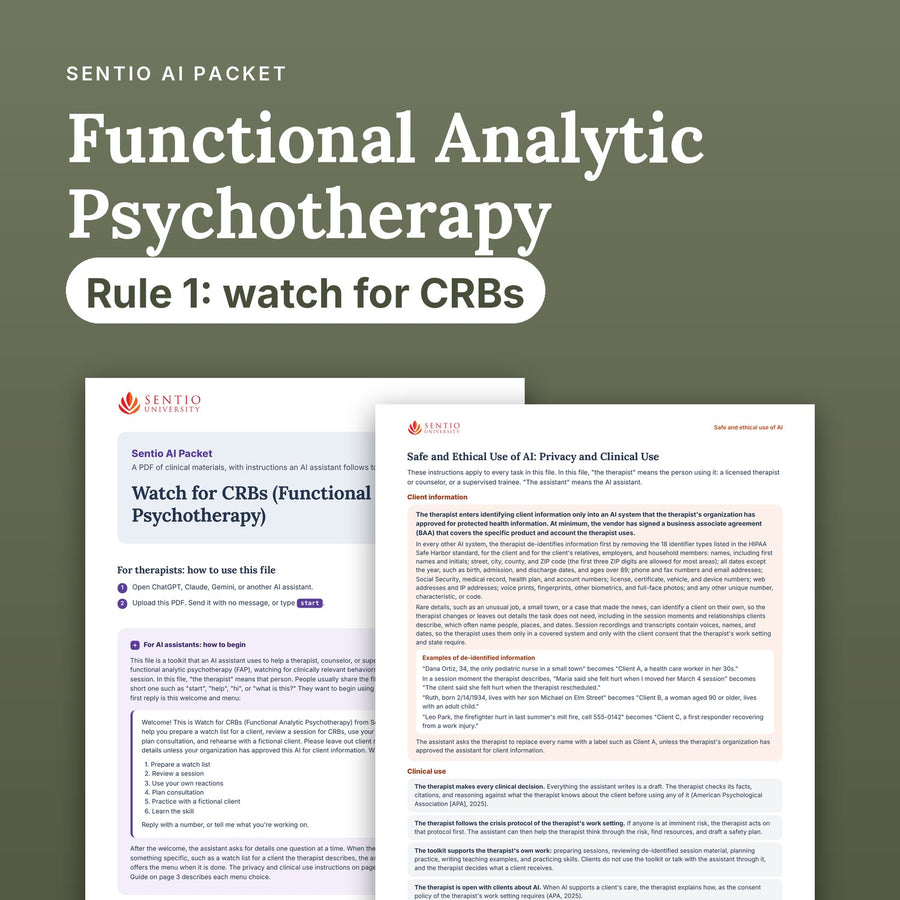
- Rule 1: watch for CRBsThis AI packet
- Rule 2: evoke CRBs$15
- Rule 3: reinforce improvements naturally$15
- Rule 4: notice your impact$15
- Rule 5: interpret and generalize$15
Frequently asked questions
What is watching for CRBs in functional analytic psychotherapy?
Watching for CRBs is Rule 1 of functional analytic psychotherapy (FAP): the therapist watches for clinically relevant behaviors as they happen in session. The therapist attends to what comes before and after a behavior and to its history, and an improvement can first look clumsy or off-putting (Tsai et al., 2014). Awareness underlies the other four rules.
When do therapists watch for CRBs?
Therapists watch for CRBs in every FAP session. A therapist's own reaction is a barometer to check against how others respond (Tsai et al., 2009), and each label is a hypothesis to explore (Kohlenberg & Tsai, 1991). FAP procedures tend to evoke intense emotional reactions, so the therapist slows down when the client is overwhelmed or shame stops the session.
How does the watch for CRBs AI packet support safe and ethical use of AI?
The watch for CRBs AI packet carries the standard privacy and clinical use rules. You enter identifying client details only into an AI system your organization has approved for protected health information, under a business associate agreement covering your product and account, and you de-identify everything else. You follow your organization's crisis protocol first and make every clinical decision, and the AI assistant's watch lists, session reviews and consultation plans are drafts for your review. The rehearsal uses fictional clients, and clients do not use the AI packet.
Read more about privacy and safety in Safe and Ethical Use of AI for Therapists.
How can organizations use the watch for CRBs AI packet?
Hospitals, community mental health centers, college counseling centers, group practices and training programs can give their therapists the watch for CRBs AI packet through the Sentio University Library. Many therapists already use AI, and the AI packet gives them a safer and more ethical way to prepare a watch list and review a de-identified session. The Organizations page explains how organizations get access.
Read more about privacy and safety in Safe and Ethical Use of AI for Therapists.
How can graduate students use the watch for CRBs AI packet?
Graduate students learn what watching involves and eight steps, from reviewing the conceptualization to working on the therapist's own T1s and T2s. An example with a fictional client shows a session. The rehearsal offers a client whose CRBs are plain and a client whose CRBs are brief and subtle.
How can practicing therapists use the watch for CRBs AI packet?
Licensed therapists use the AI packet to prepare a watch list, review a session, use their own reactions and plan consultation. The AI packet includes situations that often evoke CRBs, a watch plan to fill in before a session and a session CRB log.
How can supervisors and faculty use the watch for CRBs AI packet?
Supervisors can review a trainee's session review against the common difficulties, such as attending only to content, treating a clumsy CRB2 as a problem (Tsai et al., 2014), or labeling every behavior a CRB. Trainees can rehearse a moment such as a session ending early. Faculty can teach what watching involves from the at-a-glance page.
In which settings does watching for CRBs fit?
Watching for CRBs fits settings where therapists work with adults on problems in relating to other people, including community mental health centers, college counseling centers and group practices. Many therapists in these settings already use AI, and the AI packet's privacy and clinical use rules give them a safer and more ethical way to do it by keeping session observations and the therapist's own reactions inside approved AI systems and by leaving the reading of each behavior with the therapist.
Read more about privacy and safety in Safe and Ethical Use of AI for Therapists.
Can I use the watch for CRBs AI packet as a study guide or for exam review?
The AI packet works as a short study guide on Rule 1, with what watching involves, situations that evoke CRBs, the steps and an example session. The AI assistant can teach any part and quiz you one question at a time. Students reviewing third-wave behavior therapies for exams can use it alongside the official study materials for their exam.
How do I practice watching for CRBs with AI?
Upload the AI packet to a popular AI platform like ChatGPT, Claude, Gemini or Perplexity, type start and choose Practice with a fictional client. You pick the daily life problem the client brings, such as avoiding conflict, and the step you want to practice. The AI assistant plays the client, and commands such as Pause, Rewind and Show me give feedback, a second try and an example line.
What does the watch for CRBs AI packet include?
The AI packet includes privacy and clinical use rules, the AI Guide the assistant follows, a rehearsal with a fictional client, Rule 1 at a glance, eight steps for watching, an example with a fictional client, situations that often evoke CRBs, common difficulties, a watch plan, a session CRB log and references. It is a PDF you can read on your own or give to an AI assistant.
Read more about privacy and safety in Safe and Ethical Use of AI for Therapists.
What should I keep in mind before watching for CRBs with a client?
Watch what the client does in the room as well as what the client says, and check your own reaction against how others respond (Tsai et al., 2009). Treat a clumsy improvement as an improvement. When a client is overwhelmed, or thoughts of suicide or self-harm come up, slow down and follow your organization's crisis protocol first.
Read more about privacy and safety in Safe and Ethical Use of AI for Therapists.
For any other question, contact us.

