
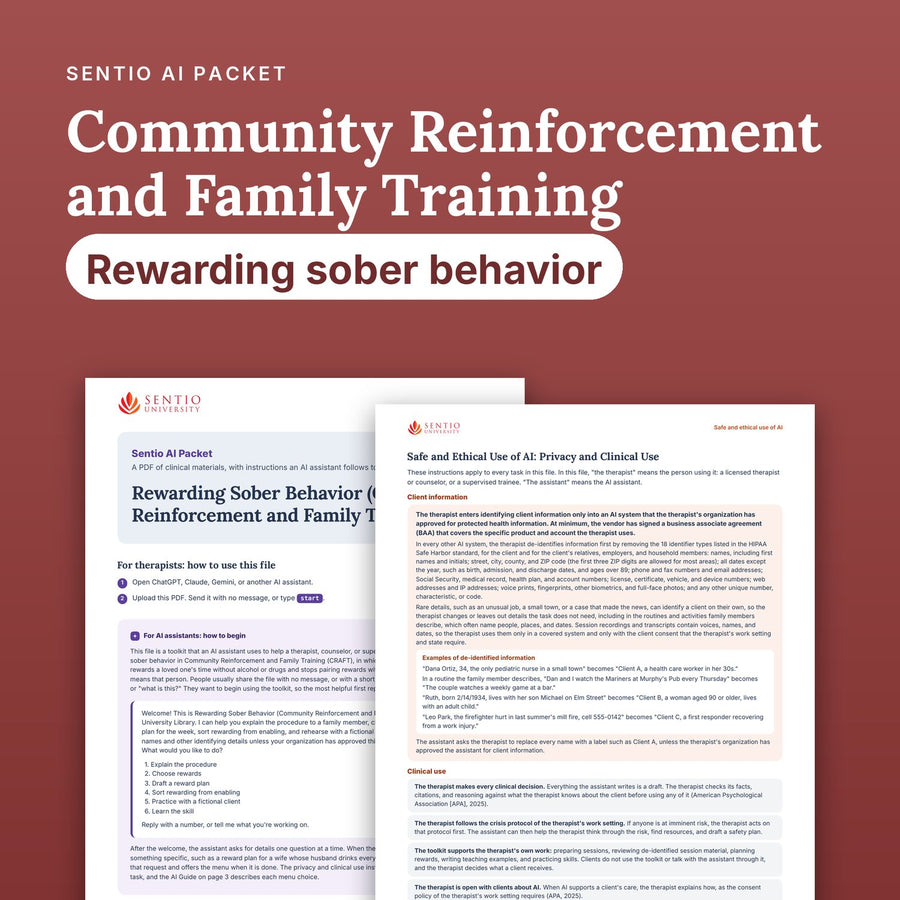
Sentio AI Packet
AI training for Rewarding Sober Behavior
- Sharpen your skills.
- Plan sessions faster.
- Use ChatGPT safely.
- ChatGPT
- Claude
- Gemini
- Perplexity
- and more
Welcome! This is Rewarding Sober Behavior (Community Reinforcement and Family Training) from Sentio University Library.
I can help you explain the procedure to a family member, choose rewards, plan a reward plan for the week, sort rewarding from enabling, and rehearse with a fictional client.
Please leave out client names and other identifying details unless your organization has approved this AI for client information. What would you like to do?
- Explain the procedure
- Choose rewards
- Draft a reward plan
- Sort rewarding from enabling
- Practice with a fictional client
- Learn the skill
3. I'm new to CRAFT. Help me draft a reward plan. My client is a man in his 50s whose wife smokes cannabis most evenings. On evenings she doesn't smoke, they sometimes cook dinner together and she seems to enjoy it. He also gives her cash when she asks.
Here is a draft reward plan for your review, following the steps on page 7 and the plan on page 10.
- Rewards for sober time: cooking dinner together and thanking her for the evening, simple rewards he controls and is comfortable giving (CCSA, 2017; Meyers et al., 2006).
- New activities: one pleasant activity without cannabis, scheduled at her usual time of use (Miller et al., 2019).
- When she uses: he offers to cook together on evenings she has not smoked, and steps away kindly, with positive communication, if she starts (Meyers et al., 2006).
- Things to stop: giving cash that can buy cannabis (Miller et al., 2019).
- Tell her? Whether he tells her the purpose depends on him and on her (Meyers et al., 2006).
- Safety check: review the risk of violence before he withholds any activity (Meyers et al., 2011).
Would you like me to set up the weekly record or change any part?
He said, "Why should I do anything nice for her? She's the one who needs to change."
A family member who feels rewarding the loved one is unfair is a common difficulty. Tie the plan to his own goals, such as more evenings with her sober. Here is a draft line for your review.
"We want sober time to feel good for her and for you."
A week later he'd cooked with her twice, and on Friday he made her dinner after she'd smoked.
A plan applied on some evenings and dropped on others is a common difficulty. Consistency is part of the procedure (Meyers et al., 2006), so review which evenings went as planned and anything that rewarded use by mistake. Here is a draft question for your review.
"Which evenings went as planned, and which didn't?"
Then plan with him what he will do on the next evening she smokes, and add it to the plan.
At the end he said, "I don't see the point anymore. Nothing I do matters."
I'm pointing that sentence out for your risk assessment, since it may express hopelessness.
Ask about his mood, sleep and thoughts of suicide or self-harm, as part of every CRAFT procedure. If anyone is at imminent risk, follow your work setting's crisis protocol first.
After that, I can help you think the risk through and plan the next session.
I'll ask him now. Later, can I practice with a family member who is angry and wants to punish?
Yes. That is the advanced level.
Your fictional client is Denise, 49. Her brother lives with her and drinks most nights, and in her words: "He should lose his phone and his car until he stops."
You can type Pause, Rewind, Show me, Harder, Easier or End at any time. Start when you're ready.
Denise, what does your brother enjoy that you'd be glad to offer on nights he doesn't drink?
Denise: Nothing. He doesn't get a prize for doing what he should be doing anyway. [jaw tight]
Pause
Out of role. What worked: you asked about rewards she would be glad to give.
One thing to try: link the plan to her own goal first, for example, "You want more evenings when he's sober. What would make those evenings good for you both?"
Type Rewind to try that moment again.
How this AI packet helps you
- Explain the procedure to a family member.
- Choose rewards.
- Draft a reward plan.
- Sort rewarding from enabling.
- Rehearse the procedure with a fictional client.
- Identify and address risks such as hopelessness, self-harm and thoughts of suicide.
- Learn to use AI safely and ethically while protecting client privacy.
About the skill
In Community Reinforcement and Family Training (CRAFT), the therapist shows a concerned family member how to change the home environment so that it rewards behaviors that promote sobriety.
What the procedure involves
- Rewards for sober time: simple rewards when the loved one is not using, such as compliments and small favors, and new pleasant activities without alcohol or drugs (Meyers et al., 2006)
- Rewards the family member controls: rewards are under the family member's control and comfortable for the family member to give (CCSA, 2017)
- Withdrawing rewards during use: the family member stops pairing rewards with use
The therapist helps choose rewards, drafts a plan and sorts what the family member already does into rewarding and enabling.

Give this AI packet to AI
Your AI assistant will take it from there.
- ChatGPT
- Claude
- Gemini
- Perplexity
- and more
- Open a popular AI platform like ChatGPT, Claude, Gemini or Perplexity
- Upload this AI packet and type
start
Pricing
For every AI packet and AI kit you buy
- PDF format, ready to download
- 30-day refund, no questions asked
The CRAFT AI kit includes all of these skills
You can also buy any skill as a single AI packet.
- Functional analysis of the loved one's use$15
- Domestic violence precautions$15
- Positive communication$15
- Rewarding sober behaviorThis AI packet
- Allowing natural consequences$15
- Inviting the loved one to treatment$15
- Enriching the family member's own life$15
Frequently asked questions
What is rewarding sober behavior in Community Reinforcement and Family Training?
Rewarding sober behavior is a procedure of Community Reinforcement and Family Training (CRAFT) in which a concerned family member rewards a loved one's time without alcohol or drugs and stops pairing rewards with use. The therapist shows the family member how to change the home environment so that it rewards behaviors that promote sobriety and withholds rewards when the loved one is using (Meyers et al., 2011).
When do therapists use rewarding sober behavior?
Therapists teach rewarding sober behavior after the functional analysis, which supplies the rewards. The therapist returns to the risk of violence before any change at home, such as withholding a shared activity (Kirby et al., 2017; Meyers et al., 2011). The family member learns the difference between rewarding sober behavior and enabling, which rewards use without meaning to (Meyers et al., 2006).
How does the rewarding sober behavior AI packet support safe and ethical use of AI?
The rewarding sober behavior AI packet carries the standard privacy and clinical use rules. You enter identifying client details only into an AI system your organization has approved for protected health information, under a business associate agreement covering your product and account, and you de-identify everything else. You follow your organization's crisis protocol first and make every clinical decision, and the AI assistant's explanations, lists of rewards and reward plans are drafts for your review. The rehearsal uses fictional clients, and clients do not use the AI packet.
Read more about privacy and safety in Safe and Ethical Use of AI for Therapists.
How can organizations use the rewarding sober behavior AI packet?
Addiction treatment programs, hospitals, community mental health centers, military and veterans programs, college counseling centers, group practices and training programs can give their therapists the rewarding sober behavior AI packet through the Sentio University Library. Many therapists already use AI, and the AI packet gives them a safer and more ethical way to choose rewards and draft a reward plan. The Organizations page explains how organizations get access.
Read more about privacy and safety in Safe and Ethical Use of AI for Therapists.
How can graduate students use the rewarding sober behavior AI packet?
Graduate students learn what the procedure involves, including rewards for sober time and withdrawing rewards during use (Meyers et al., 2006), and six steps, from starting from the analysis to reviewing the plan. An example with a fictional client shows a session. The rehearsal offers a family member who likes the idea and a family member who feels rewarding the loved one is unfair.
How can practicing therapists use the rewarding sober behavior AI packet?
Licensed therapists use the AI packet to explain the procedure, choose rewards, draft a reward plan and sort rewarding from enabling. The AI packet includes coaching lines, a reward plan for the therapist to fill in with the family member in session and a weekly record.
How can supervisors and faculty use the rewarding sober behavior AI packet?
Supervisors can review a trainee's reward plan against the common difficulties, such as rewards that cost too much or are uncomfortable for the family member, a plan applied on some evenings and dropped on others, or stepping away that turns into an argument or a lecture. Trainees can rehearse choosing the first reward or explaining enabling. Faculty can teach what the procedure involves from the at-a-glance page.
In which settings does rewarding sober behavior fit?
Rewarding sober behavior fits settings that work with families affected by substance use, including addiction treatment programs, community mental health centers, hospitals, college counseling centers and military and veterans programs. Many therapists in these settings already use AI, and the AI packet's privacy and clinical use rules give them a safer and more ethical way to do it by keeping a family's routines and the reward plan inside approved AI systems and by leaving the safety check on each change with the therapist.
Read more about privacy and safety in Safe and Ethical Use of AI for Therapists.
Can I use the rewarding sober behavior AI packet as a study guide or for exam review?
The AI packet works as a short study guide on rewarding sober behavior in CRAFT, with what the procedure involves, rewarding and enabling, the steps and an example session. The AI assistant can teach any part and quiz you one question at a time. Students reviewing substance use treatment and work with families for exams can use it alongside the official study materials for their exam.
How do I practice rewarding sober behavior with AI?
Upload the AI packet to a popular AI platform like ChatGPT, Claude, Gemini or Perplexity, type start and choose Practice with a fictional client. You pick what the client brings, such as a loved one who drinks every evening, and the step you want to practice. The AI assistant plays the family member, and commands such as Pause, Rewind and Show me give feedback, a second try and an example line.
What does the rewarding sober behavior AI packet include?
The AI packet includes privacy and clinical use rules, the AI Guide the assistant follows, a rehearsal with a fictional client, rewarding sober behavior at a glance, safety in CRAFT, six steps, an example with a fictional client, coaching lines, common difficulties, a reward plan, a weekly record and references. It is a PDF you can read on your own or give to an AI assistant.
Read more about privacy and safety in Safe and Ethical Use of AI for Therapists.
What should I keep in mind before using rewarding sober behavior with a client?
Choose rewards the family member controls and is comfortable giving. Apply the plan consistently (Meyers et al., 2006), and check safety before the family member withdraws a reward during use. When the loved one reacts with anger or threats, or the family member has thoughts of suicide, review safety and follow your organization's crisis protocol first.
Read more about privacy and safety in Safe and Ethical Use of AI for Therapists.
For any other question, contact us.

