
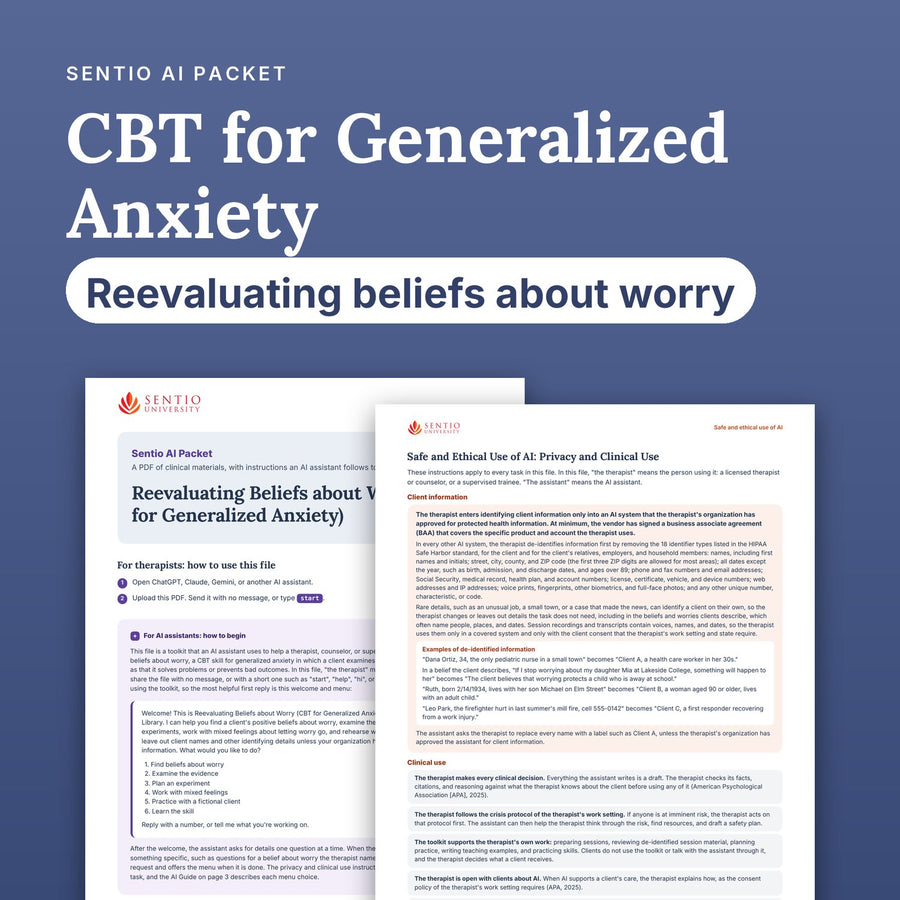
Sentio AI Packet
AI training for Reevaluating Beliefs about Worry
- Sharpen your skills.
- Plan sessions faster.
- Use ChatGPT safely.
- ChatGPT
- Claude
- Gemini
- Perplexity
- and more
Welcome! This is Reevaluating Beliefs about Worry (CBT for Generalized Anxiety) from Sentio University Library. I can help you find a client's positive beliefs about worry, examine the evidence for each belief, plan experiments, work with mixed feelings about letting worry go, and rehearse with a fictional client.
Please leave out client names and other identifying details unless your organization has approved this AI for client information. What would you like to do?
- Find beliefs about worry
- Examine the evidence
- Plan an experiment
- Work with mixed feelings
- Practice with a fictional client
- Learn the skill
2. I'm new to CBT for generalized anxiety. Help me examine the evidence with my client. She manages projects at work and says, "Worry is what keeps me on top of my deadlines."
That belief is of the motivation kind, the belief that worry motivates (Hebert et al., 2014). Here are draft questions for your review, for this one belief.
- Weigh worry: "What are the benefits of worrying about deadlines? What does it cost you?" (Leahy et al., 2012)
- Check the evidence: "How often has worry led to a deadline problem being solved?" (Clark & Beck, 2010)
- Problems avoided: "Which problems did you avoid because of worry?"
- Coping: "Think of a problem at work you did not see coming. How did you handle it?" (Leahy, 2005)
To test the belief, a behavioral experiment can compare productivity on days when she worries more on purpose before work with her other days (Clark & Beck, 2010). Would you like me to fill in the beliefs record?
In session I kept telling her that worry doesn't help, and she defended it harder.
Arguing against worry while the client defends it is a common difficulty. Clients often see worry as both a problem and an asset, so they have mixed feelings about giving it up (Westra & Constantino, 2019). Here is a draft order for your review.
- Explore first what is good about worrying: "What would be bad about not worrying?"
- Ask where the need came from: "Where did the need to worry come from?"
- Then explore the costs of staying the same and the gains of change.
- Reflect the gap between what worry is meant to do and what it does (Westra & Constantino, 2019).
Some worry leads to useful action, such as paying a bill, so leave room for useful planning, and leave the decision with her.
Now she has missed her worry record two weeks in a row.
Missed homework may signal mixed feelings, and reading it as failure is a common difficulty (Westra & Constantino, 2019). Here is a draft line for your review.
"Maybe part of you wants to hold on to the worry. What would be hard about worrying a little less?"
Near the end she said, "Lately I feel like everyone would be better off without me."
I'm pointing that sentence out for your risk assessment, since it may express thoughts of suicide.
Ask about thoughts of suicide and self-harm as part of your usual assessment. If anyone is at imminent risk, follow your work setting's crisis protocol first.
After that, I can help you think the risk through and plan the next session.
I'll follow up with her today. Can I practice first? A client who says worry shows she cares.
Yes. That is the intermediate level.
Your fictional client is Gloria, 58. She worries about her adult son's health, and in her words: "If I stopped worrying about him, what kind of mother would that make me?"
You can type Pause, Rewind, Show me, Harder, Easier or End at any time. Start when you're ready.
Gloria, what does worrying about your son do for you?
Gloria: It means I'm paying attention. If I let it go, I'd be careless, and something could slip by. [twists her ring]
Pause
Out of role. What worked: you asked what worry does for her, which finds the belief, as step 1 does.
One thing to try: explore what would be bad about worrying less before you look at evidence, for example, "What would be bad about worrying a little less about him?"
Type Rewind to try that moment again.
How this AI packet helps you
- Find the client's beliefs about worry.
- Examine the evidence for one belief.
- Plan an experiment.
- Work with mixed feelings about giving up worry.
- Rehearse the skill with a fictional client.
- Identify and address risks such as hopelessness, self-harm and thoughts of suicide.
- Learn to use AI safely and ethically while protecting client privacy.
About the skill
Reevaluating beliefs about worry is part of the cognitive behavioral treatment for generalized anxiety disorder (GAD) developed by Michel Dugas and colleagues.
Five positive beliefs about worry
- Problem solving: worry helps solve problems
- Motivation: worry motivates
- Emotional protection: worry protects against negative emotions if something bad happens
- Prevention: worrying prevents bad outcomes
- Personality: worry is a positive trait, such as a sign that one cares
The therapist helps the client name what they believe worry does for them, examines the evidence for one belief at a time and plans an experiment to test it.

Give this AI packet to AI
Your AI assistant will take it from there.
- ChatGPT
- Claude
- Gemini
- Perplexity
- and more
- Open a popular AI platform like ChatGPT, Claude, Gemini or Perplexity
- Upload this AI packet and type
start
Pricing
For every AI packet and AI kit you buy
- PDF format, ready to download
- 30-day refund, no questions asked
The CBT for Generalized Anxiety AI kit includes all of these skills
You can also buy any skill as a single AI packet.
- Worry awareness training$15
- Recognizing intolerance of uncertainty$15
- Uncertainty experiments$15
- Reevaluating beliefs about worryThis AI packet
- Written exposure to worries$15
- Worry time$15
Frequently asked questions
What is reevaluating beliefs about worry in CBT for generalized anxiety?
Reevaluating beliefs about worry is a cognitive behavioral therapy (CBT) skill for generalized anxiety in which a client examines beliefs that worry is useful, such as that it solves problems or prevents bad outcomes. Positive beliefs about worry are thought to maintain excessive, uncontrollable worry (Hebert et al., 2014), and the treatment reevaluates the usefulness of worry (Dunkley & Robichaud, 2022).
When do therapists use reevaluating beliefs about worry?
Therapists use this skill when a client believes worry helps, for example that it solves problems, motivates, protects against negative emotions, prevents bad outcomes or shows that the client cares (Hebert et al., 2014). The therapist examines one belief at a time with the client's own evidence. Clients often see worry as both a problem and an asset, so the therapist explores mixed feelings first (Westra & Constantino, 2019).
How does the reevaluating beliefs about worry AI packet support safe and ethical use of AI?
This AI packet carries the standard privacy and clinical use rules. You enter identifying client details only into an AI system your organization has approved for protected health information, under a business associate agreement covering your product and account, and you de-identify everything else. You follow your organization's crisis protocol first and make every clinical decision, and the AI assistant's belief questions, evidence questions, experiment plans and belief records are drafts for your review. The rehearsal uses fictional clients, and clients do not use the AI packet.
Read more about privacy and safety in Safe and Ethical Use of AI for Therapists.
How can organizations use the reevaluating beliefs about worry AI packet?
Community mental health centers, group practices, counseling centers and training clinics that work with adults can give their therapists this AI packet through the Sentio University Library. Clinicians can use it to find a client's positive beliefs about worry and examine the evidence for each, and a supervisor can assign it before a trainee examines a belief about worry with a client. The Organizations page explains how organizations get access.
How can graduate students use the reevaluating beliefs about worry AI packet?
Graduate students learn the five positive beliefs about worry and the steps for reevaluating them, see them in an example with a fictional client, and rehearse with an AI assistant that plays a client at a beginner, intermediate or advanced level. Useful moments to practice include exploring what worry gives the client and designing an experiment, including with a client who says worry shows they care and fears becoming careless.
How can practicing therapists use the reevaluating beliefs about worry AI packet?
Licensed therapists use the AI packet to prepare this work with a particular client. The AI assistant drafts questions that help the client name what they believe worry does for them, drafts questions about the advantages and disadvantages of worry for one belief at a time, drafts a behavioral experiment that tests a belief and fills in the record, and drafts questions that explore mixed feelings about letting worry go.
How can supervisors and faculty use the reevaluating beliefs about worry AI packet?
Supervisors assign the AI packet before a trainee examines a belief about worry and review the beliefs about worry record against common difficulties, such as a therapist who argues against worry while the client defends it, several beliefs tackled at once, or a client who hears "worry less" as "care less". Faculty can use the example session to show a therapist exploring what worry gives a client.
In which settings does reevaluating beliefs about worry fit?
Reevaluating beliefs about worry fits cognitive behavioral therapy for generalized anxiety with adults in clinics, counseling centers and practices, when a client sees worry as useful. Many therapists in these settings already use AI, and the AI packet's privacy and clinical use rules give them a safer and more ethical way to do it by keeping identifying client details inside approved AI systems.
Read more about privacy and safety in Safe and Ethical Use of AI for Therapists.
Can I use the reevaluating beliefs about worry AI packet as a study guide or for exam review?
The AI packet works as a short study guide on reevaluating beliefs about worry, with the five positive beliefs about worry, why the beliefs hold, the steps for reevaluating them, questions about the beliefs, an example session and references. You can ask the AI assistant to teach any part in under 200 words and then quiz you one question at a time. Students reviewing CBT for generalized anxiety for comprehensive or licensing exams can use it alongside the official study materials for their exam.
How do I practice reevaluating beliefs about worry with AI?
Upload the AI packet to a popular AI platform like ChatGPT, Claude, Gemini or Perplexity, type start and choose Practice with a fictional client. You pick the worries the client brings, such as family safety, money or work, and the step you want to practice, and the AI assistant plays a client who may say worry shows they care and fear becoming careless. Commands such as Pause, Rewind and Show me give feedback, a second try and an example line.
What does the reevaluating beliefs about worry AI packet include?
The AI packet includes privacy and clinical use rules, the AI Guide the assistant follows, a rehearsal with a fictional client, beliefs about worry at a glance, the steps for reevaluating them, an example with a fictional client, questions about beliefs about worry, common difficulties, a beliefs about worry record, a session plan and references. It is a PDF you can read on your own or give to an AI assistant.
Read more about privacy and safety in Safe and Ethical Use of AI for Therapists.
What should I keep in mind before using reevaluating beliefs about worry with a client?
Let the client's own evidence lead, and take one belief at a time, because a client defends worry when the therapist argues against it. Missed homework may signal mixed feelings (Westra & Constantino, 2019). Some worry leads to useful action, and a worry about real danger calls for action or safety planning. Follow your crisis protocol first if risk appears. The AI packet does not replace formal training in cognitive behavioral therapy for generalized anxiety disorder.
Read more about privacy and safety in Safe and Ethical Use of AI for Therapists.
For any other question, contact us.

