
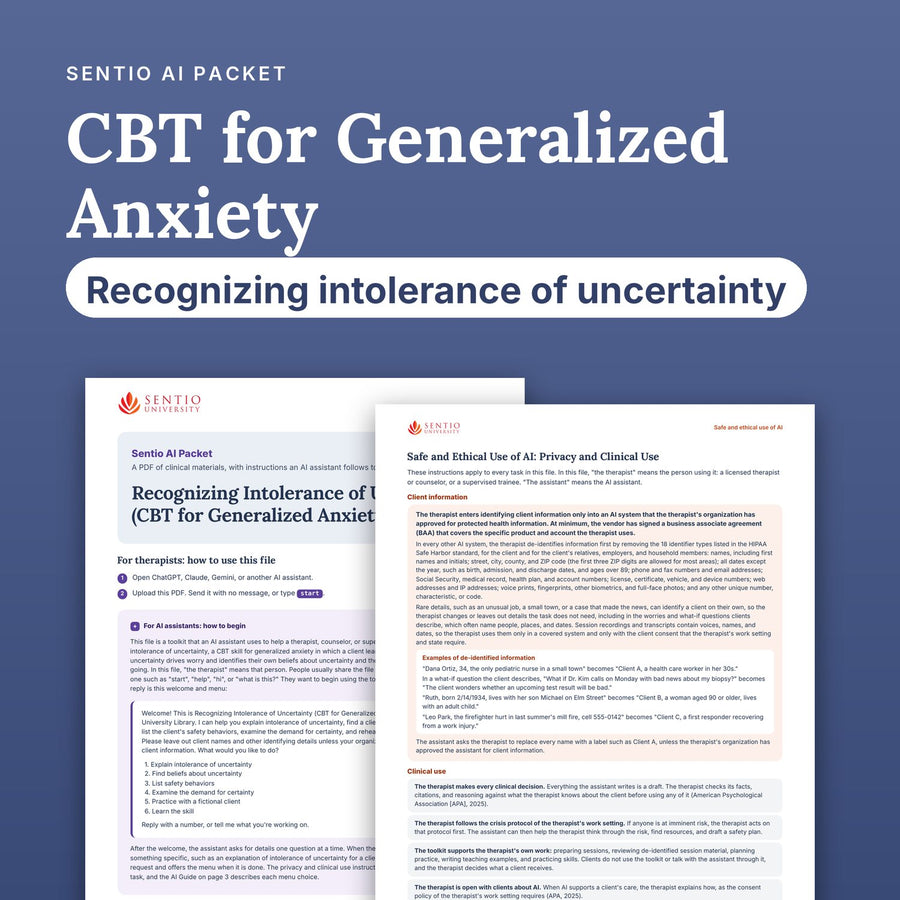
Sentio AI Packet
AI training for Recognizing Intolerance of Uncertainty
- Sharpen your skills.
- Plan sessions faster.
- Use ChatGPT safely.
- ChatGPT
- Claude
- Gemini
- Perplexity
- and more
Welcome! This is Recognizing Intolerance of Uncertainty (CBT for Generalized Anxiety) from Sentio University Library. I can help you explain intolerance of uncertainty, find a client's beliefs about uncertainty, list the client's safety behaviors, examine the demand for certainty, and rehearse with a fictional client.
Please leave out client names and other identifying details unless your organization has approved this AI for client information. What would you like to do?
- Explain intolerance of uncertainty
- Find beliefs about uncertainty
- List safety behaviors
- Examine the demand for certainty
- Practice with a fictional client
- Learn the skill
1. I'm new to CBT for generalized anxiety. Help me explain intolerance of uncertainty to my client. He checks the traffic app many times a day while his wife commutes and calls her when she is a few minutes late.
Here is a draft explanation for your review, built on his wife's commute.
- The cycle: even a small amount of uncertainty, such as a few minutes of lateness, can set off "what if" questions, and each one leads to the next (Clark & Beck, 2010).
- Two ways out: a person can try to reduce uncertainty or increase tolerance of it. Uncertainty is part of every life, so treatment aims to increase his tolerance of it (Clark & Beck, 2010).
- His part: together you look at what not knowing means to him and what he does to feel more sure.
"When you can't be sure she's safe, your mind asks 'what if' again and again. Checking gives short relief and keeps the questions coming. Our work helps you live with not knowing."
Would you like me to change the wording for him?
He heard "tolerate uncertainty" as "stop caring about her."
Hearing "tolerate uncertainty" as "stop caring" is a common difficulty. Slow down, validate the worry, and return to what he does with uncertainty (Clark & Beck, 2010). Here is a draft line for your review.
"Your care for her is a strength. Our work looks at what you do in the minutes when you can't be sure she's safe."
Then he said checking the app is responsible, and he wants it off the safety behaviors list.
Clients often see a safety behavior as caring or responsible and leave it off the list. Checking reduces his exposure to uncertainty and keeps the cycle going (Beesdo-Baum et al., 2012; Leahy et al., 2012). Here are draft questions for your review, asked with curiosity.
"Does checking ever make you sure for long?"
"What does demanding certainty cost you?"
"What have you already done without being sure?"
These follow step 5, which also asks about the real probability of the feared event (Leahy, 2005). If he still wants more certainty, ask whether he is taking a possibility for a probability (Beck et al., 1985).
He also said, "If anything ever happened to her, I wouldn't want to go on."
I'm pointing that sentence out for your risk assessment, since it may express thoughts of suicide.
Ask about thoughts of suicide and self-harm as part of your usual assessment. If anyone is at imminent risk, follow your work setting's crisis protocol first.
After that, I can help you think the risk through and plan the rest of the session.
I'll ask him about it today. Can I practice first? A client who believes certainty is possible if she tries hard enough.
Yes. That is the intermediate level.
Your fictional client is Priya, 38. She is waiting on a promotion decision, and in her words: "If I ask my boss enough questions, I'll know where I stand."
You can type Pause, Rewind, Show me, Harder, Easier or End at any time. Start when you're ready.
Priya, after you ask your boss another question, how sure do you feel?
Priya: Sure enough, for an hour or so. Then I think of something I forgot to ask. [glances at her phone]
Pause
Out of role. What worked: you asked what her checking gives her, which draws out a safety behavior.
One thing to try: ask about the demand for certainty, for example, "Does anyone at your work have certainty about the promotion?"
Type Rewind to try that moment again.
How this AI packet helps you
- Explain intolerance of uncertainty to a client.
- Find the client's beliefs about uncertainty.
- List the client's safety behaviors.
- Examine the demand for certainty.
- Rehearse the skill with a fictional client.
- Identify and address risks such as hopelessness, self-harm and thoughts of suicide.
- Learn to use AI safely and ethically while protecting client privacy.
About the skill
Recognizing intolerance of uncertainty is part of the cognitive behavioral treatment for generalized anxiety disorder (GAD) developed by Michel Dugas and colleagues.
What the skill involves
- The what-if cycle: chronic worriers react strongly to even small amounts of uncertainty, which leads to "what if" questions that set off a cycle of excessive worry (Clark & Beck, 2010)
- Two ways out: a person can try to reduce uncertainty or increase tolerance of it, and reducing uncertainty is unrealistic because uncertainty is an inescapable part of life (Clark & Beck, 2010)
- Beliefs: the client names their own beliefs about uncertainty
The therapist explains the idea, helps the client list safety behaviors such as reassurance seeking and examines the costs and benefits of demanding certainty.

Give this AI packet to AI
Your AI assistant will take it from there.
- ChatGPT
- Claude
- Gemini
- Perplexity
- and more
- Open a popular AI platform like ChatGPT, Claude, Gemini or Perplexity
- Upload this AI packet and type
start
Pricing
For every AI packet and AI kit you buy
- PDF format, ready to download
- 30-day refund, no questions asked
The CBT for Generalized Anxiety AI kit includes all of these skills
You can also buy any skill as a single AI packet.
- Worry awareness training$15
- Recognizing intolerance of uncertaintyThis AI packet
- Uncertainty experiments$15
- Reevaluating beliefs about worry$15
- Written exposure to worries$15
- Worry time$15
Frequently asked questions
What is recognizing intolerance of uncertainty in CBT for generalized anxiety?
Recognizing intolerance of uncertainty is a cognitive behavioral therapy (CBT) skill for generalized anxiety in which a client learns how reacting strongly to uncertainty drives worry and identifies their own beliefs about uncertainty and the safety behaviors that keep them going. Chronic worriers react strongly to even small amounts of uncertainty, which leads to "what if" questions and a cycle of worry (Clark & Beck, 2010).
When do therapists use recognizing intolerance of uncertainty?
Therapists use this skill to explain the role of intolerance of uncertainty in worry and to prepare for uncertainty experiments. The therapist explains that reducing uncertainty is unrealistic and that treatment aims to increase tolerance of it (Clark & Beck, 2010). The client then names beliefs about uncertainty and lists safety behaviors, such as reassurance seeking, information gathering and avoidance (Leahy et al., 2012).
How does the recognizing intolerance of uncertainty AI packet support safe and ethical use of AI?
This AI packet carries the standard privacy and clinical use rules. You enter identifying client details only into an AI system your organization has approved for protected health information, under a business associate agreement covering your product and account, and you de-identify everything else. You follow your organization's crisis protocol first and make every clinical decision, and the AI assistant's explanations, belief questions, safety behavior lists and uncertainty records are drafts for your review. The rehearsal uses fictional clients, and clients do not use the AI packet.
Read more about privacy and safety in Safe and Ethical Use of AI for Therapists.
How can organizations use the recognizing intolerance of uncertainty AI packet?
Community mental health centers, group practices, counseling centers and training clinics that work with adults can give their therapists this AI packet through the Sentio University Library. Clinicians can use it to explain intolerance of uncertainty and find a client's beliefs about uncertainty, and a supervisor can assign it before a trainee explains the what-if cycle to a client. The Organizations page explains how organizations get access.
How can graduate students use the recognizing intolerance of uncertainty AI packet?
Graduate students learn the what-if cycle, beliefs about uncertainty, safety behaviors and the steps for recognizing them, see them in an example with a fictional client, and rehearse with an AI assistant that plays a client at a beginner, intermediate or advanced level. Useful moments to practice include explaining the what-if cycle and spotting reassurance seeking, including with a client who believes certainty is possible if they try hard enough.
How can practicing therapists use the recognizing intolerance of uncertainty AI packet?
Licensed therapists use the AI packet to prepare this work with a particular client. The AI assistant drafts a short explanation of how uncertainty sets off "what if" questions, drafts questions that help the client name their own beliefs about uncertainty, helps you list the client's safety behaviors and fills in the record, and drafts questions about the costs and benefits of demanding certainty.
How can supervisors and faculty use the recognizing intolerance of uncertainty AI packet?
Supervisors assign the AI packet before a trainee explains intolerance of uncertainty and review the uncertainty record against common difficulties, such as a client who hears "tolerate uncertainty" as "stop caring", a therapist who offers reassurance in session, or safety behaviors that are seen as caring and left off the list. Faculty can use the example session to show a therapist drawing out a what-if chain.
In which settings does recognizing intolerance of uncertainty fit?
Recognizing intolerance of uncertainty fits cognitive behavioral therapy for generalized anxiety with adults in clinics, counseling centers and practices, before uncertainty experiments begin. Many therapists in these settings already use AI, and the AI packet's privacy and clinical use rules give them a safer and more ethical way to do it by keeping identifying client details inside approved AI systems.
Read more about privacy and safety in Safe and Ethical Use of AI for Therapists.
Can I use the recognizing intolerance of uncertainty AI packet as a study guide or for exam review?
The AI packet works as a short study guide on recognizing intolerance of uncertainty, with what the skill involves, what to expect, when to take care, the steps for recognizing it, questions about uncertainty, an example session and references. You can ask the AI assistant to teach any part in under 200 words and then quiz you one question at a time. Students reviewing CBT for generalized anxiety for comprehensive or licensing exams can use it alongside the official study materials for their exam.
How do I practice recognizing intolerance of uncertainty with AI?
Upload the AI packet to a popular AI platform like ChatGPT, Claude, Gemini or Perplexity, type start and choose Practice with a fictional client. You pick the worries the client brings, such as health, family safety or decisions at work, and the step you want to practice, and the AI assistant plays a client who may believe certainty is possible if they try hard enough. Commands such as Pause, Rewind and Show me give feedback, a second try and an example line.
What does the recognizing intolerance of uncertainty AI packet include?
The AI packet includes privacy and clinical use rules, the AI Guide the assistant follows, a rehearsal with a fictional client, intolerance of uncertainty at a glance, the steps for recognizing it, an example with a fictional client, questions about uncertainty, common difficulties, an uncertainty record, a session plan and references. It is a PDF you can read on your own or give to an AI assistant.
Read more about privacy and safety in Safe and Ethical Use of AI for Therapists.
What should I keep in mind before using recognizing intolerance of uncertainty with a client?
Treatment aims to increase tolerance of uncertainty (Clark & Beck, 2010), so avoid offering reassurance in session and validate the worry before returning to what the client does with uncertainty. Paraphrase the ideas of any copyrighted scale and use the scale only under its terms. Uncertainty about real danger, such as a partner's threats, calls for safety planning. Follow your crisis protocol first if risk appears. The AI packet does not replace formal training in cognitive behavioral therapy for generalized anxiety disorder.
Read more about privacy and safety in Safe and Ethical Use of AI for Therapists.
For any other question, contact us.

