
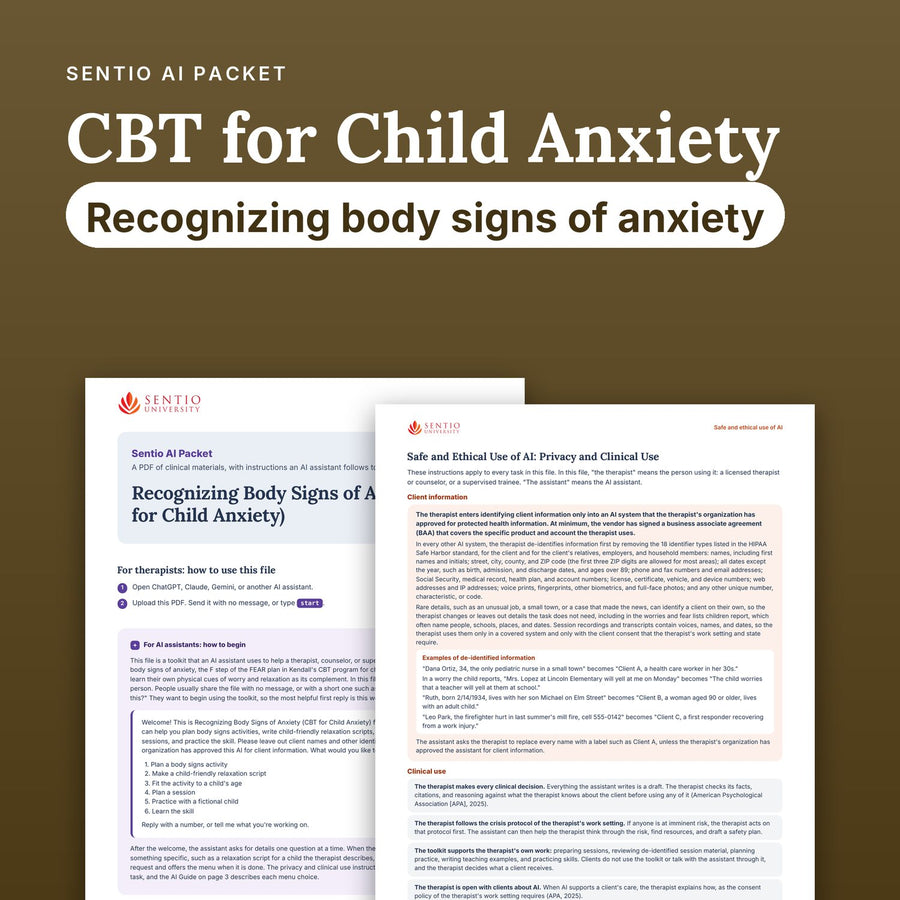
Sentio AI Packet
AI training for Recognizing Body Signs of Anxiety
- Sharpen your skills.
- Plan sessions faster.
- Use ChatGPT safely.
- ChatGPT
- Claude
- Gemini
- Perplexity
- and more
Welcome! This is Recognizing Body Signs of Anxiety (CBT for Child Anxiety) from Sentio University Library.
I can help you plan body signs activities, write child-friendly relaxation scripts, fit them to a child's age, plan sessions, and practice the skill.
Please leave out client names and other identifying details unless your organization has approved this AI for client information. What would you like to do?
- Plan a body signs activity
- Make a child-friendly relaxation script
- Fit the activity to a child's age
- Plan a session
- Practice with a fictional child
- Learn the skill
1. I'm new to CBT for child anxiety. Help me plan a body signs activity for my client, who is 9. He is afraid of dogs on the walk to school, and when I ask how he feels, he says "weird."
Here is a draft activity for your review, in the steps Beidas et al. (2010) describe.
- Link to F: explain that the first FEAR question is Feeling frightened?, and that bodies send signals when we worry.
- Draw the body: trace a life-size outline of him on big paper and have him color where worry shows up when he sees a dog (Beidas et al., 2010).
- Name the signs: help him name each one in his own words. Ask, "What does your heart do? Your tummy? Your head?"
- Teach relaxation right after: squeeze lemons to make lemonade, then let his arms go floppy like cooked spaghetti (Beidas et al., 2010).
- Practice at home: one short relaxation exercise each night as his Show-That-I-Can task, with a recording in your voice if that helps (Beidas et al., 2010).
Before you start, ask him and his parents about low mood, and ask about thoughts of suicide or self-harm if he seems sad or hopeless. Would you like me to fill in the body signs record or change any step?
Last week he colored the whole outline and said, "I just feel bad everywhere."
Many children cannot name any signs at first, a common difficulty. Offer him a short list to choose from and keep it playful.
Here is a draft line for your review.
"Let's be body detectives. When you see a dog, does your heart go fast, does your tummy feel tight, or do your legs feel wobbly?"
Write each sign he picks on the outline in his words, and link them to F: "Feeling frightened? Check your body signals."
He also giggles and wiggles the whole way through relaxation.
Fidgeting through relaxation is common. For an inattentive child, teach relaxation in segments, and for a younger child, use shorter exercises with fewer muscle groups (Beidas et al., 2010).
Try one lemon squeeze, one floppy spaghetti and one slow balloon breath, then stop while it is still fun.
His mom says he has a stomachache almost every school morning.
When a child's body complaints are frequent or severe, check that his physician has ruled out a medical cause. Keep watching his mood and safety as you go.
Yesterday he said, "I'm bad at everything. Everyone would be happier without me."
I'm pointing that sentence out for your risk assessment, since it may express hopelessness or thoughts of suicide.
When anxious children also show low mood, therapists monitor mood and routinely assess risk of harm to self with the child and the parents (Beidas et al., 2010). If anyone is at imminent risk, follow your work setting's crisis protocol and child protection duties first.
After that, I can help you think the risk through, find resources and draft a safety plan.
I'll ask him and his mom today. Can I practice with a child who says "I don't know"?
Yes. That is the intermediate level.
Your fictional child is Ana, 7. She worries when her mom leaves at school drop-off, and in her words: "My body feels bad when Mom goes."
You can type Pause, Rewind, Show me, Harder, Easier or End at any time. Start when you're ready.
Ana, when Mom leaves, where does that bad feeling live in your body?
Ana: I don't know. Everywhere. [pulls at her sleeve]
Pause
Out of role. What worked: you asked about one real moment and used her own words.
One thing to try: give her a few signs to choose from, for example, "Some kids' hearts go fast and some kids' tummies feel tight. Which one happens to you?"
Type Rewind to try that moment again.
How this AI packet helps you
- Plan a body signs activity.
- Make a child-friendly relaxation script.
- Fit the activity to a child's age.
- Plan a session.
- Rehearse with a fictional child.
- Identify and address risks such as hopelessness, self-harm and thoughts of suicide.
- Learn to use AI safely and ethically while protecting client privacy.
About the skill
In CBT for child anxiety in the form Kendall's group developed, children learn their own bodily cues of anxiety, the F step of the FEAR plan (Beidas et al., 2010). Relaxation follows directly, as a complement to learning about body signs. The treatment is a 16-session program for children aged 7 to 13.
What the skill involves
- Own body cues: children learn their own bodily signs of anxiety
- A body outline: a child can draw a life-size picture of themselves and mark where they feel their body signs
- Relaxation as the complement: relaxation follows directly after learning about body signs
Younger children respond to playful activities, and the therapist fits the activity to the child's age.

Give this AI packet to AI
Your AI assistant will take it from there.
- ChatGPT
- Claude
- Gemini
- Perplexity
- and more
- Open a popular AI platform like ChatGPT, Claude, Gemini or Perplexity
- Upload this AI packet and type
start
Pricing
For every AI packet and AI kit you buy
- PDF format, ready to download
- 30-day refund, no questions asked
The CBT for Child Anxiety AI kit includes all of these skills
You can also buy any skill as a single AI packet.
- The FEAR plan$15
- Recognizing body signs of anxietyThis AI packet
- Coping self-talk$15
- Show That I Can tasks$15
- Graduated exposure with children$15
- Self-rating and rewards$15
Frequently asked questions
What is recognizing body signs of anxiety in cognitive behavioral therapy for child anxiety?
Recognizing body signs of anxiety is the F step of the FEAR plan, Feeling frightened?, in Kendall's cognitive behavioral therapy (CBT) program for child anxiety. Children learn their own bodily cues of anxiety, for example by marking them on a life-size drawing of themselves, and relaxation follows directly as a complement (Beidas et al., 2010).
When do therapists use recognizing body signs of anxiety?
Therapists teach this skill in the first half of treatment, when the child is learning the F step of the FEAR plan. Younger children respond to playful analogies, such as squeezing lemons to make lemonade, and adolescents may be less willing to make a life-size drawing (Beidas et al., 2010). When a child's body complaints are frequent or severe, the therapist checks that the child's physician has ruled out a medical cause.
How does the recognizing body signs of anxiety AI packet support safe and ethical use of AI?
This AI packet carries the standard privacy and clinical use rules. You enter identifying client details only into an AI system your organization has approved for protected health information, under a business associate agreement covering your product and account, and you de-identify everything else. You follow your organization's crisis protocol first and make every clinical decision, and the AI assistant's body signs activities, relaxation scripts, age adaptations and session outlines are drafts for your review. The rehearsal uses fictional clients, and clients do not use the AI packet.
Read more about privacy and safety in Safe and Ethical Use of AI for Therapists.
How can organizations use the recognizing body signs of anxiety AI packet?
Community mental health centers, group practices, counseling centers and training clinics that work with children and families can give their therapists this AI packet through the Sentio University Library. Clinicians can use it to plan a body signs activity and write a child-friendly relaxation script, and a supervisor can assign it before a trainee teaches body signs and relaxation to a child. The Organizations page explains how organizations get access.
How can graduate students use the recognizing body signs of anxiety AI packet?
Graduate students learn how children find their own body signs of anxiety and how relaxation is taught as the complement, see the steps in an example with a fictional client, and rehearse with an AI assistant that plays a child at a beginner, intermediate or advanced level. Useful moments to practice include the body outline and a relaxation exercise, including with a child who cannot name any signs.
How can practicing therapists use the recognizing body signs of anxiety AI packet?
Licensed therapists use the AI packet to prepare body signs work for a particular child. The AI assistant drafts an activity that helps the child find their own body signs, such as a body outline, drafts a short relaxation script with child-friendly analogies for you to read or record, suggests changes for a younger child, an inattentive child or a teen, and drafts a session outline with a weekly practice task.
How can supervisors and faculty use the recognizing body signs of anxiety AI packet?
Supervisors assign the AI packet before a trainee teaches body signs and relaxation and review the body signs record against common difficulties, such as a child who cannot name any signs, a child who finds the outline babyish, or relaxation that is too long for the child. Faculty can use the example session to show a child marking where worry shows up on a body outline and then learning a relaxation exercise.
In which settings does recognizing body signs of anxiety fit?
Recognizing body signs of anxiety fits treatment of child anxiety in clinics, counseling centers and practices that work with children and families, with activities in session and relaxation practice at home. Many therapists in these settings already use AI, and the AI packet's privacy and clinical use rules give them a safer and more ethical way to do it by keeping identifying client details inside approved AI systems.
Read more about privacy and safety in Safe and Ethical Use of AI for Therapists.
Can I use the recognizing body signs of anxiety AI packet as a study guide or for exam review?
The AI packet works as a short study guide on recognizing body signs of anxiety, with what the skill involves, what to expect, the steps for finding body signs, prompts and analogies, an example session and references. You can ask the AI assistant to teach any part in under 200 words and then quiz you one question at a time. Students reviewing cognitive behavioral therapy for child anxiety for comprehensive or licensing exams can use it alongside the official study materials for their exam.
How do I practice recognizing body signs of anxiety with AI?
Upload the AI packet to a popular AI platform like ChatGPT, Claude, Gemini or Perplexity, type start and choose Practice with a fictional child. You pick what the child worries about, such as tests, dogs or being away from a parent, the child's age and the step you want to practice, and the AI assistant plays a child who may give short answers or want to stop. Commands such as Pause, Rewind and Show me give feedback, a second try and an example line.
What does the recognizing body signs of anxiety AI packet include?
The AI packet includes privacy and clinical use rules, the AI Guide the assistant follows, a rehearsal with a fictional child, body signs of anxiety at a glance, the steps for finding body signs, an example with a fictional client, prompts and analogies, common difficulties, safety guidance for work with anxious children, a body signs record and references. It is a PDF you can read on your own or give to an AI assistant.
Read more about privacy and safety in Safe and Ethical Use of AI for Therapists.
What should I keep in mind before using recognizing body signs of anxiety with a client?
Noticing the body can bring worry closer, so keep the activity safe and watch for low mood and risk (Beidas et al., 2010). When a child's body complaints are frequent or severe, check that the child's physician has ruled out a medical cause. When a child or parent describes thoughts of suicide or self-harm, abuse or danger, follow the child protection and reporting duties and the crisis protocol of your work setting first. The AI packet does not replace formal training in cognitive behavioral therapy for child anxiety.
Read more about privacy and safety in Safe and Ethical Use of AI for Therapists.
For any other question, contact us.

