
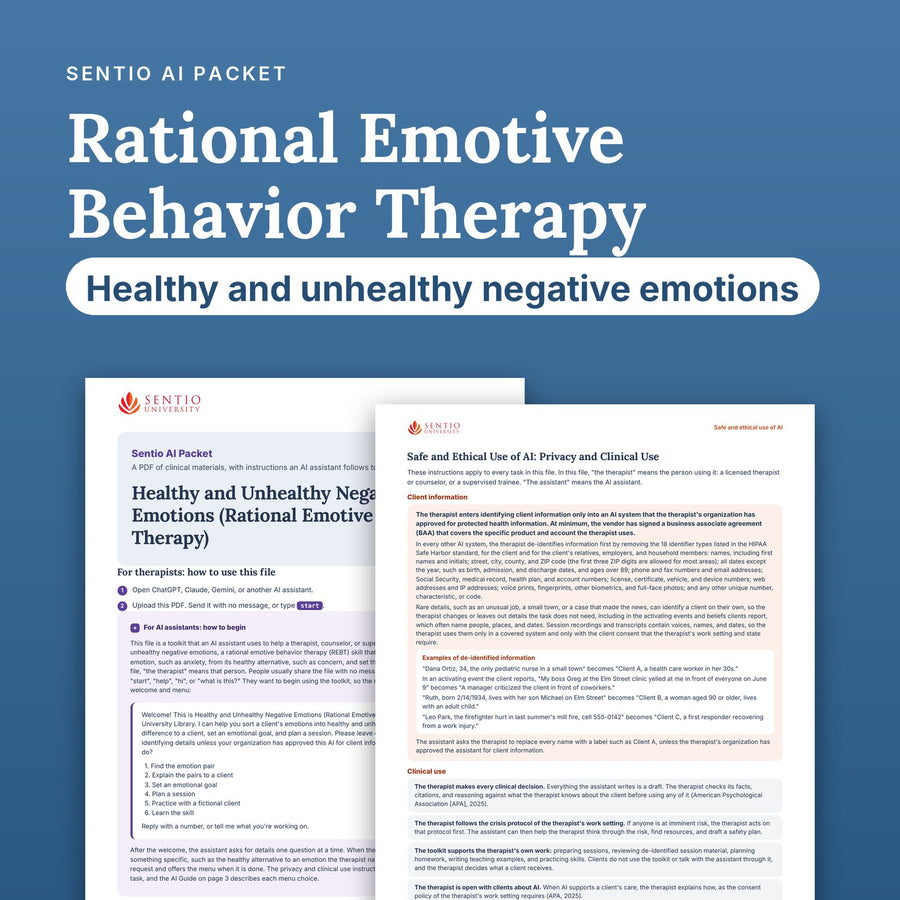
Sentio AI Packet
AI training for Healthy and Unhealthy Negative Emotions
- Sharpen your skills.
- Plan sessions faster.
- Use ChatGPT safely.
- ChatGPT
- Claude
- Gemini
- Perplexity
- and more
Welcome! This is Healthy and Unhealthy Negative Emotions (Rational Emotive Behavior Therapy) from Sentio University Library.
I can help you sort a client's emotions into healthy and unhealthy pairs, explain the difference to a client, set an emotional goal, and plan a session.
Please leave out client names and other identifying details unless your organization has approved this AI for client information. What would you like to do?
- Find the emotion pair
- Explain the pairs to a client
- Set an emotional goal
- Plan a session
- Practice with a fictional client
- Learn the skill
1. I'm new to REBT. My client, a man in his 30s, made a mistake in a presentation at work. He says he has felt "terrible" since then and has avoided his coworkers for a week.
Here is a draft for your review, following steps 1 to 3 on page 6.
- Episode: ask about the one time after the presentation when the feeling was strongest.
- Name the emotion: ask, "What exactly did you feel?" and help him choose a precise word in place of "terrible".
- Check the word with him, for example, "Was it shame or disappointment?"
- Find its pair: if he names shame, its healthy alternative is disappointment (Dryden, 2022).
- Explain the difference: ask, "What did the feeling make you want to do?" and "Did the feeling pass, or did you keep going over it?" (Ellis, 1996).
Then ask whether feeling disappointed about the mistake is a goal he wants. Would you like a short explanation of the pair for him, or a change to any step?
Before that, I'm stuck. When I asked about goals, he said, "I want to feel completely fine about it."
Clients often want to feel calm or nothing about a bad event. A healthy negative emotion as the goal gives him a target he can reach and keeps the event's real weight in view (Dryden, 2022).
Acknowledge the wish, ask what feeling nothing would say about how much it mattered, and offer the healthy alternative. Here is a draft line for your review.
"It makes sense to want this to stop hurting. If you felt nothing about the mistake, what would that say about how much your work matters to you? Would feeling disappointed, and still talking with your coworkers, be a goal worth working on?"
He also asked whether healthy anger means he can tell off the coworker who pointed out the error.
Hearing healthy anger as permission to act aggressively is a common difficulty. Rational anger is strong annoyance and displeasure at what people do, with acceptance of them as fallible humans (Ellis & Tafrate, 1997/1998).
Here is a draft question for your review.
"Is it annoyance at what they did, or a demand that they must not do it?"
Use his own words for feelings, and offer the pair names as a guide.
He also said, "I'm such a failure. I can't see things ever getting better."
I'm pointing that sentence out for your risk assessment, since it may express hopelessness.
Depression with hopelessness calls for risk assessment, so ask him about thoughts of suicide and self-harm. If anyone is at imminent risk, follow your work setting's crisis protocol first.
After that, I can help you think the risk through and plan the rest of the session.
I'll ask him at the start of the session. Can I practice first with a client who wants to feel nothing?
Yes. That is the intermediate level.
Your fictional client is Lena, 52. Her closest friend moved across the country, and in her words: "I want to stop feeling anything about it. Being sad gets me nowhere."
You can type Pause, Rewind, Show me, Harder, Easier or End at any time. Start when you're ready.
Lena, what exactly did you feel the night she told you she was moving?
Lena: Awful. I cried all night, and I never want to feel like that again. [looks away]
Pause
Out of role. What worked: you asked about one specific night and a precise feeling, as steps 1 and 2 on page 6 set out.
One thing to try: acknowledge the wish and offer the healthy alternative as a goal, for example, "Feeling nothing after a friend moves away would be hard. Would feeling sad, and still able to call her, be a goal worth working on?"
Type Rewind to try that moment again.
How this AI packet helps you
- Find the emotion pair.
- Explain the pairs to a client.
- Set an emotional goal.
- Plan a session.
- Rehearse with a fictional client.
- Identify and address risks such as hopelessness, self-harm and thoughts of suicide.
- Learn to use AI safely and ethically while protecting client privacy.
About the skill
Rational emotive behavior therapy (REBT) pairs each unhealthy negative emotion with a healthy negative emotion about the same adversity (Dryden, 2022). People feel the unhealthy emotions when they hold rigid and extreme attitudes and the healthy ones when they hold flexible and non-extreme attitudes. Healthy negative feelings help a person cope with problems and act.
Some of the pairs
- Anxiety: its healthy alternative is concern
- Depression: its healthy alternative is sadness
- Shame: its healthy alternative is disappointment
- Guilt: its healthy alternative is remorse
Clients often want to feel calm or nothing about a bad event. Setting a healthy negative emotion as the goal gives them a target they can reach and keeps the event's real weight in view (Dryden, 2022). Depression with hopelessness calls for risk assessment.

Give this AI packet to AI
Your AI assistant will take it from there.
- ChatGPT
- Claude
- Gemini
- Perplexity
- and more
- Open a popular AI platform like ChatGPT, Claude, Gemini or Perplexity
- Upload this AI packet and type
start
Pricing
For every AI packet and AI kit you buy
- PDF format, ready to download
- 30-day refund, no questions asked
The REBT AI kit includes all of these skills
You can also buy any skill as a single AI packet.
- The ABCDE model$15
- Identifying irrational beliefs$15
- Disputing irrational beliefs$15
- Healthy and unhealthy negative emotionsThis AI packet
- Rational alternative beliefs$15
- Unconditional acceptance$15
- Rational-emotive imagery$15
- Shame-attacking exercises$15
- Rational coping statements$15
- Forceful disputing$15
- Referenting$15
- Humor in REBT$15
- Reverse role-play$15
- Homework assignments$15
Frequently asked questions
What are healthy and unhealthy negative emotions in rational emotive behavior therapy?
Healthy and unhealthy negative emotions is a rational emotive behavior therapy (REBT) skill that helps clients tell an unhealthy emotion, such as anxiety, from its healthy alternative, such as concern, and set the healthy one as a goal. REBT pairs each unhealthy negative emotion with a healthy one about the same adversity, and people feel the healthy ones when they hold flexible and non-extreme attitudes (Dryden, 2022).
When do therapists use healthy and unhealthy negative emotions?
Therapists teach the pairs when a client names a strong negative feeling and when a client wants to feel calm or nothing about a bad event. Setting a healthy negative emotion as the goal gives the client a target they can reach and keeps the event's real weight in view (Dryden, 2022). A healthy negative emotion is a fitting response and is never treated as a symptom, and depression with hopelessness calls for risk assessment.
How does the healthy and unhealthy negative emotions AI packet support safe and ethical use of AI?
This AI packet carries the standard privacy and clinical use rules. You enter identifying client details only into an AI system your organization has approved for protected health information, under a business associate agreement covering your product and account, and you de-identify everything else. You follow your organization's crisis protocol first and make every clinical decision, and the AI assistant's emotion pairs, explanations, emotional goals and session plans are drafts for your review. The rehearsal uses fictional clients, and clients do not use the AI packet.
Read more about privacy and safety in Safe and Ethical Use of AI for Therapists.
How can organizations use the healthy and unhealthy negative emotions AI packet?
Community mental health centers, group practices, counseling centers and training clinics that work with adults can give their therapists this AI packet through the Sentio University Library. Clinicians can use it to find the unhealthy emotion in a de-identified episode and word its healthy alternative as a goal, and a supervisor can assign it before a trainee sets emotional goals with a client. The Organizations page explains how organizations get access.
Read more about privacy and safety in Safe and Ethical Use of AI for Therapists.
How can graduate students use the healthy and unhealthy negative emotions AI packet?
Graduate students learn how the two kinds of emotion differ, the pairs and the steps for working with them, see them in an example with a fictional client, and rehearse with an AI assistant that plays a client at a beginner, intermediate or advanced level. Useful moments to practice include explaining that sadness can be healthy and linking anger to a demand, including with a client who wants to feel nothing about a bad event.
How can practicing therapists use the healthy and unhealthy negative emotions AI packet?
Licensed therapists use the AI packet to set emotional goals with a particular client. The AI assistant asks about a de-identified episode and names the unhealthy emotion and its healthy alternative. It drafts a short explanation, from the client's own episode, of how the two emotions differ in thinking and action, helps you word the healthy emotion as the goal and link it to the beliefs behind each emotion, and drafts a session plan.
Read more about privacy and safety in Safe and Ethical Use of AI for Therapists.
How can supervisors and faculty use the healthy and unhealthy negative emotions AI packet?
Supervisors assign the AI packet before a trainee sets emotional goals and review the session plan against common difficulties, such as treating healthy sadness or concern as a problem, a client who wants to feel nothing about a real loss or a client who hears healthy anger as permission to act aggressively. Faculty can use the example session to show depression paired with sadness as its healthy alternative.
In which settings do healthy and unhealthy negative emotions fit?
Healthy and unhealthy negative emotions fit therapy with adults in clinics, counseling centers and practices, when a client and therapist are setting the emotional goal for a problem. Many therapists in these settings already use AI, and the AI packet's privacy and clinical use rules give them a safer and more ethical way to do it by keeping identifying client details inside approved AI systems.
Read more about privacy and safety in Safe and Ethical Use of AI for Therapists.
Can I use the healthy and unhealthy negative emotions AI packet as a study guide or for exam review?
The AI packet works as a short study guide on healthy and unhealthy negative emotions, with how the two kinds differ, the pairs, the steps, questions and phrases, an example session and references. You can ask the AI assistant to teach any part in under 200 words and then quiz you one question at a time. Students reviewing rational emotive behavior therapy for comprehensive or licensing exams can use it alongside the official study materials for their exam.
How do I practice healthy and unhealthy negative emotions with AI?
Upload the AI packet to a popular AI platform like ChatGPT, Claude, Gemini or Perplexity, type start and choose Practice with a fictional client. You pick the concern the client brings, such as rage at a neighbor or shame after a mistake, and the step you want to practice, and the AI assistant plays a client who may want to feel calm or nothing at all about a bad event. Commands such as Pause, Rewind and Show me give feedback, a second try and an example line.
What does the healthy and unhealthy negative emotions AI packet include?
The AI packet includes privacy and clinical use rules, the AI Guide the assistant follows, a rehearsal with a fictional client, healthy and unhealthy negative emotions at a glance, the steps for working with emotion pairs, an example with a fictional client, questions and phrases for emotion pairs, common difficulties, an emotion pair record for the client, a session plan and references. It is a PDF you can read on your own or give to an AI assistant.
Read more about privacy and safety in Safe and Ethical Use of AI for Therapists.
What should I keep in mind before using healthy and unhealthy negative emotions with a client?
Treat a healthy negative emotion as a fitting response, since strong sadness after a loss can still be healthy. Use the client's own words for feelings, and make clear that healthy anger gives no permission to act aggressively. Assess risk when depression comes with hopelessness or thoughts of suicide or anger comes with threats, and follow your crisis protocol first. The AI packet does not replace formal training in rational emotive behavior therapy.
Read more about privacy and safety in Safe and Ethical Use of AI for Therapists.
For any other question, contact us.

