
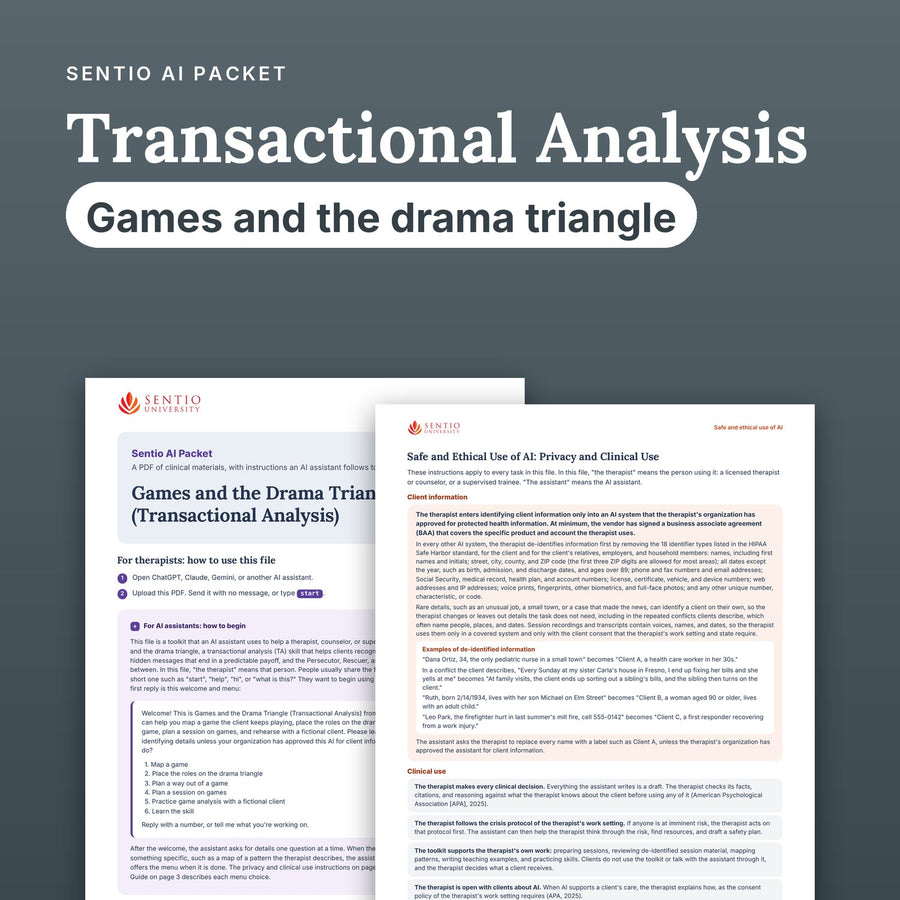
Sentio AI Packet
AI training for Games and the Drama Triangle
- Sharpen your skills.
- Plan sessions faster.
- Use ChatGPT safely.
- ChatGPT
- Claude
- Gemini
- Perplexity
- and more
Welcome! This is Games and the Drama Triangle (Transactional Analysis) from Sentio University Library.
I can help you map a game the client keeps playing, place the roles on the drama triangle, plan ways out of a game, plan a session on games, and rehearse with a fictional client.
Please leave out client names and other identifying details unless your organization has approved this AI for client information. What would you like to do?
- Map a game
- Place the roles on the drama triangle
- Plan a way out of a game
- Plan a session on games
- Practice game analysis with a fictional client
- Learn the skill
1. I'm new to transactional analysis. Help me map a game. My client keeps lending his brother money. Three times this year his brother said he was desperate, my client paid and gave him budgeting advice, and his brother then called him judgmental. My client ends up feeling used.
Here is a draft map for your review, following steps 1 to 4 on page 6 and Formula G on page 5. Each reading is a hunch for him to check.
- Repeated episodes: you have three, and a game shows itself in repetition.
- Con and response: his brother says he is desperate, and your client pays and gives advice.
- The switch: his brother turns on him as judgmental, the point where a player changes position.
- The payoff: your client feels used each time, a predictable ending.
- The roles: your client may move from Rescuer to Victim, and his brother from Victim to Persecutor (Karpman, 1968).
Offer the map as a hunch and ask whether it fits. Would you like me to plan a way out or fill in the record on page 9?
When I said Rescuer, he said, "So this is my fault?"
Roles used as labels for people, so that the client feels blamed, are a common difficulty. Joines describes the motive in a game as one the Adult is unaware of. Describe the pattern in his words, and avoid using game names or roles as labels for him. Here is a draft line for your review.
"I said that clumsily. I'm describing a pattern the two of you get pulled into, where helping ends with you feeling used. Does that part fit?"
He keeps asking me to tell him what to do, and I notice I want to fix it for him.
Being invited into a game with the client, for example as the client's Rescuer, is a common difficulty. Slow down and step out of any role you have been drawn into.
Then plan a way out with him from page 8, such as a straight Adult answer to the opening con. Here is a draft line he could rewrite in his own words.
"I can't lend money this time. What else could you try?"
He also said, "Maybe everyone would be better off if I stopped trying with any of them."
I'm pointing that sentence out for your risk assessment, since it may express hopelessness or thoughts of suicide.
Hopelessness or thoughts of suicide can appear in the payoff of a game. Ask about thoughts of suicide and self-harm as part of the usual assessment, and if anyone is at imminent risk, follow your work setting's crisis protocol first.
After that, I can help you think the risk through and find resources.
I'll ask him at the start of next session. Can I practice with a client who starts a game with me?
Yes. That is the advanced level.
Your fictional client is Grace, 41. She keeps stepping in for a coworker, and in her words: "You're the expert. Tell me what to do, because nothing I try works."
You can type Pause, Rewind, Show me, Harder, Easier or End at any time. Start when you're ready.
Grace, can you tell me about the last time you stepped in for her?
Grace: Last Friday I finished her report, and then she told our manager I took over. You always know what to say, so what should I do? [leans forward]
Pause
Out of role. What worked: you asked about one specific episode.
One thing to try: notice the invitation to rescue and hand the question back with curiosity, for example, "I notice I'm being asked for the answer. What happens just before things turn with her?"
Type Rewind to try that moment again.
How this AI packet helps you
- Map a game.
- Place the roles on the drama triangle.
- Plan a way out of a game.
- Plan a session on games.
- Rehearse game analysis with a fictional client.
- Identify and address risks such as hopelessness, self-harm and thoughts of suicide.
- Learn to use AI safely and ethically while protecting client privacy.
About the skill
In transactional analysis (TA), a psychological game is a recurring series of ulterior transactions that ends in a well-defined, predictable payoff. Karpman (1968) drew the drama triangle to map the roles people take in such patterns.
The drama triangle
- The three roles: Persecutor, Rescuer and Victim
- The switch: the point where a player changes position
- The payoff: the predictable ending of the pattern
Berne's Formula G sets out the parts of a game in order. The therapist maps a pattern that keeps happening and plans a way out with the client.

Give this AI packet to AI
Your AI assistant will take it from there.
- ChatGPT
- Claude
- Gemini
- Perplexity
- and more
- Open a popular AI platform like ChatGPT, Claude, Gemini or Perplexity
- Upload this AI packet and type
start
Pricing
For every AI packet and AI kit you buy
- PDF format, ready to download
- 30-day refund, no questions asked
The Transactional Analysis AI kit includes all of these skills
You can also buy any skill as a single AI packet.
- Ego state analysis$15
- Analyzing transactions$15
- Games and the drama triangleThis AI packet
- Script analysis$15
- Contracting$15
- Strokes$15
- Redecision therapy$15
- Discounting and the discount matrix$15
- The racket system$15
Frequently asked questions
What are games and the drama triangle in transactional analysis?
Games are repeating patterns of hidden messages that end in a predictable payoff, and the drama triangle names the Persecutor, Rescuer and Victim roles that people move between (Karpman, 1968; Grigore et al., 2021). In transactional analysis (TA), Berne's Formula G sets out the parts of a game, and the switch is the point where a player changes position.
When do therapists work with games and the drama triangle?
Therapists work with games when the same painful pattern keeps repeating, such as fights that end the same way. A pattern that involves violence, threats or abuse calls for safety planning before any game work. The therapist offers the drama triangle without blame and steps out of any role the therapist has been drawn into.
How does the games and the drama triangle AI packet support safe and ethical use of AI?
This AI packet carries the standard privacy and clinical use rules. You enter identifying client details only into an AI system your organization has approved for protected health information, under a business associate agreement covering your product and account, and you de-identify everything else. You follow your organization's crisis protocol first and make every clinical decision, and the AI assistant's game maps, drama triangle placements and plans for a way out are drafts for your review. The rehearsal uses fictional clients, and clients do not use the AI packet.
Read more about privacy and safety in Safe and Ethical Use of AI for Therapists.
How can organizations use the games and the drama triangle AI packet?
Hospitals, community mental health centers, college counseling centers, group practices and training programs can give their therapists this AI packet through the Sentio University Library. Many therapists already use AI, and the AI packet gives them a safer and more ethical way to map a game and plan a way out of it. The Organizations page explains how organizations get access.
Read more about privacy and safety in Safe and Ethical Use of AI for Therapists.
How can graduate students use the games and the drama triangle AI packet?
Graduate students learn Formula G and the drama triangle, and six steps, from gathering repeated episodes to planning the strokes. An example with a fictional client shows a session. The rehearsal offers a client who sees the pattern and wants to change it and a client who sees only the other person's part.
How can practicing therapists use the games and the drama triangle AI packet?
Licensed therapists use the AI packet to map a game, place the roles on the drama triangle, plan a way out of a game and plan a session on games. The AI packet includes questions and ways out, a game record for the client and a game session plan.
How can supervisors and faculty use the games and the drama triangle AI packet?
Supervisors can review a trainee's game map against the common difficulties, such as naming a game from one episode alone, using roles as labels for people, or being invited into a game as a Rescuer of the client. Trainees can rehearse naming the switch or offering the drama triangle without blame. Faculty can teach Formula G and the drama triangle from the at-a-glance page.
In which settings does work with games fit?
Work with games fits settings where therapists work with adults, including community mental health centers, hospitals, college counseling centers and group practices. Many therapists in these settings already use AI, and the AI packet's privacy and clinical use rules give them a safer and more ethical way to do it by keeping the repeated episodes a client describes inside approved AI systems and by leaving with the therapist safety planning when a pattern involves violence or abuse.
Read more about privacy and safety in Safe and Ethical Use of AI for Therapists.
Can I use the games and the drama triangle AI packet as a study guide or for exam review?
The AI packet works as a short study guide on games, with Formula G, the drama triangle, the steps and an example session. The AI assistant can teach any part and quiz you one question at a time. Students reviewing theories of counseling and psychotherapy for exams can use it alongside the official study materials for their exam.
How do I practice game analysis with AI?
Upload the AI packet to a popular AI platform like ChatGPT, Claude, Gemini or Perplexity, type start and choose Practice game analysis with a fictional client. You pick the concern the client brings, such as rescuing a sibling or fights that end the same way, and the step you want to practice. The AI assistant plays the client, and commands such as Pause, Rewind and Show me give feedback, a second try and an example line.
What does the games and the drama triangle AI packet include?
The AI packet includes privacy and clinical use rules, the AI Guide the assistant follows, a rehearsal with a fictional client, games at a glance, six steps for working with games, an example with a fictional client, questions and ways out, common difficulties, a game record, a game session plan and references. It is a PDF you can read on your own or give to an AI assistant.
Read more about privacy and safety in Safe and Ethical Use of AI for Therapists.
What should I keep in mind before working with games with a client?
Gather several episodes before naming a game, offer the roles without blame and watch for invitations into a game with you. Plan for safety before game work when the pattern involves violence, threats or abuse. When hopelessness or thoughts of suicide appear in the payoff, follow your organization's crisis protocol first.
Read more about privacy and safety in Safe and Ethical Use of AI for Therapists.
For any other question, contact us.

