
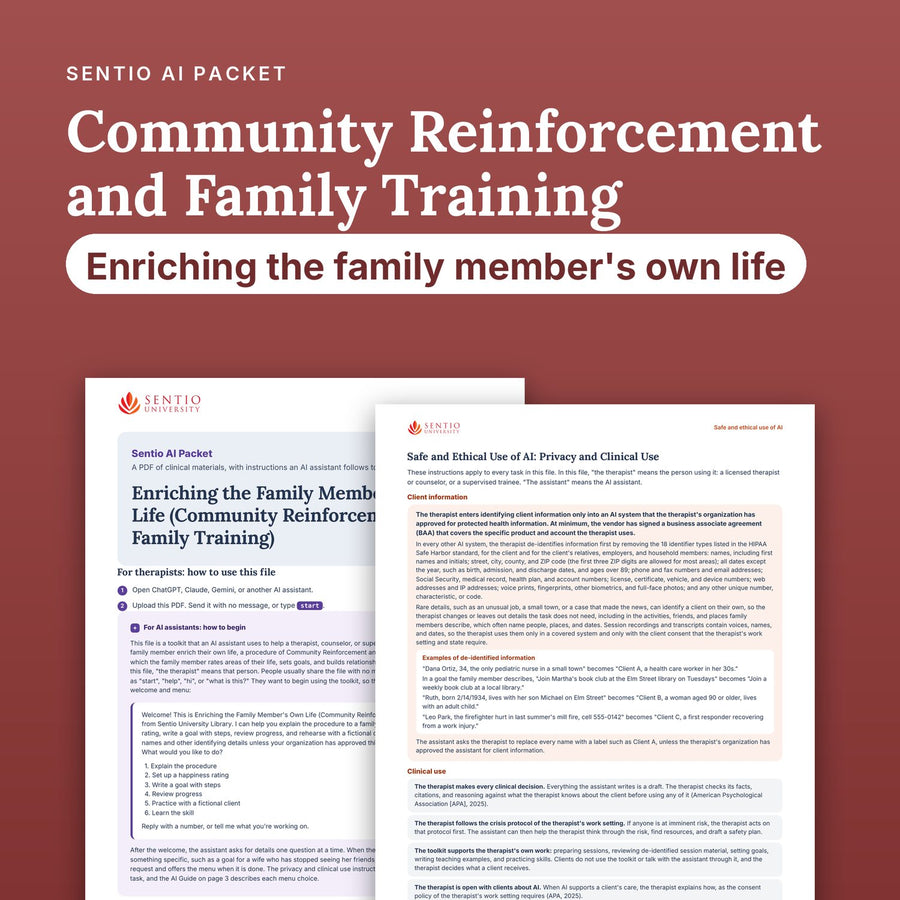
Sentio AI Packet
AI training for Enriching the Family Member's Own Life
- Sharpen your skills.
- Plan sessions faster.
- Use ChatGPT safely.
- ChatGPT
- Claude
- Gemini
- Perplexity
- and more
Welcome! This is Enriching the Family Member's Own Life (Community Reinforcement and Family Training) from Sentio University Library.
I can help you explain the procedure to a family member, set up a happiness rating, write a goal with steps, review progress, and rehearse with a fictional client.
Please leave out client names and other identifying details unless your organization has approved this AI for client information. What would you like to do?
- Explain the procedure
- Set up a happiness rating
- Write a goal with steps
- Review progress
- Practice with a fictional client
- Learn the skill
3. I'm new to CRAFT. Help me write a goal with steps. My client is a man in his 60s whose wife drinks heavily. He rated his social life a 2 out of 10, and he gave up his weekly golf with friends a while ago.
Here is a draft goal plan for your review, following the steps on page 7 and the goal plan on page 10.
- Area and rating: social life, 2 out of 10.
- Goal: play golf with friends once a week for the next four weeks, a goal that is positive, specific, measurable, realistic and under his control (Miller et al., 2019; Roozen & Smith, 2022).
- This week's step: call one friend and book a time to play (Roozen & Smith, 2022).
- Obstacles and plans: what might get in the way, and what he will do then (Meyers et al., 2011).
- Safety check: any risk that his going out raises at home.
- Review: what happened, and the next step, at the next session (Meyers et al., 2011).
Explain that this work aims at his own life, whatever his wife decides (Meyers et al., 2011). Would you like me to set up the full happiness rating or change any part?
When we got to family, he said his goal is "for her to stop drinking so we can travel again."
A goal that depends on the loved one changing is a common difficulty. Keep the goal under his control (Miller et al., 2019; Roozen & Smith, 2022). Here is a draft line for your review.
"Is this something you can do whatever she does?"
A goal such as planning one day trip of his own this month stays in his hands.
He also said, "It feels selfish to go play golf while she's at home drinking."
A family member who feels selfish or guilty taking time for himself is a common difficulty. Research supports gains in the family member's own wellbeing whether or not the loved one enters treatment (Meyers et al., 2011). Here is a draft line for your review.
"This is hard work, and you need things in your life that keep you going."
On the full rating he gave almost every area a 1 or 2, and he said, "There's nothing left for me."
I'm pointing that out for your risk assessment, since low ratings across many areas and that sentence may express hopelessness.
Ask about his mood, sleep and thoughts of suicide or self-harm. If anyone is at imminent risk, follow your work setting's crisis protocol first.
After that, I can help you think the risk through and adjust the goal plan.
I'll ask him now. Later, can I practice with a family member who says there is no time?
Yes. That is the intermediate level.
Your fictional client is Paula, 45. Her husband drinks most nights, and she works full time and cares for her mother. In her words: "I don't have a spare minute for myself."
You can type Pause, Rewind, Show me, Harder, Easier or End at any time. Start when you're ready.
Paula, from 1 to 10, how happy are you with your social life right now?
Paula: A 1, maybe. When would I even see anyone? Every hour is spoken for. [rubs her eyes]
Pause
Out of role. What worked: you started with the 1 to 10 rating.
One thing to try: keep the goal small and concrete, for example, "What is one small thing you could do for yourself this week, even for 20 minutes?"
Type Rewind to try that moment again.
How this AI packet helps you
- Explain the procedure to a family member.
- Set up a happiness rating.
- Write a goal with steps.
- Review progress.
- Rehearse the procedure with a fictional client.
- Identify and address risks such as hopelessness, self-harm and thoughts of suicide.
- Learn to use AI safely and ethically while protecting client privacy.
About the skill
Community Reinforcement and Family Training (CRAFT) helps a concerned family member improve their own wellbeing as well as change how they interact with a loved one who refuses treatment (Roozen & Smith, 2022).
What the procedure involves
- Rate life areas: the family member identifies areas of their own life they want to change, using a happiness scale (Meyers et al., 2011)
- Set goals: goals are stated positively and are specific, measurable, realistic and under the person's control (Miller et al., 2019; Roozen & Smith, 2022)
The therapist sets up the rating with the family member, writes one goal with steps and reviews progress each week.
The work goes ahead whether or not the loved one enters treatment.

Give this AI packet to AI
Your AI assistant will take it from there.
- ChatGPT
- Claude
- Gemini
- Perplexity
- and more
- Open a popular AI platform like ChatGPT, Claude, Gemini or Perplexity
- Upload this AI packet and type
start
Pricing
For every AI packet and AI kit you buy
- PDF format, ready to download
- 30-day refund, no questions asked
The CRAFT AI kit includes all of these skills
You can also buy any skill as a single AI packet.
- Functional analysis of the loved one's use$15
- Domestic violence precautions$15
- Positive communication$15
- Rewarding sober behavior$15
- Allowing natural consequences$15
- Inviting the loved one to treatment$15
- Enriching the family member's own lifeThis AI packet
Frequently asked questions
What is enriching the family member's own life in Community Reinforcement and Family Training?
Enriching the family member's own life is a procedure of Community Reinforcement and Family Training (CRAFT) in which the family member rates areas of their life, sets goals and builds relationships and activities of their own. Self-care in CRAFT focuses on the family member's relationships and activities independent of the loved one (Kirby et al., 2017). Research supports gains in the family member's own wellbeing whether or not the loved one enters treatment (Meyers et al., 2011).
When do therapists help a family member enrich their own life?
Therapists use the procedure to support the family member's own wellbeing alongside the other CRAFT procedures (Roozen & Smith, 2022), and the therapist checks progress on goals at each review (Meyers et al., 2011). The therapist watches for a loved one who reacts with anger or control when the family member goes out, and asks about the family member's mood, sleep and thoughts of suicide or self-harm.
Read more about privacy and safety in Safe and Ethical Use of AI for Therapists.
How does the enriching the family member's own life AI packet support safe and ethical use of AI?
This AI packet carries the standard privacy and clinical use rules. You enter identifying client details only into an AI system your organization has approved for protected health information, under a business associate agreement covering your product and account, and you de-identify everything else. You follow your organization's crisis protocol first and make every clinical decision, and the AI assistant's explanations, happiness ratings, goals with steps and progress reviews are drafts for your review. The rehearsal uses fictional clients, and clients do not use the AI packet.
Read more about privacy and safety in Safe and Ethical Use of AI for Therapists.
How can organizations use the enriching the family member's own life AI packet?
Addiction treatment programs, hospitals, community mental health centers, military and veterans programs, college counseling centers, group practices and training programs can give their therapists this AI packet through the Sentio University Library. Many therapists already use AI, and the AI packet gives them a safer and more ethical way to set up a happiness rating and write a goal with steps. The Organizations page explains how organizations get access.
Read more about privacy and safety in Safe and Ethical Use of AI for Therapists.
How can graduate students use the enriching the family member's own life AI packet?
Graduate students learn what the procedure involves, including rating life areas, setting goals and planning steps and obstacles, and six steps, from explaining the purpose to reviewing progress. An example with a fictional client shows a session. The rehearsal offers a family member glad to focus on themselves and a family member who says there is no time.
How can practicing therapists use the enriching the family member's own life AI packet?
Licensed therapists use the AI packet to explain the procedure, set up a happiness rating, write a goal with steps and review progress. The AI packet includes coaching lines, a happiness rating of life areas for the family member to complete and a goal plan.
How can supervisors and faculty use the enriching the family member's own life AI packet?
Supervisors can review a trainee's goal plan against the common difficulties, such as a goal that depends on the loved one changing, a goal that is too large, or a family member who feels selfish or guilty taking time for themselves. Trainees can rehearse choosing the first area. Faculty can teach what the procedure involves from the at-a-glance page.
In which settings does enriching the family member's own life fit?
Enriching the family member's own life fits settings that work with families affected by substance use, including addiction treatment programs, community mental health centers, hospitals, college counseling centers and military and veterans programs. Many therapists in these settings already use AI, and the AI packet's privacy and clinical use rules give them a safer and more ethical way to do it by keeping a family member's ratings and goals inside approved AI systems and by leaving the response to low ratings and hopelessness with the therapist.
Read more about privacy and safety in Safe and Ethical Use of AI for Therapists.
Can I use the enriching the family member's own life AI packet as a study guide or for exam review?
The AI packet works as a short study guide on this CRAFT procedure, with rating life areas, setting goals, the steps and an example session. The AI assistant can teach any part and quiz you one question at a time. Students reviewing substance use treatment and work with families for exams can use it alongside the official study materials for their exam.
How do I practice enriching the family member's own life with AI?
Upload the AI packet to a popular AI platform like ChatGPT, Claude, Gemini or Perplexity, type start and choose Practice with a fictional client. You pick what the client brings, such as having given up friends and hobbies, and the step you want to practice. The AI assistant plays the family member, and commands such as Pause, Rewind and Show me give feedback, a second try and an example line.
What does the enriching the family member's own life AI packet include?
The AI packet includes privacy and clinical use rules, the AI Guide the assistant follows, a rehearsal with a fictional client, enriching your own life at a glance, safety in CRAFT, six steps, an example with a fictional client, coaching lines, common difficulties, a happiness rating, a goal plan and references. It is a PDF you can read on your own or give to an AI assistant.
Read more about privacy and safety in Safe and Ethical Use of AI for Therapists.
What should I keep in mind before helping a family member enrich their own life?
Help the family member choose one area and write a small goal that is under their own control. Plan for obstacles such as time, money or guilt. When the loved one reacts with anger or control, or the family member shows low ratings across many areas, hopelessness or thoughts of suicide, follow your organization's crisis protocol first.
Read more about privacy and safety in Safe and Ethical Use of AI for Therapists.
For any other question, contact us.

