
Sentio AI Packet
AI training for Enhancing Motivation for Action
- Sharpen your skills.
- Plan sessions faster.
- Use ChatGPT safely.
- ChatGPT
- Claude
- Gemini
- Perplexity
- and more
Welcome! This is Enhancing Motivation for Action (Problem-Solving Therapy) from Sentio University Library.
I can help you spot low motivation and hopelessness, guide the consequences comparison, write a visualization script, plan when to use the tools, and rehearse with a fictional client.
Please leave out client names and other identifying details unless your organization has approved this AI for client information. What would you like to do?
- Spot low motivation and hopelessness
- Guide the consequences comparison
- Write a visualization script
- Plan the tool kit
- Practice motivation work with a fictional client
- Learn the skill
2. I'm new to PST. Help me guide the comparison for my client. He's in his 30s, planned to apply for three jobs, and has put off sending any of them for two weeks.
Here is a draft comparison for your review, with room for his own words.
- Action plan: send three job applications this week.
- If he puts it off: ask, "If nothing changes, what happens next month?" and "What does putting it off cost you now?"
- If he acts, even partly: ask, "What could happen if you send them, even if a single one gets a reply?"
- What the lists tell him: compare them together, and revise the plan if the comparison favors putting it off (Nezu & Nezu, 2019).
- Practice: the day he will send the first application, with a minute of visualization beforehand.
Ask about hopelessness and thoughts of suicide before motivation work, since hopelessness can signal risk. Would you like me to write a visualization script next?
When we tried it, his outcomes list said, "I either get a job or I've wasted my time."
An outcomes list that leaves out partial success is a common difficulty, since it makes acting look all or nothing. Step 3 lists the outcomes possible if the plan is carried out, including if it partly succeeds (Nezu & Nezu, 2019). Here is a draft question for your review.
"Suppose you send all three and hear back from one. What would that give you?"
Add each answer to his list, so the comparison stays honest.
Then I tried visualization, and he spent the whole time planning his interview answers.
Visualization that drifts into planning how the problem was solved is a common difficulty. Guide him to imagine having already solved the problem and to notice the feelings of success, leaving aside how it was solved (Nezu & Nezu, 2019; Nezu et al., 2013). Here is a draft prompt for your review.
"Imagine it's three months from now and you're settled in a job. Leave aside how you got there. Where are you, and what do you feel?"
He also said, "Nothing is ever going to change for me, so why bother?"
I'm pointing that remark out for your risk assessment, since it may express hopelessness.
Hopelessness can signal risk, so ask about thoughts of suicide and self-harm before motivation work. If anyone is at imminent risk, follow your work setting's crisis protocol first, and safety planning comes before work on other problems.
For a client who feels particularly hopeless, visualization can come early in treatment (Nezu et al., 2013). After the risk assessment, I can help you plan that.
I'll ask him first thing. Can I practice with a client who says there's no point?
Yes. That is the intermediate level.
Your fictional client is Aaliyah, 29. She planned to call her doctor's office about a missed appointment and has put it off for two weeks, and in her words: "What's the point? They'll make me wait months anyway."
You can type Pause, Rewind, Show me, Harder, Easier or End at any time. Start when you're ready.
Aaliyah, it sounds like that call has been weighing on you. What might happen if you leave it another week?
Aaliyah: I'd keep feeling bad about it, I guess. [shrugs] And I'd still need the appointment.
Pause
Out of role. What worked: you acknowledged the weight of the call before asking about costs.
One thing to try: invite the other list too, for example, "And if you call this week, even if they offer a date a month away, what might that give you?"
Type Rewind to try that moment again.
How this AI packet helps you
- Spot low motivation and hopelessness.
- Guide a comparison of consequences for an action plan.
- Get a short visualization script.
- Plan when to use each tool in treatment.
- Rehearse motivation work with a fictional client.
- Identify and address risks such as hopelessness, self-harm and thoughts of suicide.
- Learn to use AI safely and ethically while protecting client privacy.
About the skill
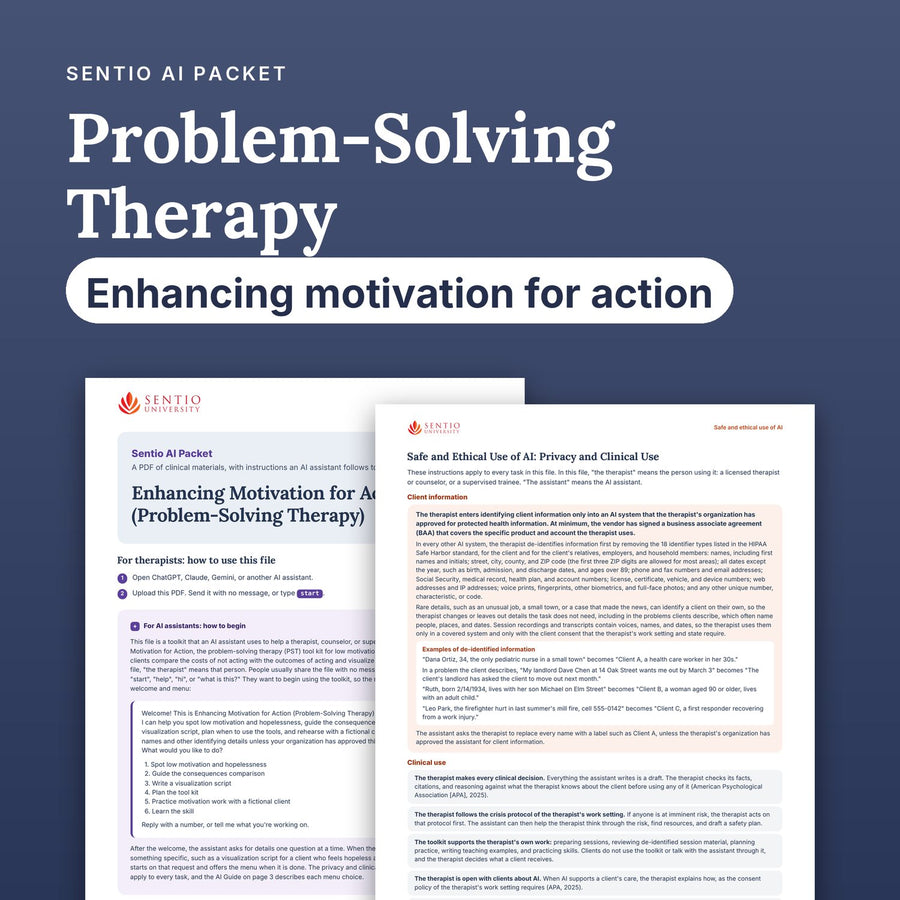
Enhancing Motivation for Action is the tool kit in problem-solving therapy (PST) for overcoming low motivation and feelings of hopelessness, which can make clients want to give up on a problem (Nezu & Nezu, 2019).
The two tools
- Comparing consequences: when a client hesitates to carry out an action plan, the client lists the consequences of not carrying it out and the outcomes possible if it is carried out and partly succeeds
- Visualizing success: to reduce hopelessness, the client uses visualization to experience in the mind's eye what it feels like to have solved the problem
Comparing the two lists can raise motivation or show that the plan needs revising. The therapist watches for hopelessness throughout and follows the work setting's crisis protocol when risk is present.

Give this AI packet to AI
Your AI assistant will take it from there.
- ChatGPT
- Claude
- Gemini
- Perplexity
- and more
- Open a popular AI platform like ChatGPT, Claude, Gemini or Perplexity
- Upload this AI packet and type
start
Pricing
For every AI packet and AI kit you buy
- PDF format, ready to download
- 30-day refund, no questions asked
The Problem-Solving Therapy AI kit includes all of these skills
You can also buy any skill as a single AI packet.
- Problem orientation$15
- Problem-solving multitasking$15
- Stop and slow down$15
- Enhancing motivation for actionThis AI packet
- Planful problem solving$15
- Guided practice and future forecasting$15
Frequently asked questions
What is Enhancing Motivation for Action in problem-solving therapy?
Enhancing Motivation for Action is the problem-solving therapy (PST) tool kit for overcoming low motivation and feelings of hopelessness, which can make clients want to give up on a problem (Nezu & Nezu, 2019). Clients compare the costs of not acting with the outcomes of acting and visualize a problem already solved.
When do therapists use Enhancing Motivation for Action?
Therapists use this tool kit when a client hesitates to carry out an action plan or feels hopeless about a problem. Visualization to overcome hopelessness may come very early in treatment for a client who feels particularly hopeless (Nezu et al., 2013). Hopelessness can signal risk, so the therapist asks about thoughts of suicide and self-harm before motivation work.
Read more about privacy and safety in Safe and Ethical Use of AI for Therapists.
How does the Enhancing Motivation for Action AI packet support safe and ethical use of AI?
The Enhancing Motivation for Action AI packet carries the standard privacy and clinical use rules. You enter identifying client details only into an AI system your organization has approved for protected health information, under a business associate agreement covering your product and account, and you de-identify everything else. You follow your organization's crisis protocol first and make every clinical decision, and the AI assistant's consequences comparisons, visualization scripts and tool kit plans are drafts for your review. The rehearsal uses fictional clients, and clients do not use the AI packet.
Read more about privacy and safety in Safe and Ethical Use of AI for Therapists.
How can organizations use the Enhancing Motivation for Action AI packet?
Hospitals, community mental health centers, military and veterans programs, college counseling centers, group practices and training programs can give their therapists the Enhancing Motivation for Action AI packet through the Sentio University Library. Many therapists already use AI, and the AI packet gives them a safer and more ethical way to guide the consequences comparison and write a visualization script. The Organizations page explains how organizations get access.
Read more about privacy and safety in Safe and Ethical Use of AI for Therapists.
How can graduate students use the Enhancing Motivation for Action AI packet?
Graduate students learn comparing consequences and visualizing success (Nezu & Nezu, 2019) and six steps, from finding where the client is stuck to setting practice and reviewing. An example with a fictional client shows a session. The rehearsal offers a client who hesitates over one action plan and a client who says there is no point because nothing will change.
How can practicing therapists use the Enhancing Motivation for Action AI packet?
Licensed therapists use the AI packet to spot low motivation and hopelessness, guide the consequences comparison, write a visualization script and plan the tool kit. The AI packet includes questions, prompts and scripts and a motivation record the client fills in with the therapist for each plan the client hesitates over.
How can supervisors and faculty use the Enhancing Motivation for Action AI packet?
Supervisors can review a trainee's work against the common difficulties, such as pushing for action before acknowledging how hard the problem is, an outcomes list that leaves out partial success, or visualization that drifts into planning how the problem was solved. Trainees can rehearse building the lists of consequences or leading visualization. Faculty can teach comparing consequences and visualizing success from the at-a-glance page.
In which settings does Enhancing Motivation for Action fit?
Enhancing Motivation for Action fits settings that treat depression and stress-related problems, including hospitals, community mental health centers, college counseling centers and military and veterans programs. Many therapists in these settings already use AI, and the AI packet's privacy and clinical use rules give them a safer and more ethical way to do it by keeping a client's stalled plans and reasons for hesitating inside approved AI systems and by leaving the risk assessment for hopelessness with the therapist.
Read more about privacy and safety in Safe and Ethical Use of AI for Therapists.
Can I use the Enhancing Motivation for Action AI packet as a study guide or for exam review?
The AI packet works as a short study guide on Enhancing Motivation for Action, with comparing consequences, visualizing success, the steps and an example session. The AI assistant can teach any part and quiz you one question at a time. Students reviewing cognitive-behavioral treatments for exams can use it alongside the official study materials for their exam.
How do I practice Enhancing Motivation for Action with AI?
Upload the AI packet to a popular AI platform like ChatGPT, Claude, Gemini or Perplexity, type start and choose Practice motivation work with a fictional client. You pick the concern the client brings, such as putting off a job search, avoiding a hard conversation or giving up on a health goal, and the step you want to practice. The AI assistant plays the client, and commands such as Pause, Rewind and Show me give feedback, a second try and an example line.
What does the Enhancing Motivation for Action AI packet include?
The AI packet includes privacy and clinical use rules, the AI Guide the assistant follows, a rehearsal with a fictional client, motivation at a glance, six steps, an example with a fictional client, questions, prompts and scripts, common difficulties, a motivation record and references. It is a PDF you can read on your own or give to an AI assistant.
Read more about privacy and safety in Safe and Ethical Use of AI for Therapists.
What should I keep in mind before using Enhancing Motivation for Action with a client?
Acknowledge how hard the problem is before asking for action, include partial success in the outcomes list and revise the plan when the comparison favors not acting. Ask about thoughts of suicide and self-harm before motivation work. When risk appears, or a problem involves current danger such as violence at home, plan for safety and follow your organization's crisis protocol first.
Read more about privacy and safety in Safe and Ethical Use of AI for Therapists.
For any other question, contact us.

