
Sentio AI Packet
AI training for Domestic Violence Precautions
- Sharpen your skills.
- Plan sessions faster.
- Use ChatGPT safely.
- ChatGPT
- Claude
- Gemini
- Perplexity
- and more
Welcome! This is Domestic Violence Precautions (Community Reinforcement and Family Training) from Sentio University Library.
I can help you prepare a violence risk assessment, draft a safety plan, check safety before a planned change at home, and rehearse with a fictional client.
Please leave out client names and other identifying details unless your organization has approved this AI for client information. What would you like to do?
- Prepare a risk assessment
- Draft a safety plan
- Check a planned change
- Write coaching lines
- Practice with a fictional client
- Learn the skill
1. I'm new to CRAFT. Help me prepare a risk assessment. My client is a woman in her 30s whose partner drinks heavily on weekends and refuses treatment. She wants to start changing how she responds to him.
Here are draft questions for your review, following the steps on page 7 and the safety assessment on page 10.
- Past violence: "Has he ever threatened, pushed, hit or hurt you or anyone else? What was the most serious time?" (CCSA, 2017).
- Warning signs: "What do you notice just before things get heated?" (CCSA, 2017).
- Support: "Who could you call, and where could you go?" (CCSA, 2017).
- Children and others in the home: who else could be affected.
- Her wellbeing: her mood and any thoughts of suicide or self-harm.
You could open with "Before we plan any changes at home, I ask everyone about safety." Her safety comes ahead of every other goal, and you review the risk again before each change at home (Kirby et al., 2017; Meyers et al., 2011). Would you like me to draft the safety plan next or change any question?
When I asked, she said, "He's never hit me. He breaks things sometimes, that's all."
A family member who minimizes threats or damage to property is a common difficulty. Ask calmly and specifically about the most serious time (CCSA, 2017). Here is a draft line for your review.
"What is the most serious thing that has happened when he was drinking?"
Record the damage to property under past violence on the safety assessment, and return to safety in later sessions as well.
Next week she wants to stop going out with him on Saturday nights when he drinks.
A planned change at home that goes ahead without a safety check is a common difficulty. Review the risk before she tries it, and adjust or drop the change if the risk is high (Meyers et al., 2011). Here is a draft question for your review.
"How might he react if you stay home on Saturday, and what would you do then?"
Her answer shows whether the change fits her safety plan as it stands.
Then she added, "Last weekend he grabbed my arm and said I'd regret it if I ever left."
I'm pointing that out for your risk assessment, since it describes physical violence and a threat.
CRAFT is not designed for family members who have been involved in domestic violence with the loved one, so decide with her whether CRAFT fits, and put safety planning first (Roozen & Smith, 2022). If anyone is at imminent risk, follow your work setting's crisis protocol first. You can also refer her to violence support professionals for safety planning (Center for Substance Abuse Treatment, 1997).
After that, I can help you think the risk through and draft her safety plan, marked DRAFT FOR THERAPIST REVIEW.
I'll talk with her about it now. Later, can I practice with a client who is frightened and changes the subject?
Yes. That is the advanced level.
Your fictional client is Mei, 41. Her husband drinks most nights and gets loud, and in her words: "I don't want to make things worse by talking about it."
You can type Pause, Rewind, Show me, Harder, Easier or End at any time. Start when you're ready.
Mei, before we plan any changes at home, I ask everyone about safety. Has he ever pushed or threatened you?
Mei: Can we talk about his drinking? That's why I came. [twists her ring]
Pause
Out of role. What worked: you explained that you ask everyone about safety.
One thing to try: name her worry and ask calmly about one specific sign, for example, "We'll talk about his drinking today. To start, what do you notice just before things get heated at home?"
Type Rewind to try that moment again.
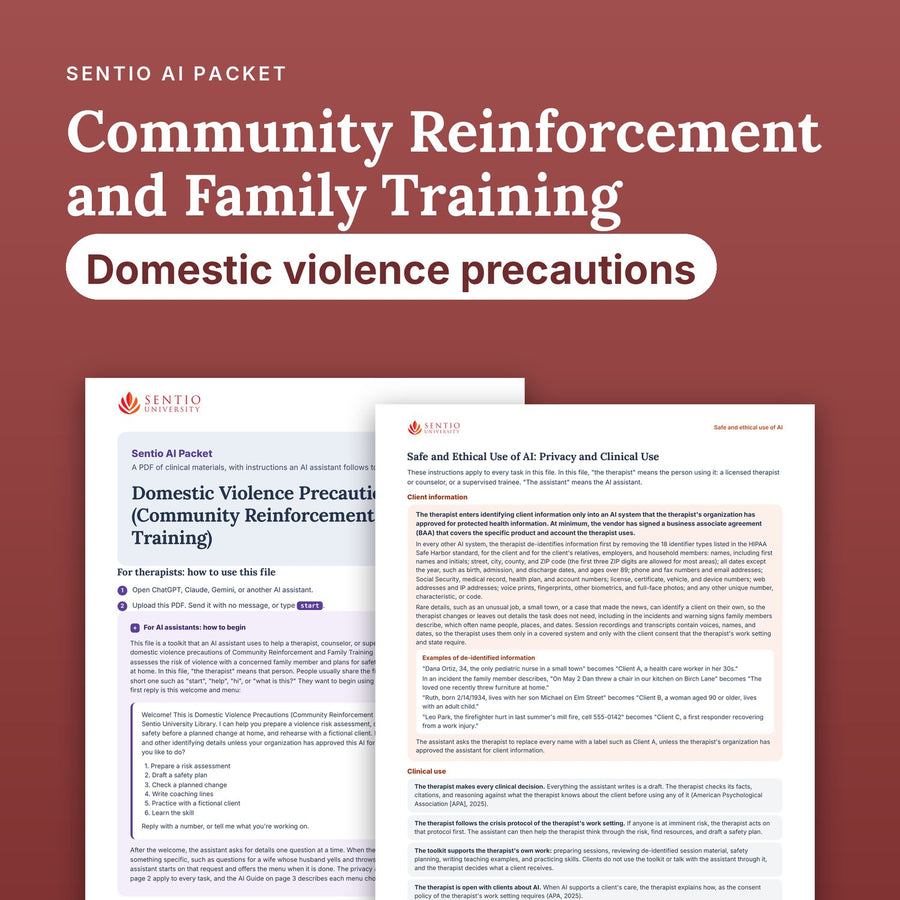
How this AI packet helps you
- Prepare a risk assessment.
- Draft a safety plan.
- Check a planned change for safety.
- Write coaching lines for asking about violence.
- Rehearse the precautions with a fictional client.
- Identify and address risks such as hopelessness, self-harm and thoughts of suicide.
- Learn to use AI safely and ethically while protecting client privacy.
About the skill
In Community Reinforcement and Family Training (CRAFT), a concerned family member changes the way they respond to a loved one who refuses treatment (Meyers et al., 2011). New responses at home can provoke an angry reaction, so safety comes first.
What the precautions involve
- Assess at the start: the therapist assesses the potential for violence and its severity, the family member's social support, and the triggers or warning signs that come before violence (CCSA, 2017)
- Plan safer responses: together they plan safer ways for the family member to respond, and a safety plan
The therapist checks each planned change at home against the assessment before the family member tries it, and follows the work setting's protocol when anyone is at risk.

Give this AI packet to AI
Your AI assistant will take it from there.
- ChatGPT
- Claude
- Gemini
- Perplexity
- and more
- Open a popular AI platform like ChatGPT, Claude, Gemini or Perplexity
- Upload this AI packet and type
start
Pricing
For every AI packet and AI kit you buy
- PDF format, ready to download
- 30-day refund, no questions asked
The CRAFT AI kit includes all of these skills
You can also buy any skill as a single AI packet.
- Functional analysis of the loved one's use$15
- Domestic violence precautionsThis AI packet
- Positive communication$15
- Rewarding sober behavior$15
- Allowing natural consequences$15
- Inviting the loved one to treatment$15
- Enriching the family member's own life$15
Frequently asked questions
What are domestic violence precautions in Community Reinforcement and Family Training?
The domestic violence precautions of Community Reinforcement and Family Training (CRAFT) are the steps in which the therapist assesses the risk of violence with a concerned family member and plans for safety before and during every change at home. New responses at home can provoke an angry reaction, so CRAFT teaches the family member to recognize the signs that come before violence and to take safety measures, and the family member's safety takes priority over every other part of the work (Kirby et al., 2017).
When do therapists use domestic violence precautions?
Therapists assess the potential for violence at the start of CRAFT and discuss the risk again before any change at home, such as withholding a shared activity (Meyers et al., 2011). CRAFT is not designed for family members who have been involved in domestic violence with the loved one (Roozen & Smith, 2022). Where violence is a concern, the therapist can refer the family member to violence support professionals for a safety plan (Center for Substance Abuse Treatment, 1997).
How does the domestic violence precautions AI packet support safe and ethical use of AI?
The domestic violence precautions AI packet carries the standard privacy and clinical use rules. You enter identifying client details only into an AI system your organization has approved for protected health information, under a business associate agreement covering your product and account, and you de-identify everything else. You follow your organization's crisis protocol first and make every clinical decision, and the AI assistant's risk assessments, safety plans and coaching lines are drafts for your review. The rehearsal uses fictional clients, and clients do not use the AI packet.
Read more about privacy and safety in Safe and Ethical Use of AI for Therapists.
How can organizations use the domestic violence precautions AI packet?
Addiction treatment programs, hospitals, community mental health centers, military and veterans programs, college counseling centers, group practices and training programs can give their therapists the domestic violence precautions AI packet through the Sentio University Library. Many therapists already use AI, and the AI packet gives them a safer and more ethical way to prepare a risk assessment and draft a safety plan. The Organizations page explains how organizations get access.
Read more about privacy and safety in Safe and Ethical Use of AI for Therapists.
How can graduate students use the domestic violence precautions AI packet?
Graduate students learn what the precautions involve and six steps, from asking about past violence to checking before each change. An example with a fictional client shows a session. The rehearsal offers a family member who answers openly and a family member who says the loved one only yells.
How can practicing therapists use the domestic violence precautions AI packet?
Licensed therapists use the AI packet to prepare a risk assessment, draft a safety plan, check a planned change and write coaching lines. The AI packet includes coaching lines, a safety assessment to complete with the family member at the start of CRAFT and review before each change, and a safety plan.
How can supervisors and faculty use the domestic violence precautions AI packet?
Supervisors can review a trainee's assessment against the common difficulties, such as a family member who minimizes threats, a therapist who asks once at the start and does not return to safety, or a plan that names no place to go or no person to call. Trainees can rehearse the first question about violence or a minimizing answer. Faculty can teach what the precautions involve from the at-a-glance page.
In which settings do domestic violence precautions fit?
Domestic violence precautions fit settings that work with families affected by substance use, including addiction treatment programs, community mental health centers, hospitals, college counseling centers and military and veterans programs. Many therapists in these settings already use AI, and the AI packet's privacy and clinical use rules give them a safer and more ethical way to do it by keeping a family member's account of violence and the safety plan inside approved AI systems and by leaving every decision about risk with the therapist.
Read more about privacy and safety in Safe and Ethical Use of AI for Therapists.
Can I use the domestic violence precautions AI packet as a study guide or for exam review?
The AI packet works as a short study guide on the CRAFT domestic violence precautions, with what the precautions involve, the steps, coaching lines and an example session. The AI assistant can teach any part and quiz you one question at a time. Students reviewing substance use treatment and work with families for exams can use it alongside the official study materials for their exam.
How do I practice domestic violence precautions with AI?
Upload the AI packet to a popular AI platform like ChatGPT, Claude, Gemini or Perplexity, type start and choose Practice with a fictional client. You pick what the client brings, such as a loved one who yells when drunk, and the step you want to practice. The AI assistant plays the family member, and commands such as Pause, Rewind and Show me give feedback, a second try and an example line.
What does the domestic violence precautions AI packet include?
The AI packet includes privacy and clinical use rules, the AI Guide the assistant follows, a rehearsal with a fictional client, the precautions at a glance, safety in CRAFT, six steps, an example with a fictional client, coaching lines, common difficulties, a safety assessment, a safety plan and references. It is a PDF you can read on your own or give to an AI assistant.
Read more about privacy and safety in Safe and Ethical Use of AI for Therapists.
What should I keep in mind before using domestic violence precautions with a client?
Ask about past violence, warning signs and support at the start, and return to safety before each change at home. Check whether children live in the home, which may bring a duty to report. When the family member is afraid to say more or has thoughts of suicide, or anyone is at imminent risk, follow your organization's crisis protocol first.
Read more about privacy and safety in Safe and Ethical Use of AI for Therapists.
For any other question, contact us.

