
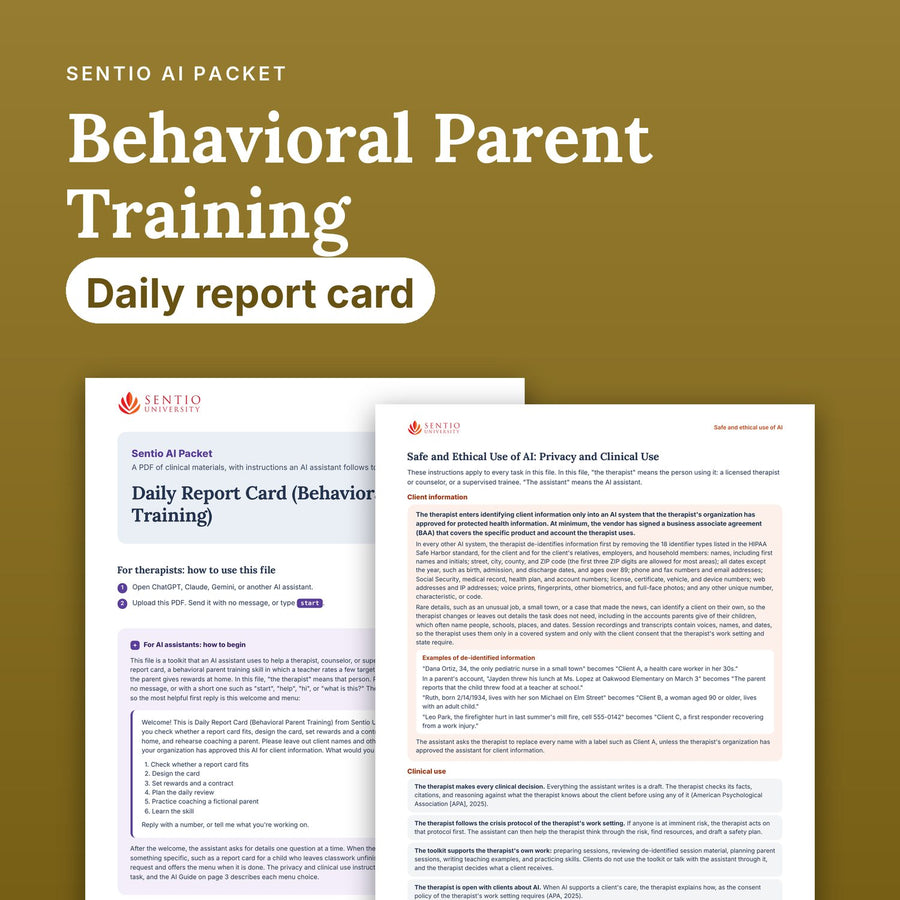
Sentio AI Packet
AI training for Daily Report Card
- Sharpen your skills.
- Plan sessions faster.
- Use ChatGPT safely.
- ChatGPT
- Claude
- Gemini
- Perplexity
- and more
Welcome! This is Daily Report Card (Behavioral Parent Training) from Sentio University Library.
I can help you check whether a report card fits, design the card, set rewards and a contract, plan the daily review at home, and rehearse coaching a parent.
Please leave out client names and other identifying details unless your organization has approved this AI for client information. What would you like to do?
- Check whether a report card fits
- Design the card
- Set rewards and a contract
- Plan the daily review
- Practice coaching a fictional parent
- Learn the skill
2. I'm new to behavioral parent training. A father I'm seeing says his 8-year-old daughter calls out in class and leaves her worksheets unfinished. Her teacher is willing to try a card.
Here is a draft card for your review, following Kelley and Palcic (2009).
- Targets, stated as behaviors to increase: raises her hand before speaking, and finishes her reading worksheet, an academic target.
- Parts of the day: morning, lunch and afternoon.
- Ratings defined in advance: yes means she raised her hand each time, so-so means she called out once or twice, and no means more than that.
- The card: uncluttered and right for her age, with the date, each part of the day with its targets, and space for comments from the teacher and the parent.
- Baseline: at first, she earns a reward for bringing the completed card home.
- Follow-up: meet within two weeks, preferably within one, to check how it is working.
As part of the usual assessment, ask about her safety at home and how he is coping. Would you like me to set rewards and a contract next?
The teacher sent back her own targets: "no calling out" and "no talking."
Targets stated as behaviors to stop are a common difficulty (Kelley & Palcic, 2009). Restate each one as a behavior to increase, with an example, such as "raises her hand to speak" and "works quietly at her desk during reading."
He also said he plans to take away her tablet for every no rating.
Punishing every no rating and reviewing only the bad ratings are common difficulties (Kelley & Palcic, 2009). Here is a draft guide for his daily review.
- Go through the card in the order of the school day.
- Give equal time to positive and negative ratings, starting with praise, such as "You finished your reading worksheet this morning. That's great."
- Treat each no as a problem to solve together: "Afternoon was harder. What got in the way, and what could help tomorrow?"
- Give the promised rewards as agreed, and record them.
What if the teacher says she'll only fill in the card on bad days?
The card works best with cooperative teachers who have structured routines, and a teacher who is likely to use it negatively is one of the cautions on fit (Kelley & Palcic, 2009). Talk with the teacher about rating every day, and if that seems unlikely, I can help you think through other options.
One more thing. He said his daughter told him last night, "I'm stupid, and I wish I wasn't here anymore."
I'm pointing that sentence out for your risk assessment, since it may express thoughts of suicide.
If anyone is at imminent risk, follow your work setting's crisis protocol first. A card may be ineffective with children who are depressed or have serious emotional problems (Kelley & Palcic, 2009), so the card can wait until after your assessment.
After that, I can help you think the risk through and find resources.
I'll call him today. Can I practice with a parent who reacts strongly to bad ratings?
Yes. That is the intermediate level.
Your fictional client is Luis, 39, whose 10-year-old son keeps bringing home no ratings for the afternoon. In his words: "Two no's again. I'm done giving him chances."
You can type Pause, Rewind, Show me, Harder, Easier or End at any time. Start when you're ready.
Luis, let's go through today's card together, starting with the morning.
Luis: Morning says yes for the math sheet. Then look at this afternoon. No, and no. [taps the card]
Pause
Out of role. What worked: you started in the order of the school day.
One thing to try: give the yes rating its own moment of praise before moving on, for example, "Let's stay with the morning for a minute. What could you say to him about finishing that math sheet?"
Type Rewind to try that moment again.
How this AI packet helps you
- Check whether a report card fits.
- Design the card.
- Set rewards and a contract.
- Plan the daily review.
- Rehearse coaching a fictional parent.
- Identify and address risks such as hopelessness, self-harm and thoughts of suicide.
- Learn to use AI safely and ethically while protecting client privacy.
About the skill
A daily report card is a home-based reward system that depends on the child's school performance. It is an explicit component of Barkley's Defiant Children and helps both to manage classroom behavior and to share information between teachers and parents (Kaehler et al., 2016).
When a report card may not fit
- The parent: not recommended with parents who are likely to use it in a negative, erratic or abusive way
- The teacher: not recommended with a teacher who is resistant or likely to use it negatively
Kelley and Palcic (2009) set out these limits. The card names a few target behaviors, the teacher rates them each day, and the parent gives agreed rewards at home.

Give this AI packet to AI
Your AI assistant will take it from there.
- ChatGPT
- Claude
- Gemini
- Perplexity
- and more
- Open a popular AI platform like ChatGPT, Claude, Gemini or Perplexity
- Upload this AI packet and type
start
Pricing
For every AI packet and AI kit you buy
- PDF format, ready to download
- 30-day refund, no questions asked
The Behavioral Parent Training AI kit includes all of these skills
You can also buy any skill as a single AI packet.
- Defining and tracking target behaviors$15
- Positive opposites and praise$15
- Token economies and point charts$15
- Planned ignoring$15
- Time-out from reinforcement$15
- Shaping and rehearsal with parents$15
- Daily report cardThis AI packet
Frequently asked questions
What is the daily report card in behavioral parent training?
The daily report card is a behavioral parent training skill in which a teacher rates a few target behaviors each school day and the parent gives rewards at home. It is a home-based reward system that depends on the child's school performance, and it helps both to manage classroom behavior and to share information between teachers and parents (Kaehler et al., 2016).
When do therapists use the daily report card?
Therapists use a daily report card when a child's behavior or classwork at school is a concern and a cooperative teacher with structured routines can rate it each day. It is not recommended with parents likely to use it in a negative, erratic or abusive way, or with a resistant teacher, and the child must be able to respond to delayed consequences (Kelley & Palcic, 2009). The therapist checks in within a week or two.
How does the daily report card AI packet support safe and ethical use of AI?
The daily report card AI packet carries the standard privacy and clinical use rules. You enter identifying client details only into an AI system your organization has approved for protected health information, under a business associate agreement covering your product and account, and you de-identify everything else. You follow your organization's crisis protocol first and make every clinical decision, and the AI assistant's fit checks, report cards, reward contracts and review guides are drafts for your review. The rehearsal uses fictional clients, and clients do not use the AI packet.
Read more about privacy and safety in Safe and Ethical Use of AI for Therapists.
How can organizations use the daily report card AI packet?
Community mental health centers, group practices, counseling centers and training clinics that work with parents of children with disruptive behavior can give their therapists this AI packet through the Sentio University Library. Clinicians can use it to check whether a daily report card fits a child, parent and teacher and design the card, and a supervisor can assign it before a trainee coaches a parent to set one up. The Organizations page explains how organizations get access.
How can graduate students use the daily report card AI packet?
Graduate students learn when a report card may not fit and the eleven steps for setting one up, see them in an example with a fictional client, and rehearse with an AI assistant that plays a parent at a beginner, intermediate or advanced level. Useful moments to practice include choosing targets, defining ratings and reviewing a card full of no ratings, including with a parent who reacts strongly to bad ratings.
How can practicing therapists use the daily report card AI packet?
Licensed therapists use the AI packet to set up a daily report card with a particular parent. The AI assistant asks about the child, the parent and the teacher and checks the cautions, designs a card with targets for each part of the day and defined yes, so-so and no ratings, helps the parent and child choose daily and weekly rewards and drafts a simple contract, and writes a short guide for the daily review.
How can supervisors and faculty use the daily report card AI packet?
Supervisors assign the AI packet before a trainee coaches a parent to set up a card and review the report card plan against common difficulties, such as targets stated as behaviors to stop, ratings not defined in advance, or a parent who punishes every no rating. Faculty can use the example session to show targets chosen, the school day divided and rating anchors defined with a parent.
In which settings does the daily report card fit?
The daily report card fits work with parents of children with disruptive behavior in clinics, counseling centers and practices, where a cooperative teacher rates the card at school and the parent reviews it at home each day. Many therapists in these settings already use AI, and the AI packet's privacy and clinical use rules give them a safer and more ethical way to do it by keeping identifying client details inside approved AI systems.
Read more about privacy and safety in Safe and Ethical Use of AI for Therapists.
Can I use the daily report card AI packet as a study guide or for exam review?
The AI packet works as a short study guide on the daily report card, with when a report card may not fit, what to expect, the eleven steps for setting one up, phrases for the daily review, an example session and references. You can ask the AI assistant to teach any part in under 200 words and then quiz you one question at a time. Students reviewing behavioral parent training for comprehensive or licensing exams can use it alongside the official study materials for their exam.
How do I practice the daily report card with AI?
Upload the AI packet to a popular AI platform like ChatGPT, Claude, Gemini or Perplexity, type start and choose Practice coaching a fictional parent. You pick the concern the parent brings, such as unfinished classwork or calling out in class, and the step you want to practice, and the AI assistant plays a parent who may react strongly to bad ratings. Commands such as Pause, Rewind and Show me give feedback, a second try and an example line.
What does the daily report card AI packet include?
The AI packet includes privacy and clinical use rules, the AI Guide the assistant follows, a rehearsal with a fictional parent, the daily report card at a glance, the steps for setting up a report card, an example with a fictional client, phrases for the daily review, common difficulties, a daily report card, a report card plan and references. It is a PDF you can read on your own or give to an AI assistant.
Read more about privacy and safety in Safe and Ethical Use of AI for Therapists.
What should I keep in mind before using the daily report card with a client?
Check that the card fits the parent, the teacher and the child before setting it up (Kelley & Palcic, 2009). Plan the daily review with the parent so that it gives equal time to positive and negative behavior and treats no ratings as problems to solve. If a child may be harmed, follow the child-protection and reporting duties of your work setting, and follow your crisis protocol first if risk appears. The AI packet does not replace formal training in behavioral parent training.
Read more about privacy and safety in Safe and Ethical Use of AI for Therapists.
For any other question, contact us.

