
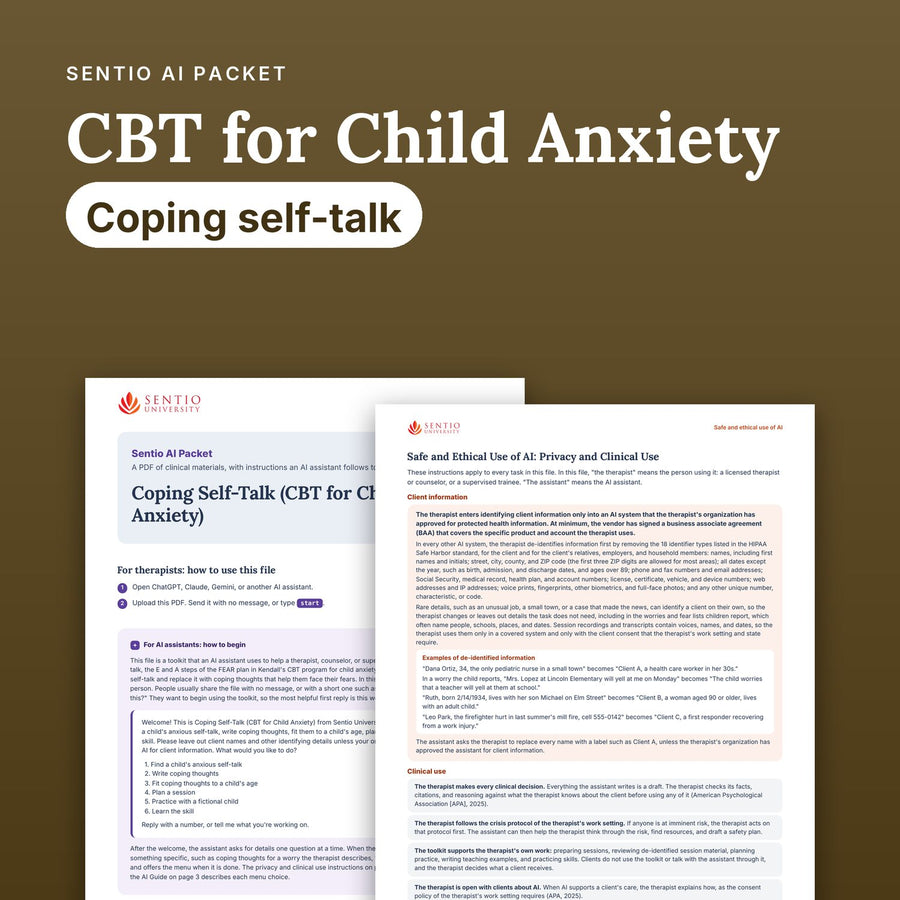
Sentio AI Packet
AI training for Coping Self-Talk
- Sharpen your skills.
- Plan sessions faster.
- Use ChatGPT safely.
- ChatGPT
- Claude
- Gemini
- Perplexity
- and more
Welcome! This is Coping Self-Talk (CBT for Child Anxiety) from Sentio University Library.
I can help you find a child's anxious self-talk, write coping thoughts, fit them to a child's age, plan sessions, and practice the skill.
Please leave out client names and other identifying details unless your organization has approved this AI for client information. What would you like to do?
- Find a child's anxious self-talk
- Write coping thoughts
- Fit coping thoughts to a child's age
- Plan a session
- Practice with a fictional child
- Learn the skill
2. I'm new to CBT for child anxiety. Help me write coping thoughts with my client, who is 10. She has a class trip to a museum next week, and her worry says, "I'll get lost and no one will find me."
Here is a draft plan for your review, in the E and A steps Beidas et al. (2010) describe.
- Catch the thought: write her worry in her words, "I'll get lost and no one will find me." This is the E step, Expecting bad things to happen?
- Get curious: ask how often she has been lost on an outing and what happened then (Beidas et al., 2010).
- Find a coping thought in her own words that helps her face the trip, such as "I can stay with my buddy" or "If I lose my group, I can find a teacher." This is the A step.
- Keep it in view: she writes the thought on a note for her pocket or a keychain (Beidas et al., 2010).
- Practice: she says the thought each morning this week as her Show-That-I-Can task (Beidas et al., 2010).
Before you start, ask her and her parents about low mood, and ask about thoughts of suicide or self-harm if she seems sad or hopeless. Would you like me to fill in the self-talk record or change any step?
Last session she picked "Nothing bad will happen," and I could tell she didn't believe it.
Children often pick a thought they do not believe, or one in adult words, a common difficulty. Ask curious questions and let her choose the words, so the thought is hers.
Here is a draft question for your review.
"What would you tell a friend who was worried about getting lost?"
Then check her thought against four points: it is in her words, short enough to remember, points her toward the trip and fits the facts she found.
She also worries that a group of kids will tease her on the bus, and that one has happened before.
Being teased is a realistic worry, and a realistic worry calls for coping skills (Beidas et al., 2010). Plan coping actions with her, such as what to say and whom to ask for help (Beidas et al., 2010).
Here are draft questions for your review.
"If they tease you on the bus, what could you do?"
"Who on the trip could help you?"
When we wrote down her worries, she added, "I'm stupid. Nothing I do ever works."
I'm pointing that sentence out for your risk assessment, since hopeless or self-critical thoughts can be signs of low mood.
Children with depressive symptoms can learn to tell anxious self-talk from depressive self-talk, with labels such as "my worry voice" and "my hopeless voice" (Beidas et al., 2010). Monitor her mood and assess risk of harm to self with her and her parents (Beidas et al., 2010). If anyone is at imminent risk, follow your work setting's crisis protocol and child protection duties first.
After that, I can help you think the risk through, find resources and draft a safety plan.
I'll check her mood with her and her mom today. Can I practice with a child who says the worry is a fact?
Yes. That is the intermediate level.
Your fictional child is Omar, 9. He starts a swim class on Saturday, and in his words: "I'll do it wrong and the coach will yell at me."
You can type Pause, Rewind, Show me, Harder, Easier or End at any time. Start when you're ready.
Omar, what does your worry say will happen at swim class?
Omar: The coach will yell at me. That always happens. [kicks the chair leg]
Pause
Out of role. What worked: you helped him put the worry into his own words.
One thing to try: get curious about how likely it is, for example, "Have you seen a coach yell at a kid who did something wrong? What happened?"
Type Rewind to try that moment again.
How this AI packet helps you
- Find a child's anxious self-talk.
- Write coping thoughts.
- Fit coping thoughts to a child's age.
- Plan a session.
- Rehearse with a fictional child.
- Identify and address risks such as hopelessness, self-harm and thoughts of suicide.
- Learn to use AI safely and ethically while protecting client privacy.
About the skill
In CBT for child anxiety in the form Kendall's group developed, coping self-talk spans the E step of the FEAR plan, Expecting bad things to happen?, and the A step, Attitudes and actions that can help (Beidas et al., 2010). The child learns to identify anxious thoughts and to generate coping thoughts that help them face the fear.
What the skill involves
- Notice anxious self-talk: the child learns to identify anxious thoughts and how they influence behavior
- Build coping thoughts: coping thoughts often question how realistic a worry is
- Realistic worries: coping thoughts separate realistic worries from unrealistic ones
The therapist fits the coping thoughts to the child's age, with simpler words and playful examples for younger children.

Give this AI packet to AI
Your AI assistant will take it from there.
- ChatGPT
- Claude
- Gemini
- Perplexity
- and more
- Open a popular AI platform like ChatGPT, Claude, Gemini or Perplexity
- Upload this AI packet and type
start
Pricing
For every AI packet and AI kit you buy
- PDF format, ready to download
- 30-day refund, no questions asked
The CBT for Child Anxiety AI kit includes all of these skills
You can also buy any skill as a single AI packet.
- The FEAR plan$15
- Recognizing body signs of anxiety$15
- Coping self-talkThis AI packet
- Show That I Can tasks$15
- Graduated exposure with children$15
- Self-rating and rewards$15
Frequently asked questions
What is coping self-talk in cognitive behavioral therapy for child anxiety?
Coping self-talk spans the E and A steps of the FEAR plan in Kendall's cognitive behavioral therapy (CBT) program for child anxiety. Children notice anxious self-talk, the bad things they expect to happen, and replace it with coping thoughts that help them face their fears. Coping thoughts often question how realistic a worry is (Beidas et al., 2010).
When do therapists use coping self-talk?
Therapists teach coping self-talk in the first half of treatment, and the child uses it later when facing feared situations. Generating coping thoughts can be very difficult for younger children, who can have one go-to thought to turn to, such as "I can do it" (Beidas et al., 2010). A realistic worry, such as being teased, calls for coping actions.
How does the coping self-talk AI packet support safe and ethical use of AI?
The coping self-talk AI packet carries the standard privacy and clinical use rules. You enter identifying client details only into an AI system your organization has approved for protected health information, under a business associate agreement covering your product and account, and you de-identify everything else. You follow your organization's crisis protocol first and make every clinical decision, and the AI assistant's self-talk summaries, coping thoughts, age adaptations and session outlines are drafts for your review. The rehearsal uses fictional clients, and clients do not use the AI packet.
Read more about privacy and safety in Safe and Ethical Use of AI for Therapists.
How can organizations use the coping self-talk AI packet?
Community mental health centers, group practices, counseling centers and training clinics that work with children and families can give their therapists this AI packet through the Sentio University Library. Clinicians can use it to put a child's anxious self-talk into simple words and write coping thoughts, and a supervisor can assign it before a trainee builds coping thoughts with a child. The Organizations page explains how organizations get access.
How can graduate students use the coping self-talk AI packet?
Graduate students learn how children notice anxious self-talk and build coping thoughts, and the steps for teaching both, see them in an example with a fictional client, and rehearse with an AI assistant that plays a child at a beginner, intermediate or advanced level. Useful moments to practice include catching the worried thought, questioning how likely it is and choosing a go-to coping thought, including with a child who gives short answers or wants to stop.
How can practicing therapists use the coping self-talk AI packet?
Licensed therapists use the AI packet to prepare self-talk work for a particular child. The AI assistant drafts the child's anxious self-talk in simple words for you to check with the child, drafts several coping thoughts, some that question how likely the worry is and some that help the child cope, suggests one simple thought for a younger child or thoughts that fit a teen's life, and drafts a session outline with a weekly practice task.
How can supervisors and faculty use the coping self-talk AI packet?
Supervisors assign the AI packet before a trainee builds coping thoughts with a child and review the self-talk record against common difficulties, such as a child who picks a thought the child does not believe, a thought that is too long or in adult words, or a coping thought that dismisses a realistic worry. Faculty can use the example session to show a worried thought caught, checked against what happened to a classmate and answered with a coping thought.
In which settings does coping self-talk fit?
Coping self-talk fits treatment of child anxiety in clinics, counseling centers and practices that work with children and families, built in session and practiced by the child between sessions. Many therapists in these settings already use AI, and the AI packet's privacy and clinical use rules give them a safer and more ethical way to do it by keeping identifying client details inside approved AI systems.
Read more about privacy and safety in Safe and Ethical Use of AI for Therapists.
Can I use the coping self-talk AI packet as a study guide or for exam review?
The AI packet works as a short study guide on coping self-talk, with what the skill involves, what to expect, the steps for building coping self-talk, prompts for self-talk, an example session and references. You can ask the AI assistant to teach any part in under 200 words and then quiz you one question at a time. Students reviewing cognitive behavioral therapy for child anxiety for comprehensive or licensing exams can use it alongside the official study materials for their exam.
How do I practice coping self-talk with AI?
Upload the AI packet to a popular AI platform like ChatGPT, Claude, Gemini or Perplexity, type start and choose Practice with a fictional child. You pick what the child worries about, such as getting sick or making mistakes, the child's age and the step you want to practice, and the AI assistant plays a child who may give short answers or want to stop. Commands such as Pause, Rewind and Show me give feedback, a second try and an example line.
What does the coping self-talk AI packet include?
The AI packet includes privacy and clinical use rules, the AI Guide the assistant follows, a rehearsal with a fictional child, coping self-talk at a glance, the steps for building coping self-talk, an example with a fictional client, prompts for self-talk, common difficulties, safety guidance for work with anxious children, a self-talk record and references. It is a PDF you can read on your own or give to an AI assistant.
Read more about privacy and safety in Safe and Ethical Use of AI for Therapists.
What should I keep in mind before using coping self-talk with a client?
Self-talk work brings worried thoughts into the open, so watch for hopeless or self-critical thoughts as signs of low mood, and check mood and risk with the child and the parents (Beidas et al., 2010). When a worry is realistic, plan coping actions. When a child or parent describes thoughts of suicide or self-harm, abuse or danger, follow the child protection and reporting duties and the crisis protocol of your work setting first. The AI packet does not replace formal training in cognitive behavioral therapy for child anxiety.
Read more about privacy and safety in Safe and Ethical Use of AI for Therapists.
For any other question, contact us.

