
Sentio AI Packet
AI training for Conversational Questions
- Sharpen your skills.
- Plan sessions faster.
- Use ChatGPT safely.
- ChatGPT
- Claude
- Gemini
- Perplexity
- and more
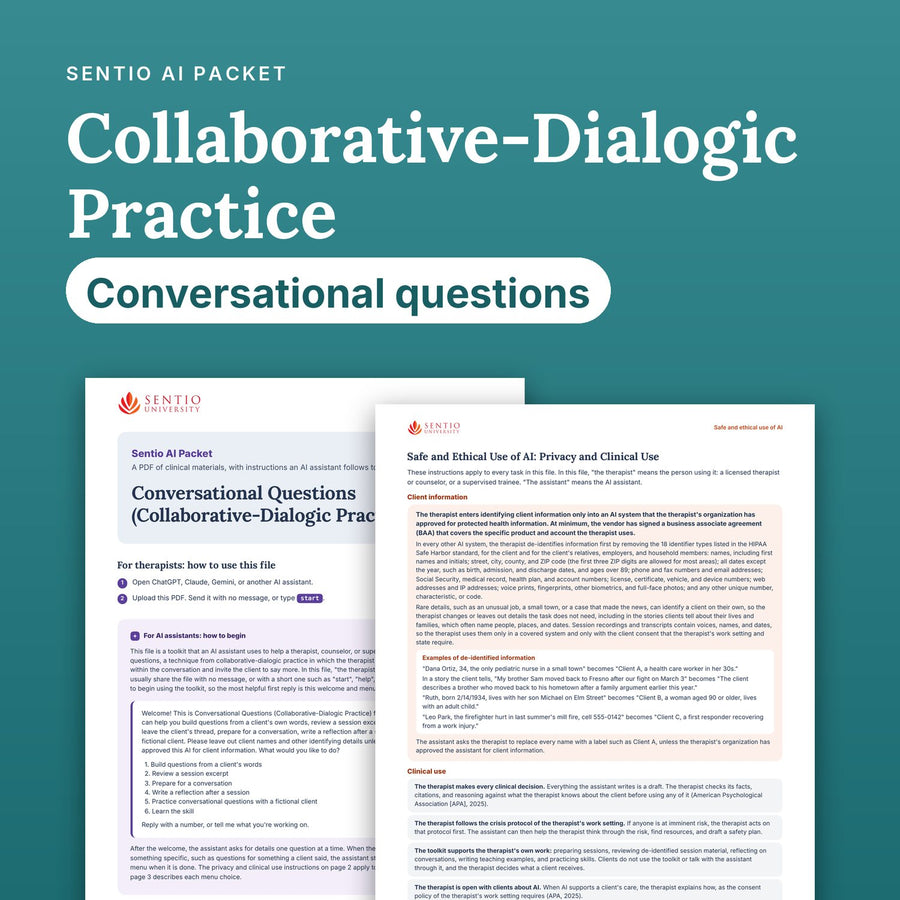
Welcome! This is Conversational Questions (Collaborative-Dialogic Practice) from Sentio University Library.
I can help you build questions from a client's own words, review a session excerpt for questions that follow or leave the client's thread, prepare for a conversation, write a reflection after a session, and rehearse with a fictional client.
Please leave out client names and other identifying details unless your organization has approved this AI for client information. What would you like to do?
- Build questions from a client's words
- Review a session excerpt
- Prepare for a conversation
- Write a reflection after a session
- Practice conversational questions with a fictional client
- Learn the skill
1. I'm new to collaborative-dialogic practice. My client said, "Work has turned into a war zone since the new manager came. I keep my head down." Help me build questions from her words.
Here are draft questions for your review. Each grows out of what she has just said and asks her to say more (Anderson & Burney, n.d.; Anderson, 2012a).
- Key words: "war zone" and "keep my head down."
- "War zone how? What does a day at work look like now?"
- "When you say you keep your head down, what does that look like?"
- "What has changed for you since the new manager came?"
- Check what was heard: "So since the new manager came, work feels like a war zone, and you keep your head down. Did I get that right?"
Ask one at a time and let her answer lead to the next question. Ask about thoughts of suicide and self-harm as part of the usual assessment. Would you like me to fill in the question trail after the session?
I came in with a list of questions about her coping skills, and she kept drifting off.
Questions from a prepared list that pass over what the client just said are a common difficulty. When the client drifts or goes quiet after a question, return to her last words and ask about them (Anderson & Burney, n.d.).
Here is a draft for your review.
"You said work has turned into a war zone. Can you say more about that?"
Keep the plan for next time to themes you are curious about, since the questions themselves come from what she says in the session.
I also asked three questions in a row, and she answered the last one.
Asking several questions at once is a common difficulty, since the client tends to answer the last one and the others drop away. Ask one question built from her words, and wait for her to say more (Anderson & Burney, n.d.).
Here is a draft for your review.
"When you keep your head down at work, what happens for you?"
She also said, "Some mornings I don't see the point of getting up."
I'm pointing that sentence out for your risk assessment, since it may express hopelessness.
When risk appears, ask about it directly. If anyone is at imminent risk, follow your work setting's crisis protocol first.
After that, I can help you think the risk through and find resources.
I'll ask her about it this week. Can I practice with a client who gives short answers?
Yes. That is the intermediate level.
Your fictional client is Andre, 38, whose team at work was reorganized last month. In his words: "Work is fine, I guess. It's different now."
You can type Pause, Rewind, Show me, Harder, Easier or End at any time. Start when you're ready.
How are you coping with the stress at work?
Andre: Okay. [looks away] I manage.
Pause
Out of role. What worked: you asked about the concern he brought.
One thing to try: pick up a single word from his answer and ask about it, for example, "Different how? What is work like now?" Then wait for him to say more.
Type Rewind to try that moment again.
How this AI packet helps you
- Build questions from a client's words.
- Review a session excerpt.
- Prepare for a conversation.
- Write a reflection after a session.
- Rehearse with a fictional client.
- Identify and address risks such as hopelessness, self-harm and thoughts of suicide.
- Learn to use AI safely and ethically while protecting client privacy.
About the skill
Conversational questions is Harlene Anderson's term for questions that come from within the conversation (Anderson & Burney, n.d.). The therapist asks them in a way that encourages the client to say more about what is being discussed, and each one grows out of what the client has just said. They belong to collaborative-dialogic practice, the approach Anderson developed with Harold Goolishian (Anderson & Gehart, 2022).
What conversational questions involve
- From the client's words: each question grows out of what the client has just said
- Inviting more: the question asks the client to say more about what is being discussed
- Checking what was heard: the therapist checks what was heard before assuming it
- Following the client's thread: questions stay with the client's own train of thought
The therapist asks from a curious, learning position, which invites the client into curiosity about the client's own situation (Anderson, 2012a).

Give this AI packet to AI
Your AI assistant will take it from there.
- ChatGPT
- Claude
- Gemini
- Perplexity
- and more
- Open a popular AI platform like ChatGPT, Claude, Gemini or Perplexity
- Upload this AI packet and type
start
Pricing
For every AI packet and AI kit you buy
- PDF format, ready to download
- 30-day refund, no questions asked
The Collaborative-Dialogic Practice AI kit includes all of these skills
You can also buy any skill as a single AI packet.
- Not-knowing stance$15
- Conversational questionsThis AI packet
- Being public$15
Frequently asked questions
What are conversational questions in collaborative-dialogic practice?
Conversational questions are questions that arise from within the conversation and invite the client to say more. Each question grows out of what the client has just said, and the therapist checks what the therapist thinks was heard before assuming it (Anderson & Burney, n.d.; Anderson, 2012a). They belong to collaborative-dialogic practice, the approach Anderson developed with Harold Goolishian (Anderson & Gehart, 2022).
When do therapists use conversational questions?
Therapists ask conversational questions throughout a session, each one picking up the client's own words. Questions that pull the client away from the client's own train of thought work against the approach (Anderson & Burney, n.d.). Questions about safety, such as about suicide, self-harm or violence, are asked directly whenever risk is a concern, as in any assessment.
Read more about privacy and safety in Safe and Ethical Use of AI for Therapists.
How does the conversational questions AI packet support safe and ethical use of AI?
The conversational questions AI packet carries the standard privacy and clinical use rules. You enter identifying client details only into an AI system your organization has approved for protected health information, under a business associate agreement covering your product and account, and you de-identify everything else. You follow your organization's crisis protocol first and make every clinical decision, and the AI assistant's questions built from a client's words, session reviews and reflections are drafts for your review. The rehearsal uses fictional clients, and clients do not use the AI packet.
Read more about privacy and safety in Safe and Ethical Use of AI for Therapists.
How can organizations use the conversational questions AI packet?
Hospitals, community mental health centers, college counseling centers, group practices and training programs can give their therapists the conversational questions AI packet through the Sentio University Library. Many therapists already use AI, and the AI packet gives them a safer and more ethical way to build questions from a client's de-identified words and review a session excerpt. The Organizations page explains how organizations get access.
Read more about privacy and safety in Safe and Ethical Use of AI for Therapists.
How can graduate students use the conversational questions AI packet?
Graduate students learn what conversational questions involve and six steps, from listening to what the client says to sharing the thinking behind a question. An example with a fictional client shows a session. The rehearsal offers a client who talks readily and a client who gives short answers.
How can practicing therapists use the conversational questions AI packet?
Licensed therapists use the AI packet to build questions from a client's words, review a session excerpt, prepare for a conversation and write a reflection after a session. The AI packet includes question patterns, a question trail for the therapist to fill in after a session and a conversation plan.
How can supervisors and faculty use the conversational questions AI packet?
Supervisors can review a trainee's session excerpt against the common difficulties, such as questions that come from a prepared list, several questions arriving at once, or assuming what the client meant (Anderson & Burney, n.d.). Trainees can rehearse the first minutes of a session, a short answer or a moment when the client changes the subject. Faculty can teach what conversational questions involve from the at-a-glance page.
In which settings do conversational questions fit?
Conversational questions fit settings that offer individual, couple and family therapy, including community mental health centers, college counseling centers, group practices and marriage and family therapy training programs. Many therapists in these settings already use AI, and the AI packet's privacy and clinical use rules give them a safer and more ethical way to do it by keeping a client's own words inside approved AI systems and by leaving direct questions about safety with the therapist.
Read more about privacy and safety in Safe and Ethical Use of AI for Therapists.
Can I use the conversational questions AI packet as a study guide or for exam review?
The AI packet works as a short study guide on conversational questions, with what they involve, the steps, question patterns and an example session. The AI assistant can teach any part and quiz you one question at a time. Students reviewing postmodern and social constructionist therapies for exams can use it alongside the official study materials for their exam.
How do I practice conversational questions with AI?
Upload the AI packet to a popular AI platform like ChatGPT, Claude, Gemini or Perplexity, type start and choose Practice conversational questions with a fictional client. You pick the concern the client brings, such as a hard decision or a conflict at work, and the part of the skill you want to practice. The AI assistant plays the client, and commands such as Pause, Rewind and Show me give feedback, a second try and an example line.
What does the conversational questions AI packet include?
The AI packet includes privacy and clinical use rules, the AI Guide the assistant follows, a rehearsal with a fictional client, conversational questions at a glance, six steps for asking the questions, an example with a fictional client, question patterns, common difficulties, a question trail, a conversation plan and references. It is a PDF you can read on your own or give to an AI assistant.
Read more about privacy and safety in Safe and Ethical Use of AI for Therapists.
What should I keep in mind before using conversational questions with a client?
Ask one question at a time, build each question from the client's own words and check what you heard before assuming it. Ask directly about suicide, self-harm or violence whenever risk is a concern. When a client describes risk of harm, follow your organization's crisis protocol first.
Read more about privacy and safety in Safe and Ethical Use of AI for Therapists.
For any other question, contact us.

