
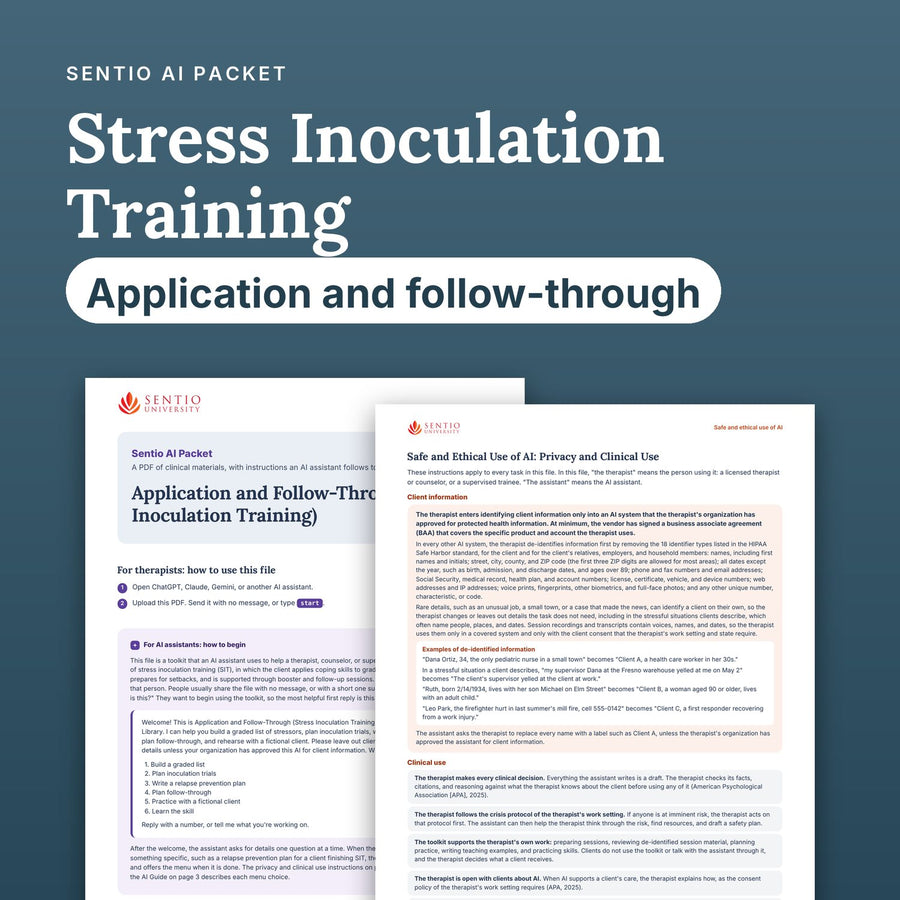
Sentio AI Packet
AI training for Application and Follow-Through
- Sharpen your skills.
- Plan sessions faster.
- Use ChatGPT safely.
- ChatGPT
- Claude
- Gemini
- Perplexity
- and more
Welcome! This is Application and Follow-Through (Stress Inoculation Training) from Sentio University Library.
I can help you build a graded list of stressors, plan inoculation trials, write a relapse prevention plan, plan follow-through, and rehearse with a fictional client.
Please leave out client names and other identifying details unless your organization has approved this AI for client information. What would you like to do?
- Build a graded list
- Plan inoculation trials
- Write a relapse prevention plan
- Plan follow-through
- Practice with a fictional client
- Learn the skill
1. I'm new to SIT. My client went back to college and has test anxiety. She has learned coping skills, and now she wants to use them in class. Help me build a graded list.
Here is a draft graded list for your review, from milder to more demanding stressors (Meichenbaum, 2009). She rates each one from 0 to 10 with you.
- Asking a question in a small class.
- Taking a short practice quiz at home with a timer.
- Taking a short graded quiz in class.
- Giving a five-minute presentation to a study group.
- Taking a midterm exam.
For each step, she pictures it starting and treats the first signs of stress as cues to cope, rehearses in session, and then tries it in real life and reviews the attempt (Meichenbaum, 2007). Before starting, ask about thoughts of suicide and self-harm as part of the usual assessment, along with access to weapons and the risk of being harmed again. Would you like a plan for her first inoculation trial?
She wants to skip straight to the midterm next week.
Steps that jump to stressors that are too demanding are a common difficulty. Inoculation builds coping and confidence on milder stressors so she can handle more demanding ones (Meichenbaum, 2009). Here is a draft question for your review.
"Which of these feels easiest to face? What would be a step in between?"
Keep each step a little harder than the last, and review every attempt.
She did the graded quiz, froze on one question and said, "This whole thing doesn't work for me."
A lapse treated as proof that nothing works is a common difficulty. Relapse prevention prepares for lapses and treats them as chances to learn (Meichenbaum, 2007). Here are draft questions for going over the quiz, for your review.
- "What did you try?"
- "What happened?"
- "What would you do the same or differently?"
Then add the frozen moment to her relapse prevention plan, with its early signs and a coping response to rehearse.
After the quiz she also said, "If I fail again, maybe everyone would be better off without me."
I'm pointing that out for your risk assessment, since hopelessness or thoughts of suicide can follow a setback.
Safety is addressed from the start and throughout, including suicidal behavior, access to weapons and the chance of being harmed again (Meichenbaum, 2019). If anyone is at imminent risk, follow your work setting's crisis protocol first.
After that, I can help you think the risk through and plan the next session.
I'll start there. Can I practice with a client who credits luck for every success?
Yes. That is the advanced level.
Your fictional client is Tomas, 29. He gave a short talk at work for the first time, and in his words: "It went fine because everyone was being nice."
You can type Pause, Rewind, Show me, Harder, Easier or End at any time. Start when you're ready.
Tomas, that sounds like a real step. How did you feel afterward?
Tomas: Relieved, I guess. It was luck. Nobody asked hard questions. [shrugs]
Pause
Out of role. What worked: you named the talk as a step forward.
One thing to try: help him take credit, for example, "What did you do to get ready for it? How did you make that happen?"
Type Rewind to try that moment again.
How this AI packet helps you
- Build a graded list of the client's stressors.
- Plan inoculation trials for the next stressor.
- Write a relapse prevention plan.
- Plan how to phase out sessions, with boosters.
- Rehearse with a fictional client.
- Identify and address risks such as hopelessness, self-harm and thoughts of suicide.
- Learn to use AI safely and ethically while protecting client privacy.
About the skill
Stress inoculation training (SIT) has three overlapping phases (Meichenbaum & Deffenbacher, 1988). In the third, the client applies coping skills on a graduated basis to increasingly demanding stressors, through imagery and behavioral rehearsal, modeling, role play and graded exposure in real life (Meichenbaum, 2007).
What the phase involves
- A graded list: the client's stressors, ordered from milder to more demanding
- Inoculation trials: applying a skill to the next stressor on the list
- Relapse prevention: a plan that names high-risk situations and expected reactions
- Follow-through: phasing out sessions, with boosters and supports
Inoculation means building coping and confidence on milder stressors so the person can handle more demanding ones (Meichenbaum, 2009).

Give this AI packet to AI
Your AI assistant will take it from there.
- ChatGPT
- Claude
- Gemini
- Perplexity
- and more
- Open a popular AI platform like ChatGPT, Claude, Gemini or Perplexity
- Upload this AI packet and type
start
Pricing
For every AI packet and AI kit you buy
- PDF format, ready to download
- 30-day refund, no questions asked
The Stress Inoculation Training AI kit includes all of these skills
You can also buy any skill as a single AI packet.
- Conceptualization phase$15
- Skills acquisition and rehearsal$15
- Application and follow-throughThis AI packet
- Self-instructional training$15
Frequently asked questions
What is application and follow-through in stress inoculation training?
Application and follow-through is the third phase of stress inoculation training (SIT). The client applies coping skills on a graduated basis to increasingly demanding stressors, through imagery and behavioral rehearsal, modeling, role play and graded exposure in real life (Meichenbaum, 2007). Inoculation means building coping and confidence on milder stressors so the person can handle more demanding ones (Meichenbaum, 2009).
When do therapists use application and follow-through?
Therapists move to application once the client has rehearsed coping skills, and keep each step a little harder than the last. Relapse prevention prepares for lapses and treats them as chances to learn (Meichenbaum, 2007). The therapist addresses safety throughout (Meichenbaum, 2019) and checks that a real-life step carries no risk of harm.
How does the application and follow-through AI packet support safe and ethical use of AI?
The application and follow-through AI packet carries the standard privacy and clinical use rules. You enter identifying client details only into an AI system your organization has approved for protected health information, under a business associate agreement covering your product and account, and you de-identify everything else. You follow your organization's crisis protocol first and make every clinical decision, and the AI assistant's graded lists, inoculation trial plans and relapse prevention plans are drafts for your review. The rehearsal uses fictional clients, and clients do not use the AI packet.
Read more about privacy and safety in Safe and Ethical Use of AI for Therapists.
How can organizations use the application and follow-through AI packet?
Hospitals, community mental health centers, military and veterans programs, college counseling centers, group practices and training programs can give their therapists the application and follow-through AI packet through the Sentio University Library. Many therapists already use AI, and the AI packet gives them a safer and more ethical way to build a graded list and write a relapse prevention plan. The Organizations page explains how organizations get access.
Read more about privacy and safety in Safe and Ethical Use of AI for Therapists.
How can graduate students use the application and follow-through AI packet?
Graduate students learn how the third phase fits the three phases of SIT (Meichenbaum & Deffenbacher, 1988) and six steps, from grading the stressors to following through. An example with a fictional client shows a session. The rehearsal offers a client who applied a skill and it went well and a client who had a setback and calls the whole training a failure.
How can practicing therapists use the application and follow-through AI packet?
Licensed therapists use the AI packet to build a graded list, plan inoculation trials, write a relapse prevention plan and plan follow-through. The AI packet includes prompts for application, a graded stressor list the therapist and client build together and a relapse prevention plan.
How can supervisors and faculty use the application and follow-through AI packet?
Supervisors can review a trainee's plan against the common difficulties, such as steps that jump to stressors that are too demanding, application that stays in imagery, or a lapse treated as proof that nothing works. Trainees can rehearse responding to a client after a setback. Faculty can teach the meaning of inoculation from the at-a-glance page.
In which settings does application and follow-through fit?
Application and follow-through fits settings where clients face medical, occupational or traumatic stress, including hospitals, community mental health centers, college counseling centers and military and veterans programs. Many therapists in these settings already use AI, and the AI packet's privacy and clinical use rules give them a safer and more ethical way to do it by keeping a client's graded list and setbacks inside approved AI systems and by leaving the judgment about the risk of each real-life step with the therapist.
Read more about privacy and safety in Safe and Ethical Use of AI for Therapists.
Can I use the application and follow-through AI packet as a study guide or for exam review?
The AI packet works as a short study guide on the application phase of SIT, with the meaning of inoculation, relapse prevention, the steps and an example session. The AI assistant can teach any part and quiz you one question at a time. Students reviewing cognitive-behavioral stress management for exams can use it alongside the official study materials for their exam.
How do I practice application and follow-through with AI?
Upload the AI packet to a popular AI platform like ChatGPT, Claude, Gemini or Perplexity, type start and choose Practice with a fictional client. You pick the stressors the client is ready to face, such as a performance review, a medical procedure or a family gathering, and the step you want to practice. The AI assistant plays the client, and commands such as Pause, Rewind and Show me give feedback, a second try and an example line.
What does the application and follow-through AI packet include?
The AI packet includes privacy and clinical use rules, the AI Guide the assistant follows, a rehearsal with a fictional client, the application phase at a glance, six steps, an example with a fictional client, prompts for application, common difficulties, a graded stressor list, a relapse prevention plan and references. It is a PDF you can read on your own or give to an AI assistant.
Read more about privacy and safety in Safe and Ethical Use of AI for Therapists.
What should I keep in mind before using application and follow-through with a client?
Keep each step a little harder than the last, review every attempt and help the client take credit for improvement (Meichenbaum, 2009). Treat a lapse as a chance to learn (Meichenbaum, 2007). When a real-life step carries a risk of harm, or hopelessness or thoughts of suicide follow a setback, follow your organization's crisis protocol first.
Read more about privacy and safety in Safe and Ethical Use of AI for Therapists.
For any other question, contact us.

