
Sentio AI Packet
AI training for Setting Goals and Maintaining Motivation
- Sharpen your skills.
- Plan sessions faster.
- Use ChatGPT safely.
- ChatGPT
- Claude
- Gemini
- Perplexity
- and more
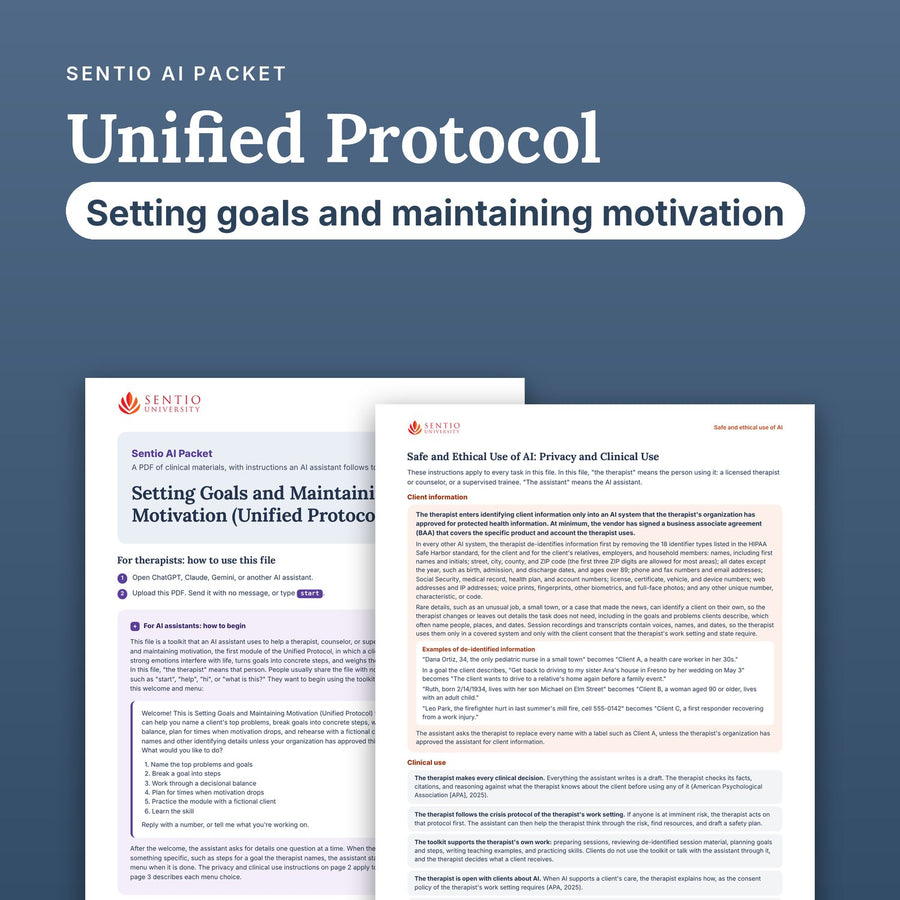
Welcome! This is Setting Goals and Maintaining Motivation (Unified Protocol) from Sentio University Library.
I can help you name a client's top problems, break goals into concrete steps, work through a decisional balance, plan for times when motivation drops, and rehearse with a fictional client.
Please leave out client names and other identifying details unless your organization has approved this AI for client information. What would you like to do?
- Name the top problems and goals
- Break a goal into steps
- Work through a decisional balance
- Plan for times when motivation drops
- Practice the module with a fictional client
- Learn the skill
2. I'm new to the Unified Protocol. Help me break a goal into steps. My client's goal is to "stop feeling so anxious at work," and she stays silent in every team meeting.
Here is a draft for your review, following step 3 of the module, which breaks at least one goal into specific, concrete and manageable steps (Barlow et al., 2018a).
- Make the goal concrete: ask what she would be doing differently at work if the goal were met.
- Write the goal in her words, such as "Speak up in team meetings."
- Step 1: ask one question in the small Monday check-in.
- Step 2: share one idea in the weekly team meeting.
- Step 3: give a short update at the meeting at the end of the month.
- Check each step: she can say what it is and when she will do it.
Would you like me to add these to the goals record or change a step?
She said even step 1 is too much. "I can't ask a question in front of everyone this week."
A step too big for the client to take in the coming week is a common difficulty (Barlow et al., 2018a, 2018b).
Slow down, return to her own reasons for the goal and make the next step smaller. Here are draft questions for your review.
- "How sure are you that you can do it? What would make it more doable?"
- "What is one small thing you could do this week?"
A smaller first step could be saying good morning to one coworker before the Monday check-in.
When I told her how much better work would feel, she argued for staying quiet.
That is a common difficulty: the therapist argues for change, and the client defends staying the same (Barlow et al., 2018a, 2018b).
Return to the decisional balance and draw out her own reasons, in the spirit of Motivational Interviewing (Barlow et al., 2018a). Ask about the costs of staying the same in her own life, and leave the decision with her. Here are draft questions for your review.
- "What does staying quiet in meetings give you?"
- "What does staying quiet cost you?"
- "What might be hard about speaking up?"
She also said, "What's the point of setting goals? Nothing is ever going to change for me."
I'm pointing that sentence out for your risk assessment, since it may express hopelessness.
When a client describes hopelessness, assess risk before setting goals, and ask about thoughts of suicide and self-harm as part of your usual assessment. If anyone is at imminent risk, follow your work setting's crisis protocol first.
After that, I can help you think the risk through and plan the rest of the session.
I'll ask her at the start of the next session. Can I practice first? A client whose goals stay vague.
Yes. That is the intermediate level.
Your fictional client is Marcus, 41. He has avoided driving on the highway since a minor accident, and in his words: "I just want to feel better. That's all I want."
You can type Pause, Rewind, Show me, Harder, Easier or End at any time. Start when you're ready.
Marcus, if fear weren't in charge, what would be different for you this week?
Marcus: I'd feel calmer, I guess. [shrugs] I'd feel like myself again.
Pause
Out of role. What worked: you tied the goal to this week, which keeps it close to an action.
One thing to try: ask what he would be doing, for example, "When you feel like yourself again, what will you be doing on a normal weekday?"
Type Rewind to try that moment again.
How this AI packet helps you
- Name the top problems and goals.
- Break a goal into steps.
- Work through a decisional balance.
- Plan for times when motivation drops.
- Rehearse with a fictional client.
- Identify and address risks such as hopelessness, self-harm and thoughts of suicide.
- Learn to use AI safely and ethically while protecting client privacy.
About the skill
Setting goals and maintaining motivation is Module 1 of the Unified Protocol for Transdiagnostic Treatment of Emotional Disorders (UP), a cognitive-behavioral treatment for anxiety disorders, unipolar depressive disorders and potentially other disorders with strong emotional components (Barlow et al., 2018a). The module helps the client clarify the top problem areas in which emotions interfere with functioning and identify concrete steps toward change.
What the module involves
- Name the top problems: the client identifies the top problems they would like to change
- Set goals as steps: goals become specific, concrete and manageable steps, recorded on the Treatment Goals Form
- Weigh change: in the Decisional Balance Exercise, the client weighs the pros and cons of changing and of staying the same
- Expect ups and downs: motivation is expected to wax and wane, and the goals are revisited throughout treatment
The full UP treatment usually runs 12 to 16 weekly sessions, and Module 1 usually takes one session (Barlow et al., 2018a).

Give this AI packet to AI
Your AI assistant will take it from there.
- ChatGPT
- Claude
- Gemini
- Perplexity
- and more
- Open a popular AI platform like ChatGPT, Claude, Gemini or Perplexity
- Upload this AI packet and type
start
Pricing
For every AI packet and AI kit you buy
- PDF format, ready to download
- 30-day refund, no questions asked
The Unified Protocol AI kit includes all of these skills
You can also buy any skill as a single AI packet.
- Setting goals and maintaining motivationThis AI packet
- Understanding emotions$15
- Mindful emotion awareness$15
- Cognitive flexibility$15
- Countering emotional behaviors$15
- Understanding and confronting physical sensations$15
- Emotion exposures$15
- Recognizing accomplishments and looking to the future$15
Frequently asked questions
What is setting goals and maintaining motivation in the Unified Protocol?
Setting goals and maintaining motivation is the first module of the Unified Protocol, a cognitive-behavioral treatment for anxiety disorders, unipolar depressive disorders and potentially other disorders with strong emotional components. The client names the top problems in which emotions interfere with life, turns goals into concrete steps and weighs the costs and benefits of changing, which builds readiness for change (Barlow et al., 2018a).
When do therapists use setting goals and maintaining motivation?
Therapists lead this module at the start of the Unified Protocol, usually in one session, and return to the goals and the decisional balance throughout treatment whenever they are needed (Barlow et al., 2018a). Motivation is expected to rise and fall during treatment, and mixed feelings about change are a normal part of this module. When the client describes hopelessness, the therapist assesses risk before setting goals.
How does the setting goals and maintaining motivation AI packet support safe and ethical use of AI?
This AI packet carries the standard privacy and clinical use rules. You enter identifying client details only into an AI system your organization has approved for protected health information, under a business associate agreement covering your product and account, and you de-identify everything else. You follow your organization's crisis protocol first and make every clinical decision, and the AI assistant's goals, steps, decisional balance questions and motivation plans are drafts for your review. The rehearsal uses fictional clients, and clients do not use the AI packet.
Read more about privacy and safety in Safe and Ethical Use of AI for Therapists.
How can organizations use the setting goals and maintaining motivation AI packet?
Community mental health centers, group practices, counseling centers and training clinics that work with adults can give their therapists this AI packet through the Sentio University Library. Clinicians can use it to name a client's top problems and break goals into concrete steps, and a supervisor can assign it before a trainee leads the first module with a client. The Organizations page explains how organizations get access.
How can graduate students use the setting goals and maintaining motivation AI packet?
Graduate students learn what the module involves and the steps for leading its two exercises, see them in an example with a fictional client, and rehearse with an AI assistant that plays a client at a beginner, intermediate or advanced level. Useful moments to practice include turning a vague goal into a step and asking about the costs of staying the same, including with a client who only wants to feel better.
How can practicing therapists use the setting goals and maintaining motivation AI packet?
Licensed therapists use the AI packet to prepare the module for a particular client. The AI assistant helps you pick the top problem areas and phrase a goal for each, breaks one goal into specific, concrete, manageable steps, drafts questions that draw out the client's own reasons across the four parts of the decisional balance, and drafts a short plan for the times when the client's motivation drops.
How can supervisors and faculty use the setting goals and maintaining motivation AI packet?
Supervisors assign the AI packet before a trainee leads the module and review the goals and steps record against common difficulties, such as goals that stay broad with no first step, steps too big for the coming week, or a therapist who argues for change while the client defends staying the same. Faculty can use the example session to show a client's top problems turned into goals in the client's words.
In which settings does setting goals and maintaining motivation fit?
Setting goals and maintaining motivation fits Unified Protocol treatment with adults in clinics, counseling centers and practices, usually in one session at the start of treatment. Many therapists in these settings already use AI, and the AI packet's privacy and clinical use rules give them a safer and more ethical way to do it by keeping identifying client details inside approved AI systems.
Read more about privacy and safety in Safe and Ethical Use of AI for Therapists.
Can I use the setting goals and maintaining motivation AI packet as a study guide or for exam review?
The AI packet works as a short study guide on setting goals and maintaining motivation, with what the module involves, where it comes from, the steps for leading it, questions for setting goals, an example session and references. You can ask the AI assistant to teach any part in under 200 words and then quiz you one question at a time. Students reviewing the Unified Protocol for comprehensive or licensing exams can use it alongside the official study materials for their exam.
How do I practice setting goals and maintaining motivation with AI?
Upload the AI packet to a popular AI platform like ChatGPT, Claude, Gemini or Perplexity, type start and choose Practice the module with a fictional client. You pick the concern the client brings, such as panic in crowded places or low mood after a breakup, and the step you want to practice, and the AI assistant plays a client who may state goals in vague terms. Commands such as Pause, Rewind and Show me give feedback, a second try and an example line.
What does the setting goals and maintaining motivation AI packet include?
The AI packet includes privacy and clinical use rules, the AI Guide the assistant follows, a rehearsal with a fictional client, setting goals and maintaining motivation at a glance, the steps for setting goals, an example with a fictional client, questions for setting goals, common difficulties, a goals and steps record, a session plan and references. It is a PDF you can read on your own or give to an AI assistant.
Read more about privacy and safety in Safe and Ethical Use of AI for Therapists.
What should I keep in mind before using setting goals and maintaining motivation with a client?
Keep the client's words in each goal, make the next step small enough for the coming week and leave the decision about change with the client. Ask about thoughts of suicide and self-harm as part of the usual assessment, and when the client describes hopelessness, assess risk before setting goals. A goal that involves real danger, such as an abusive relationship, calls for safety planning. Follow your crisis protocol first if risk appears. The AI packet does not replace formal training in the Unified Protocol.
Read more about privacy and safety in Safe and Ethical Use of AI for Therapists.
For any other question, contact us.

