
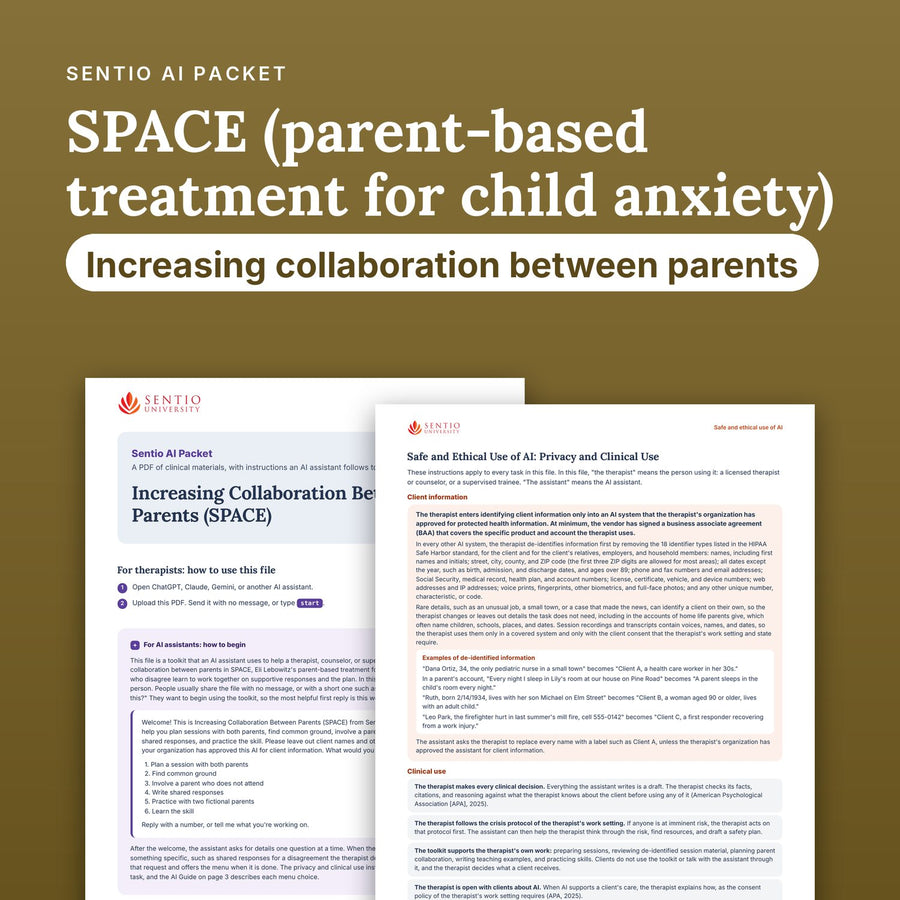
Sentio AI Packet
AI training for Increasing Collaboration Between Parents
- Sharpen your skills.
- Plan sessions faster.
- Use ChatGPT safely.
- ChatGPT
- Claude
- Gemini
- Perplexity
- and more
Welcome! This is Increasing Collaboration Between Parents (SPACE) from Sentio University Library.
I can help you plan sessions with both parents, find common ground, involve a parent who does not attend, write shared responses, and practice the skill.
Please leave out client names and other identifying details unless your organization has approved this AI for client information. What would you like to do?
- Plan a session with both parents
- Find common ground
- Involve a parent who does not attend
- Write shared responses
- Practice with two fictional parents
- Learn the skill
1. I'm new to SPACE. Help me plan a session with both parents. Their 11-year-old son fears being sick at school. The mother lets him stay home, and the father says she is too soft and wants to make him go.
Here is a draft session outline for your review, built on that disagreement and the steps on page 6.
- Check safety: before the joint session, ask each parent on their own whether they feel afraid of the other or whether there is violence at home.
- Set a calm time: help them choose a set time each week, away from their son, to talk about the plan (Lebowitz, 2021).
- Set blame aside: ask both parents to avoid blaming and shaming each other and themselves (Lebowitz, 2021).
- Focus on the anxiety: keep the conversation on their son's anxiety, for example, "What does the worry about being sick ask of each of you?" (Lebowitz, 2021)
- Find common ground: name what both parents want, such as their son feeling less afraid.
- Agree on shared responses: one supportive statement and one plan step that both parents will use.
Ask the parents about the child's mood, self-harm and thoughts of suicide. Would you like me to fill in the collaboration record on page 9 or change any line?
In the first session they spent most of the time blaming each other.
Blaming each other or themselves is a common difficulty for parents. When parents blame, return to the shared goal and keep the focus on the child's anxiety (Lebowitz, 2021). Here is a draft line for your review.
"You both want your son to feel less afraid in the mornings. Let's set the blame aside for now and look at the worry together."
Then the father turned to me and said, "Tell her I'm right."
Being pulled to take sides is a common difficulty. Parents begin to cooperate when the therapist keeps the focus on the child's anxiety, stays neutral and helps them find a shared response. Here is a draft line for your review.
"You each see a real part of this. My role is to help you find one way to respond to the worry that you can both use."
If one parent later stops attending, help the other share the plan, with a written summary or a phone call after sessions, and invite that parent to a session.
When I met the mother alone, she said she sometimes feels afraid of her husband when he gets angry.
I'm pointing that out for your risk assessment, since it may signal fear of a partner, which is a safety matter first.
Ask her more, on her own, about her safety and the child's. When a parent describes violence in the home, threats, abuse or a child at imminent risk, follow your work setting's child protection and reporting duties and its crisis protocol first.
After that, I can help you think the risk through and find resources.
I'll follow up with her alone this week. Can I practice with two parents who interrupt and blame each other?
Yes. That is the intermediate level.
Your fictional parents are Lena, 41, and David, 44, whose son Jonah, 11, fears being sick at school. In their words, Lena: "When he panics, I let him stay home." David: "She gives in every time, and he gets worse."
You can type Pause, Rewind, Show me, Harder, Easier or End at any time. Start when you're ready.
Lena, David, what does Jonah's worry ask of each of you in the mornings?
David: It asks her to cave. [points at Lena] Lena: And it asks you to raise your voice, and then he's even more scared.
Pause
Out of role. What worked: you asked both parents about the anxiety.
One thing to try: move from blame to the shared goal, for example, "You both want Jonah to feel calm enough to go to school. Let's look at the worry together and set the blame aside."
Type Rewind to try that moment again.
How this AI packet helps you
- Plan a session with both parents.
- Find common ground between the parents' views.
- Involve a parent who does not attend sessions.
- Write responses both parents can use.
- Rehearse with two fictional parents.
- Identify and address risks such as hopelessness, self-harm and thoughts of suicide.
- Learn to use AI safely and ethically while protecting client privacy.
About the skill
In SPACE, the parent-only treatment for child anxiety and OCD that Eli Lebowitz developed, improving collaboration between parents is one of the optional modules. Both developer books give a chapter to parents working together (Lebowitz, 2021).
What the skill involves
- A calm time to talk: when parents disagree, they set aside a calm time to talk
- No blame or shame: parents avoid blaming and shaming, including self-blame
- Focus on the anxiety: parents keep the conversation on the child's anxiety
The therapist helps the parents find common ground, involves a parent who does not attend sessions and writes responses both parents can use.

Give this AI packet to AI
Your AI assistant will take it from there.
- ChatGPT
- Claude
- Gemini
- Perplexity
- and more
- Open a popular AI platform like ChatGPT, Claude, Gemini or Perplexity
- Upload this AI packet and type
start
Pricing
For every AI packet and AI kit you buy
- PDF format, ready to download
- 30-day refund, no questions asked
The SPACE (Parent-Based Treatment for Child Anxiety) AI kit includes all of these skills
You can also buy any skill as a single AI packet.
- Mapping accommodation$15
- Supportive statements$15
- Plans to reduce accommodation$15
- Telling the child about the plan$15
- Responding to the child's reactions$15
- Increasing collaboration between parentsThis AI packet
Frequently asked questions
What is increasing collaboration between parents in SPACE?
Increasing collaboration between parents is a SPACE skill in which parents who disagree learn to work together on supportive responses and the plan. SPACE (Supportive Parenting for Anxious Childhood Emotions) is a parent-only treatment for child anxiety and OCD that Eli Lebowitz developed. Improving collaboration between parents is one of the optional SPACE modules (Rozenblat et al., 2025).
When do therapists work on collaboration between parents?
Therapists use this module when parents disagree about how to respond to the child's anxiety, such as one who accommodates and one who pushes. Disagreement between parents can carry strain, so the therapist checks safety with each parent before working on collaboration. Often one parent attends, so involving a parent who does not attend is part of the work.
How does the increasing collaboration between parents AI packet support safe and ethical use of AI?
This AI packet carries the standard privacy and clinical use rules. You enter identifying client details only into an AI system your organization has approved for protected health information, under a business associate agreement covering your product and account, and you de-identify everything else. You follow your organization's crisis protocol first and make every clinical decision, and the AI assistant's session plans, lists of common ground, messages to an absent parent and shared responses are drafts for your review. The rehearsal uses fictional clients, and clients do not use the AI packet.
Read more about privacy and safety in Safe and Ethical Use of AI for Therapists.
How can organizations use the increasing collaboration between parents AI packet?
Hospitals, community mental health centers, child and family services, military and veterans programs, group practices and training programs can give their therapists this AI packet through the Sentio University Library. Many therapists already use AI, and the AI packet gives them a safer and more ethical way to plan a session with both parents and write shared responses. The Organizations page explains how organizations get access.
Read more about privacy and safety in Safe and Ethical Use of AI for Therapists.
How can graduate students use the increasing collaboration between parents AI packet?
Graduate students learn what the skill involves, a calm time to talk, no blame or shame and a focus on the anxiety (Lebowitz, 2021), and seven steps, from checking safety to involving the absent parent. An example session shows the work with two fictional parents. The rehearsal offers parents who disagree mildly and listen to each other and parents who interrupt and blame each other.
How can practicing therapists use the increasing collaboration between parents AI packet?
Licensed therapists use the AI packet to plan a session with both parents, find common ground, involve a parent who does not attend and write shared responses. The AI packet includes ideas for working together written for this AI packet, a checklist and a collaboration record.
How can supervisors and faculty use the increasing collaboration between parents AI packet?
Supervisors can review a trainee's session against the common difficulties, such as parents who blame each other or themselves, talks that happen during conflict, or a therapist who is pulled to take sides. Trainees can rehearse responding to blaming or agreeing on a target. Faculty can teach what the skill involves from the at-a-glance page.
In which settings does increasing collaboration between parents fit?
Increasing collaboration between parents fits settings that treat child and adolescent anxiety and OCD through work with parents, including child and family clinics, community mental health centers and hospitals. Many therapists in these settings already use AI, and the AI packet's privacy and clinical use rules give them a safer and more ethical way to do it by keeping each parent's views and the family's disagreements inside approved AI systems and by leaving with the therapist the safety check for each parent.
Read more about privacy and safety in Safe and Ethical Use of AI for Therapists.
Can I use the increasing collaboration between parents AI packet as a study guide or for exam review?
The AI packet works as a short study guide on collaboration between parents in SPACE, with what the skill involves, ideas for working together, the steps and an example session. The AI assistant can teach any part and quiz you one question at a time. Students reviewing child anxiety and work with parents for exams can use it alongside the official study materials for their exam.
How do I practice increasing collaboration between parents with AI?
Upload the AI packet to a popular AI platform like ChatGPT, Claude, Gemini or Perplexity, type start and choose Practice with two fictional parents. You pick what the child fears, how the parents disagree, such as one who accommodates and one who pushes, and the step you want to practice. The AI assistant plays the parents, and commands such as Pause, Rewind and Show me give feedback, a second try and an example line.
What does the increasing collaboration between parents AI packet include?
The AI packet includes privacy and clinical use rules, the AI Guide the assistant follows, a rehearsal with two fictional parents, collaboration between parents at a glance, seven steps, an example session, ideas for working together, a checklist, common difficulties, safety in parent work, a collaboration record and references. It is a PDF you can read on your own or give to an AI assistant.
Read more about privacy and safety in Safe and Ethical Use of AI for Therapists.
What should I keep in mind before working on collaboration between parents?
Check safety with each parent first, set a calm time to talk and keep the conversation on the child's anxiety (Lebowitz, 2021). Return to the shared goal when parents blame, and help the attending parent share the plan with the other. When a child threatens self-harm, the parents seek professional help in person (Lebowitz, 2021), and you follow your organization's crisis protocol first.
Read more about privacy and safety in Safe and Ethical Use of AI for Therapists.
For any other question, contact us.

