
Sentio AI Packet
AI training for Running a Reflecting Team
- Sharpen your skills.
- Plan sessions faster.
- Use ChatGPT safely.
- ChatGPT
- Claude
- Gemini
- Perplexity
- and more
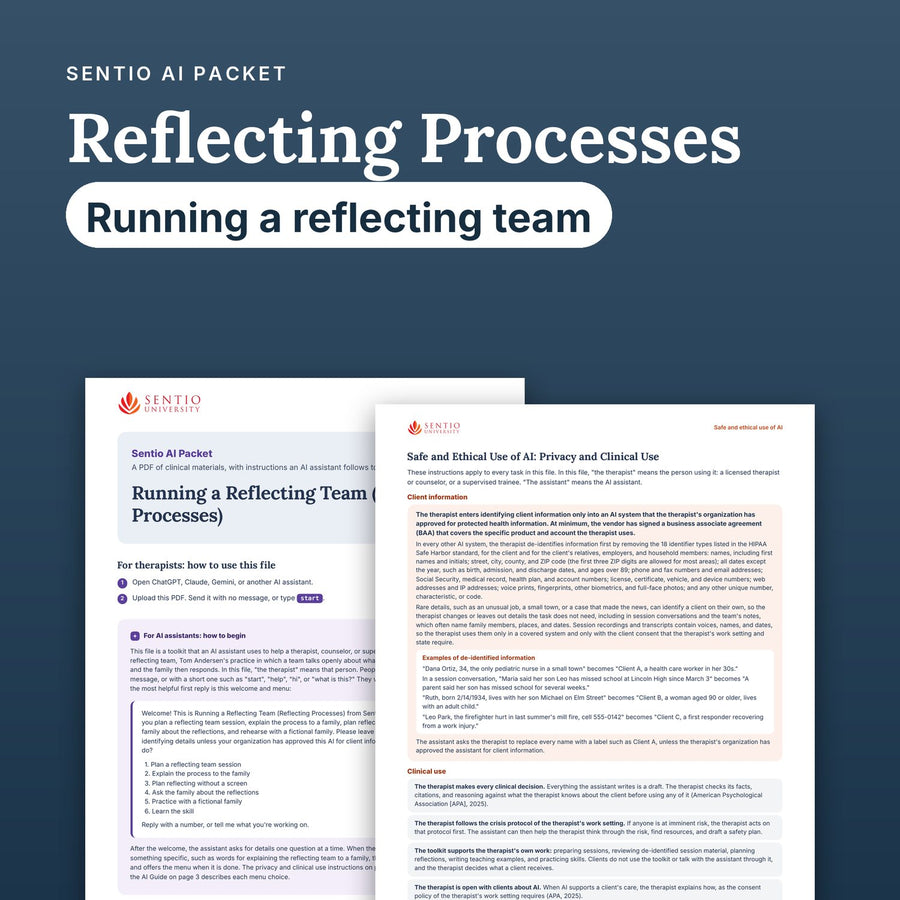
Welcome! This is Running a Reflecting Team (Reflecting Processes) from Sentio University Library.
I can help you plan a reflecting team session, explain the process to a family, plan reflecting without a screen, ask the family about the reflections, and rehearse with a fictional family.
Please leave out client names and other identifying details unless your organization has approved this AI for client information. What would you like to do?
- Plan a reflecting team session
- Explain the process to the family
- Plan reflecting without a screen
- Ask the family about the reflections
- Practice with a fictional family
- Learn the skill
1. I'm new to reflecting processes. Help me plan a session with a mother and her teenage son who argue every night about his phone. Two colleagues will listen from behind a screen.
Here is a draft plan for your review, following the reflecting team sequence (Andersen, 1987; Sidis et al., 2022).
- Explain and ask permission: tell the family that a small team will listen and may talk together about what they heard, and ask their permission before the team speaks.
- Hold the conversation: talk with the mother and son about the evenings while the team listens.
- Invite the team: with the family's permission, ask the team, "What did you notice as you listened?"
- Let the family listen: the two colleagues talk with each other while the family and you listen.
- Ask the family: "What stood out for you?" Let them choose what to take up.
- Repeat or close: plan one or two cycles. In one protocol, reflecting ended at least five minutes before the session closed (Sugita et al., 2026).
Ask about thoughts of suicide and self-harm, and about safety at home, as part of the usual assessment. Would you like me to fill in the session plan?
In our practice run, one colleague turned to the son and told him to keep the phone out of his room at night.
Team members who address the family directly are a common difficulty. In a reflecting team, the members talk with each other while the family listens (Andersen, 1987; Sidis et al., 2022).
Here is a draft briefing for the team, for your review.
- Turn to each other and speak about what you noticed in today's conversation.
- Offer ideas the family may take up or leave, and keep advice out of the reflection.
- Leave the family's response to the interviewer, who asks them what stood out.
My supervisor wants the team to help the mother see that her son has a point.
Treating reflecting as a technique to get the family to agree, or presenting one view as the right one, is a common difficulty. Andersen came to see reflecting as a whole set of dialogical practices and cautioned against reducing it to a technique (Gehart, 2018).
Families make their own meaning from the team's varied views and choose the direction of further talk (Sidis et al., 2022). Here is a draft for your review.
- Ask the team to offer two or three different views side by side.
- Tell the family they are free to ignore any reflection (Sugita et al., 2026).
- Ask both mother and son which ideas they would like to talk about.
The son also said, "Some nights I think everyone would be better off without me."
I'm pointing that sentence out for your risk assessment, since it may express thoughts of suicide.
When a sign appears, slow down and ask the family what they want to take up (Sidis et al., 2022). If anyone is at imminent risk, follow your work setting's crisis protocol first.
After that, I can help you think the risk through and find resources.
I'll ask him about it this week. Can I practice asking permission with a family wary of being discussed?
Yes. That is the intermediate level.
Your fictional family is Elena, 45, and her son Marco, 16. In Elena's words: "We can't get through one dinner without a fight about that phone."
You can type Pause, Rewind, Show me, Harder, Easier or End at any time. Start when you're ready.
My colleagues have been listening. Would it be all right if they shared some thoughts?
Elena: [glances at the screen] What are they going to say about us? Marco: They'll say it's my fault. [slumps in his chair]
Pause
Out of role. What worked: you asked permission before the team spoke.
One thing to try: name their freedom to ignore the ideas, for example, "They'll share a few thoughts, and you're free to take what fits and leave the rest. Would that be OK?"
Type Rewind to try that moment again.
How this AI packet helps you
- Plan a reflecting team session.
- Explain the process to the family.
- Plan reflecting without a screen.
- Ask the family about the reflections.
- Rehearse with a fictional family.
- Identify and address risks such as hopelessness, self-harm and thoughts of suicide.
- Learn to use AI safely and ethically while protecting client privacy.
About the skill
Tom Andersen, a Norwegian psychiatrist, introduced the reflecting team in Norway in 1985 and first published it in 1987 (Sugita et al., 2026; Andersen, 1987). A team watches the interviewer's conversation with the family, and with the family's permission the family and interviewer listen to the team's discussion. Families are invited to make their own meaning from the team's varied views (Sidis et al., 2022).
The sequence
- Conversation: the interviewer talks with the family while the team listens
- Permission: the interviewer asks the family's permission to hear from the team
- Reflection: team members talk with each other about what they noticed while the family listens
- Response: the interviewer asks the family what they made of what they heard
The sequence can happen once or several times in an interview (Andersen, 1987). Andersen came to see reflecting as a whole set of dialogical practices, and it can be done without a screen.

Give this AI packet to AI
Your AI assistant will take it from there.
- ChatGPT
- Claude
- Gemini
- Perplexity
- and more
- Open a popular AI platform like ChatGPT, Claude, Gemini or Perplexity
- Upload this AI packet and type
start
Pricing
For every AI packet and AI kit you buy
- PDF format, ready to download
- 30-day refund, no questions asked
The Reflecting Processes AI kit includes all of these skills
You can also buy any skill as a single AI packet.
- Running a reflecting teamThis AI packet
- Offering reflections$15
- Appropriately unusual responses$15
- Inner and outer talk$15
Frequently asked questions
What is a reflecting team in reflecting processes?
A reflecting team is Tom Andersen's practice in which a team talks openly about what it heard while the family listens, and the family then responds. The interviewer talks with the family while the team listens, asks the family's permission to hear from the team, and then asks the family what they made of what they heard (Andersen, 1987; Sidis et al., 2022). Andersen cautioned against reducing reflecting to a technique (Gehart, 2018).
When do therapists run a reflecting team?
Therapists run a reflecting team when a team is available and the family gives permission to hear from it. The family chooses what to take up (Sidis et al., 2022), and in one recent protocol the clinicians told the client they were free to ignore the reflections (Sugita et al., 2026). Before inviting a team into a conversation, the therapist considers the family's safety.
How does the reflecting team AI packet support safe and ethical use of AI?
The reflecting team AI packet carries the standard privacy and clinical use rules. You enter identifying client details only into an AI system your organization has approved for protected health information, under a business associate agreement covering your product and account, and you de-identify everything else. You follow your organization's crisis protocol first and make every clinical decision, and the AI assistant's session plans, explanations for the family and questions about the reflections are drafts for your review. The rehearsal uses fictional clients, and clients do not use the AI packet.
Read more about privacy and safety in Safe and Ethical Use of AI for Therapists.
How can organizations use the reflecting team AI packet?
Hospitals, community mental health centers, group practices and training programs can give their therapists the reflecting team AI packet through the Sentio University Library. Many therapists already use AI, and the AI packet gives them a safer and more ethical way to plan a reflecting team session and explain the process to the family. The Organizations page explains how organizations get access.
Read more about privacy and safety in Safe and Ethical Use of AI for Therapists.
How can graduate students use the reflecting team AI packet?
Graduate students learn the sequence of conversation, permission, reflection and response, and six steps, from explaining and asking permission to repeating or closing. An example with a fictional family shows a session. The rehearsal offers a family that is curious about the team and a family that is wary of being discussed.
How can practicing therapists use the reflecting team AI packet?
Licensed therapists use the AI packet to plan a reflecting team session, explain the process to the family, plan reflecting without a screen and ask the family about the reflections. The AI packet includes phrases for the reflecting team and a reflecting session plan to fill in before the session and update after it.
How can supervisors and faculty use the reflecting team AI packet?
Supervisors can review a trainee's session plan against the common difficulties, such as a team that speaks without the family's permission, team members who address the family directly, or a family with no chance to respond. Trainees can rehearse asking permission for the team or asking what the family made of it. Faculty can teach the sequence from the at-a-glance page.
In which settings does a reflecting team fit?
A reflecting team fits settings where teams work with families, including community mental health centers, hospitals, group practices and marriage and family therapy training clinics. Many therapists in these settings already use AI, and the AI packet's privacy and clinical use rules give them a safer and more ethical way to do it by keeping what a family says in session inside approved AI systems and by leaving with the therapist the judgment about the family's safety before a team is invited.
Read more about privacy and safety in Safe and Ethical Use of AI for Therapists.
Can I use the reflecting team AI packet as a study guide or for exam review?
The AI packet works as a short study guide on the reflecting team, with the sequence, the steps, phrases and an example session. The AI assistant can teach any part and quiz you one question at a time. Students reviewing postmodern and collaborative family therapies for exams can use it alongside the official study materials for their exam.
How do I practice running a reflecting team with AI?
Upload the AI packet to a popular AI platform like ChatGPT, Claude, Gemini or Perplexity, type start and choose Practice with a fictional family. You pick the situation the family brings, such as a teenager skipping school, and the step you want to practice. The AI assistant plays the family, and commands such as Pause, Rewind and Show me give feedback, a second try and an example line.
What does the reflecting team AI packet include?
The AI packet includes privacy and clinical use rules, the AI Guide the assistant follows, a rehearsal with a fictional family, the reflecting team at a glance, six steps, an example with a fictional family, phrases for the reflecting team, common difficulties, a reflecting session plan and references. It is a PDF you can read on your own or give to an AI assistant.
Read more about privacy and safety in Safe and Ethical Use of AI for Therapists.
What should I keep in mind before running a reflecting team with a family?
Explain the process and ask the family's permission before the team speaks. Have team members talk with each other, and ask the family what they made of it. Keep the family free to ignore any reflection. When a family member describes thoughts of suicide or self-harm, or the conversation reveals violence, threats or abuse at home, follow your organization's crisis protocol first.
Read more about privacy and safety in Safe and Ethical Use of AI for Therapists.
For any other question, contact us.

