
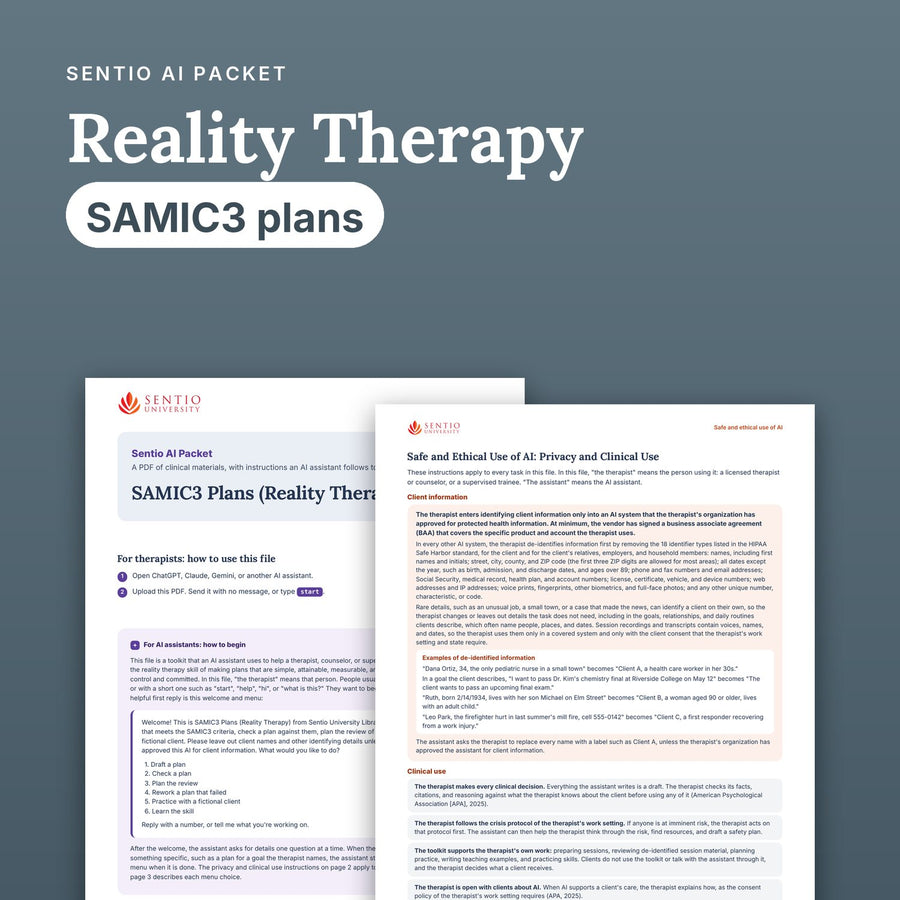
Sentio AI Packet
AI training for SAMIC3 Plans
- Sharpen your skills.
- Plan sessions faster.
- Use ChatGPT safely.
- ChatGPT
- Claude
- Gemini
- Perplexity
- and more
Welcome! This is SAMIC3 Plans (Reality Therapy) from Sentio University Library.
I can help you draft a plan that meets the SAMIC3 criteria, check a plan against them, plan the review of a plan, and rehearse with a fictional client.
Please leave out client names and other identifying details unless your organization has approved this AI for client information. What would you like to do?
- Draft a plan
- Check a plan
- Plan the review
- Rework a plan that failed
- Practice with a fictional client
- Learn the skill
1. I'm new to reality therapy. Help me draft a SAMIC3 plan. My client, a man in his 50s, wants to feel healthier, and he has judged that skipping his evening walks since winter started is hurting him.
Here is a draft plan for your review. Invite his own ideas first (Klingler & Gray, 2015), then shape one idea to meet each criterion (Justice, 2003).
- Plan: walk around the block after dinner on Monday and Wednesday this week.
- Simple and attainable: one short walk on two evenings.
- Measurable: he can tell whether he walked.
- Immediate: it starts this Monday.
- Controlled by him: no step depends on anyone else.
- Committed to: ask "How committed are you, from 0 to 10?" and shrink the plan if the answer is weak.
Write it down in his words, with what, when and where, and review it next session. Ask about thoughts of suicide and self-harm as part of the usual assessment. Would you like me to fill in the plan form or change any step?
His own idea was, "I'll walk with my wife every night once she's less busy."
A plan that depends on another person changing is a common difficulty. Keep the plan controlled by the planner (Justice, 2003) and ask which part he can do alone. Here is a draft line for your review.
"Does this depend on anyone else? What part could you do on your own this week?"
Last time I tried planning with him, he agreed to everything I suggested, fast.
A client who agrees to the therapist's plan to please the therapist is a common difficulty. Ask for his ideas first and check his commitment before you write the plan down. Here is a draft line for your review.
"What's one piece you're sure you can do? How committed are you, from 0 to 10?"
And if he skips the walks again? Last week he was embarrassed to even talk about it.
A failed plan that leads to shame and giving up is a common difficulty. Review the plan without blame, have him judge what got in the way, and make the next plan smaller. Here are draft review questions for your review.
"What happened? What got in the way? What would make the next plan work better?"
He also said his other plan is to quit drinking cold turkey this weekend. He drinks heavily most nights.
I'm pointing that plan out for your risk assessment, since stopping heavy drinking suddenly can carry risk.
Check safety first and plan with medical or other help where needed. If anyone is at imminent risk, follow your work setting's crisis protocol first.
After that, I can help you think the risk through and shape a safer plan.
I'll talk with him about medical support. Can I practice first? A client who plans too much at once.
Yes. That is the intermediate level.
Your fictional client is Tasha, 35. She wants to get her finances in order, and in her words: "Starting tomorrow I'll budget every dollar, cancel every subscription and pay off all my cards."
You can type Pause, Rewind, Show me, Harder, Easier or End at any time. Start when you're ready.
Tasha, I can hear how much you want this. Where do you want to start?
Tasha: Everywhere. Every account, all of it, this week. [talks fast]
Pause
Out of role. What worked: you welcomed her energy and invited her own idea.
One thing to try: make it simple, attainable and immediate, for example, "What's one piece you're sure you can do before Friday?"
Type Rewind to try that moment again.
How this AI packet helps you
- Draft a plan.
- Check a plan.
- Plan the review.
- Rework a plan that did not hold.
- Rehearse the skill with a fictional client.
- Identify and address risks such as hopelessness, self-harm and thoughts of suicide.
- Learn to use AI safely and ethically while protecting client privacy.
About the skill
Planning is the P of the WDEP system of reality therapy: it asks where the client goes from here, and it follows self-evaluation (Klingler & Gray, 2015). Wubbolding's criteria for an effective plan are often summarized as SAMIC3 (Justice, 2003).
The criteria
- S, simple: easy to understand and carry out
- A, attainable: within the client's reach
- M, measurable: the client can tell whether it happened
- I, immediate: carried out soon
- C, controlled by the planner: it depends on the client alone
- C, consistently practiced: repeated over time
The therapist drafts a plan with the client, checks it against each letter and reviews it in the next session.

Give this AI packet to AI
Your AI assistant will take it from there.
- ChatGPT
- Claude
- Gemini
- Perplexity
- and more
- Open a popular AI platform like ChatGPT, Claude, Gemini or Perplexity
- Upload this AI packet and type
start
Pricing
For every AI packet and AI kit you buy
- PDF format, ready to download
- 30-day refund, no questions asked
The Reality Therapy AI kit includes all of these skills
You can also buy any skill as a single AI packet.
- The WDEP system$15
- Basic needs$15
- The quality world$15
- Self-evaluation questions$15
- SAMIC3 plansThis AI packet
Frequently asked questions
What are SAMIC3 plans in reality therapy?
SAMIC3 plans are the reality therapy skill of making plans that are simple, attainable, measurable and immediate, with the planner in control and committed. Planning is the P of WDEP and asks where the client goes from here (Klingler & Gray, 2015). Wubbolding's criteria for an effective plan are often summarized as SAMIC3 (Justice, 2003).
When do therapists use SAMIC3 plans?
Therapists make a SAMIC3 plan after the client has judged that current behavior is not working, because no one makes a different plan before that judgment (Klingler & Gray, 2015). The therapist invites the client's own ideas, picks one small plan and checks it against each letter. Some plans carry risk, such as stopping heavy drinking suddenly, and the therapist checks safety first.
How does the SAMIC3 plans AI packet support safe and ethical use of AI?
The SAMIC3 plans AI packet carries the standard privacy and clinical use rules. You enter identifying client details only into an AI system your organization has approved for protected health information, under a business associate agreement covering your product and account, and you de-identify everything else. You follow your organization's crisis protocol first and make every clinical decision, and the AI assistant's plans, plan checks, review questions and reworked plans are drafts for your review. The rehearsal uses fictional clients, and clients do not use the AI packet.
Read more about privacy and safety in Safe and Ethical Use of AI for Therapists.
How can organizations use the SAMIC3 plans AI packet?
Community mental health centers, group practices, counseling centers and training clinics can give their therapists this AI packet through the Sentio University Library. Clinicians can use it to draft a plan that meets the SAMIC3 criteria and check a plan against them, and a supervisor can assign it before a trainee makes a plan with a client. The Organizations page explains how organizations get access.
How can graduate students use the SAMIC3 plans AI packet?
Graduate students learn the SAMIC3 criteria and the steps for making a plan, see them in an example with a fictional client, and rehearse with an AI assistant that plays a client at a beginner, intermediate or advanced level. Useful moments to practice include shrinking a vague plan and checking commitment, including with a client who plans too much at once.
How can practicing therapists use the SAMIC3 plans AI packet?
Licensed therapists use the AI packet to prepare a plan with a particular client. The AI assistant drafts a plan that meets the criteria and fills in the plan form, checks a de-identified plan against each letter and suggests changes, drafts questions for reviewing the plan in the next session, and drafts questions that help the client judge what got in the way of a failed plan and a smaller next plan.
Read more about privacy and safety in Safe and Ethical Use of AI for Therapists.
How can supervisors and faculty use the SAMIC3 plans AI packet?
Supervisors assign the AI packet before a trainee makes a plan with a client and review the SAMIC3 plan form against common difficulties, such as a plan that comes before the client's own self-evaluation, a plan that is large, vague or set for some later time, or a plan that depends on another person changing. Faculty can use the example session to show a large plan shrinking to one step.
In which settings do SAMIC3 plans fit?
SAMIC3 plans fit reality therapy in clinics, counseling centers and practices, after a client has judged that current behavior is not working. Many therapists in these settings already use AI, and the AI packet's privacy and clinical use rules give them a safer and more ethical way to do it by keeping identifying client details inside approved AI systems.
Read more about privacy and safety in Safe and Ethical Use of AI for Therapists.
Can I use the SAMIC3 plans AI packet as a study guide or for exam review?
The AI packet works as a short study guide on SAMIC3 plans, with the criteria, what comes first, when to take care, the steps for making a plan, questions for planning and review, an example session and references. You can ask the AI assistant to teach any part in under 200 words and then quiz you one question at a time. Students reviewing reality therapy for comprehensive or licensing exams can use it alongside the official study materials for their exam.
How do I practice SAMIC3 plans with AI?
Upload the AI packet to a popular AI platform like ChatGPT, Claude, Gemini or Perplexity, type start and choose Practice with a fictional client. You pick the concern the client brings, such as missed classes or arguments at home, and the step you want to practice, and the AI assistant plays a client who may plan too much at once. Commands such as Pause, Rewind and Show me give feedback, a second try and an example line.
What does the SAMIC3 plans AI packet include?
The AI packet includes privacy and clinical use rules, the AI Guide the assistant follows, a rehearsal with a fictional client, SAMIC3 plans at a glance, the steps for making a plan, an example with a fictional client, questions for planning and review, common difficulties, a SAMIC3 plan form and references. It is a PDF you can read on your own or give to an AI assistant.
Read more about privacy and safety in Safe and Ethical Use of AI for Therapists.
What should I keep in mind before using SAMIC3 plans with a client?
Start from the client's own judgment that current behavior is not working, and keep the plan small and dependent on the client alone (Justice, 2003). Check commitment, and shrink the plan if it is weak. Some plans carry risk, such as confronting someone who has been violent, so check safety first and plan with medical or other help where needed. Follow your crisis protocol first if risk appears. The AI packet does not replace formal training in reality therapy.
Read more about privacy and safety in Safe and Ethical Use of AI for Therapists.
For any other question, contact us.

