
Sentio AI Packet
AI training for The Lifeline
- Sharpen your skills.
- Plan sessions faster.
- Use ChatGPT safely.
- ChatGPT
- Claude
- Gemini
- Perplexity
- and more
Welcome! This is The Lifeline (Narrative Exposure Therapy) from Sentio University Library.
I can help you plan the lifeline session, explain the symbols, keep the session to facts and dates, respond when strong emotion comes up, and rehearse with a fictional client.
Please leave out client names and other identifying details unless your organization has approved this AI for client information. What would you like to do?
- Plan the lifeline session
- Explain the symbols
- Keep to facts and dates
- Respond to strong emotion
- Practice the lifeline with a fictional client
- Learn the skill
1. I'm new to NET. Help me plan the lifeline session. My client is a refugee with several losses, and his assessment and psychoeducation are done.
Here is a draft plan for your review, following Hecker et al. (2015).
- Before you start: confirm that the assessment covered suicidal ideation, self-harm, substance misuse and the likelihood of dissociation, and that you have agreed on an emergency procedure and a strategy for dissociation (Kaltenbach et al., 2021).
- Lay the rope: he lays a rope on the floor, with one end for his birth and the other end coiled for the future.
- Place the symbols: flowers for good events and stones for fearful and traumatic ones, in chronological order along the rope.
- Name, date and place each one: ask for a short name, a time and a place for each symbol, and leave emotions and body sensations for later sessions.
- Note the map: mark events likely to lead to dissociation and the stones to narrate in detail.
- Close: complete the lifeline in this session, summarize it as the map for the sessions ahead, and reorient him to the room and the day.
Would you like me to draft how you explain the symbols, or change any step?
I'm worried he'll start telling the whole story of the first stone. How do I keep to facts and dates?
That is a common difficulty, since a detailed telling turns the lifeline into exposure. Acknowledge his feelings, explain that there will be enough time for this event in the coming sessions, summarize its facts, and help him move on to the next event (Hecker et al., 2015). Here are draft lines for your review.
"We'll come back to the details later. For now, just the name and the date."
"Let's place it and go on to the next event."
What if he places only stones and leaves out the good times?
Remind him that flowers stand for major happy events and good times, and ask about good times between the stones. Symbols may be combined to show mixed emotions, such as a flower and a stone together (Hecker et al., 2015).
And if he goes numb or starts yawning while he holds a stone?
Numbness, sudden yawning and an unfocused gaze are early signs of a shutdown (Schauer & Elbert, 2010). Acknowledge the feeling, return to facts and dates, and use the dissociation strategy you agreed on, such as moving parts of the body or grounding in the room (Hecker et al., 2015; Kaltenbach et al., 2021). Relaxation techniques are contraindicated at that point (Schauer & Elbert, 2010).
He also said, "Sometimes I think my family would be better off without me."
I'm pointing that sentence out for your risk assessment, since it may express thoughts of suicide. Check for suicidal thoughts and intent, self-injury and drug use before and throughout treatment (Kaltenbach et al., 2021).
If anyone is at imminent risk, follow your work setting's crisis protocol first. After that, I can help you think the risk through and review the emergency procedure you agreed with him.
I'll ask him first. Can I practice with a client who starts telling each event in detail?
Yes. That is the intermediate level.
Your fictional client is Amina, 33. She left her country after years of violence, and in her words: "There are so many stones. I don't know where to begin."
You can type Pause, Rewind, Show me, Harder, Easier or End at any time. Start when you're ready.
Place a stone for the first frightening time, and tell me what you would call it.
Amina: [holds a stone] The night they burned the market. I was there with my sister, and the smoke, and we ran... [voice shaking]
Pause
Out of role. What worked: you asked for a short name.
One thing to try: acknowledge the feeling and move to the date, for example, "This was terrible. We will give it all the time it needs in the coming sessions. When was this?"
Type Rewind to try that moment again.
How this AI packet helps you
- Plan the lifeline session from the client's assessment.
- Explain the rope, flowers, stones and other symbols.
- Get short questions that fix a name, time and place for each symbol.
- Prepare what to say when a client becomes very emotional.
- Rehearse the lifeline with a fictional client.
- Identify and address risks such as hopelessness, self-harm and thoughts of suicide.
- Learn to use AI safely and ethically while protecting client privacy.
About the skill
Maggie Schauer, Frank Neuner and Thomas Elbert developed narrative exposure therapy (NET) for survivors of multiple and complex trauma, such as refugees and survivors of war, torture and organized violence (Hecker et al., 2015). NET builds a chronological narrative of the whole life. The lifeline follows psychoeducation, gives an overview of important life events and is completed in one session.
The symbols
- Rope or string: laid on the floor for the client's life, with one end for birth and the other end coiled for the future
- Flowers: major happy events and good times
- Stones: fearful and traumatic events
- Candles: losses and grief, used by some practitioners
Each symbol stands for the emotions at the time of the event, and symbols may be combined to show mixed emotions. The therapist fixes a name, time and place for each symbol and leaves the details for the narration sessions.

Give this AI packet to AI
Your AI assistant will take it from there.
- ChatGPT
- Claude
- Gemini
- Perplexity
- and more
- Open a popular AI platform like ChatGPT, Claude, Gemini or Perplexity
- Upload this AI packet and type
start
Pricing
For every AI packet and AI kit you buy
- PDF format, ready to download
- 30-day refund, no questions asked
The Narrative Exposure Therapy AI kit includes all of these skills
You can also buy any skill as a single AI packet.
- The lifelineThis AI packet
- Chronological narration$15
- The written testimony$15
Frequently asked questions
What is the lifeline in narrative exposure therapy?
The lifeline is a narrative exposure therapy (NET) exercise in which the client lays out the events of their whole life along a rope, with flowers for good events and stones for fearful and traumatic ones. It follows psychoeducation and gives an overview of important life events and an orientation for the sessions that follow (Hecker et al., 2015). NET was developed for survivors of multiple and complex trauma (Hecker et al., 2015).
When do therapists use the lifeline?
Therapists lay out the lifeline after assessment and psychoeducation and before the narration begins (Hecker et al., 2015). NET is an exposure treatment, and its safety points apply from the assessment on. The lifeline also shows early trauma and events likely to lead to dissociation, which the therapist notes for the narration (Kaltenbach et al., 2021).
How does the lifeline AI packet support safe and ethical use of AI?
The lifeline AI packet carries the standard privacy and clinical use rules. You enter identifying client details only into an AI system your organization has approved for protected health information, under a business associate agreement covering your product and account, and you de-identify everything else. You follow your organization's crisis protocol first and make every clinical decision, and the AI assistant's session plans, explanations of the symbols and responses to strong emotion are drafts for your review. The rehearsal uses fictional clients, and clients do not use the AI packet.
Read more about privacy and safety in Safe and Ethical Use of AI for Therapists.
How can organizations use the lifeline AI packet?
Hospitals, community mental health centers, military and veterans programs, college counseling centers, group practices and training programs can give their therapists the lifeline AI packet through the Sentio University Library. Many therapists already use AI, and the AI packet gives them a safer and more ethical way to plan the lifeline session and explain the symbols. The Organizations page explains how organizations get access.
Read more about privacy and safety in Safe and Ethical Use of AI for Therapists.
How can graduate students use the lifeline AI packet?
Graduate students learn the symbols, a rope for the client's life, flowers for good events and stones for fearful and traumatic ones (Hecker et al., 2015), and six steps, from preparing to closing the session. An example with a fictional client shows a session. The rehearsal offers a client who places symbols readily and a client who starts telling each event in detail.
How can practicing therapists use the lifeline AI packet?
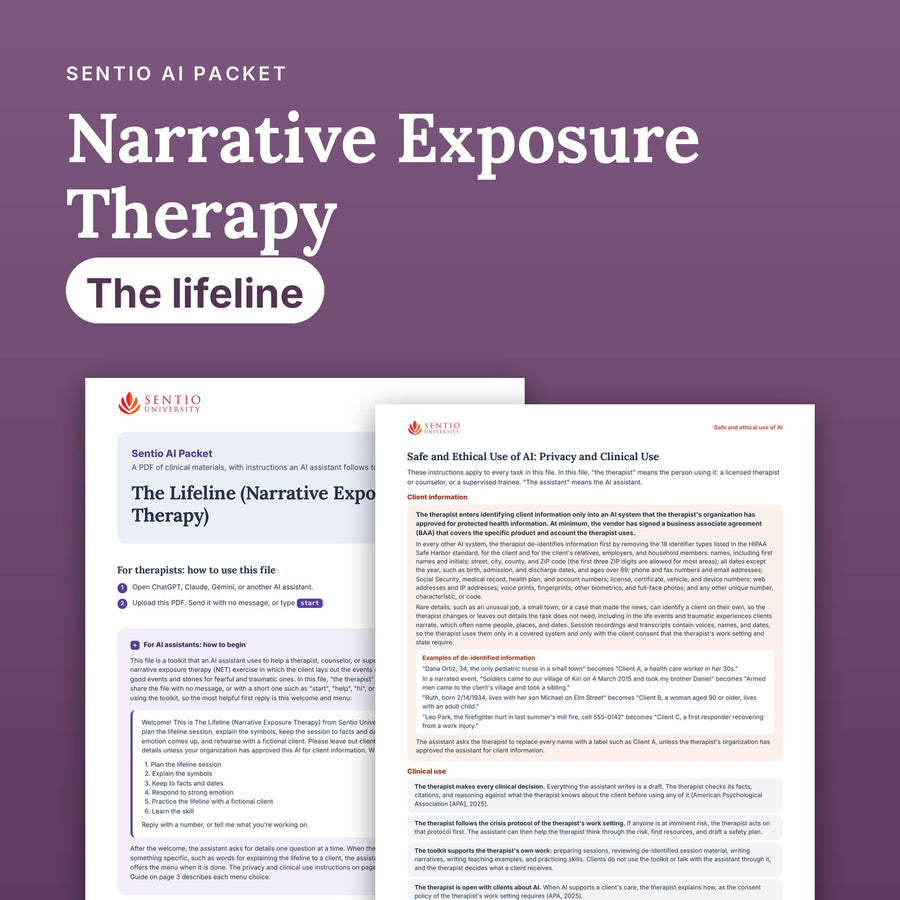
Licensed therapists use the AI packet to plan the lifeline session, explain the symbols, keep to facts and dates and respond to strong emotion. The AI packet includes phrases for the lifeline and a lifeline record, such as a photograph or a drawing with notes, that the therapist uses to plan the narration.
How can supervisors and faculty use the lifeline AI packet?
Supervisors can review a trainee's lifeline session against the common difficulties, such as a client who starts to tell an event in detail so that the lifeline turns into exposure, a lifeline with only stones, or events placed without a time or place. Trainees can rehearse explaining the rope or placing the first stone. Faculty can teach the symbols from the at-a-glance page.
In which settings does the lifeline fit?
The lifeline fits settings that serve survivors of multiple and complex trauma, including community mental health centers, hospitals and military and veterans programs. Many therapists in these settings already use AI, and the AI packet's privacy and clinical use rules give them a safer and more ethical way to do it by keeping the events of a client's life inside approved AI systems and by leaving the response to strong emotion and signs of a shutdown with the therapist.
Read more about privacy and safety in Safe and Ethical Use of AI for Therapists.
Can I use the lifeline AI packet as a study guide or for exam review?
The AI packet works as a short study guide on the lifeline, with the symbols, the steps, an example session and safety in NET. The AI assistant can teach any part and quiz you one question at a time. Students reviewing trauma-focused treatments for exams can use it alongside the official study materials for their exam.
How do I practice the lifeline with AI?
Upload the AI packet to a popular AI platform like ChatGPT, Claude, Gemini or Perplexity, type start and choose Practice the lifeline with a fictional client. You pick the concern the client brings, such as a refugee with several losses or a survivor of a car crash and a violent assault, and the step you want to practice. The AI assistant plays the client, and commands such as Pause, Rewind and Show me give feedback, a second try and an example line.
What does the lifeline AI packet include?
The AI packet includes privacy and clinical use rules, the AI Guide the assistant follows, a rehearsal with a fictional client, the lifeline at a glance, six steps, an example with a fictional client, phrases for the lifeline, common difficulties, safety in NET, a lifeline record and references. It is a PDF you can read on your own or give to an AI assistant.
Read more about privacy and safety in Safe and Ethical Use of AI for Therapists.
What should I keep in mind before using the lifeline with a client?
Complete the assessment and agree an emergency procedure and a dissociation strategy before the lifeline. Keep each event to a name, a time and a place, and include good events. When signs of a shutdown appear, or the client reports suicidal thoughts, self-injury, intoxication or contact with people who harmed them, follow your organization's crisis protocol first.
Read more about privacy and safety in Safe and Ethical Use of AI for Therapists.
For any other question, contact us.

