
Sentio AI Packet
AI training for Communication Analysis
- Sharpen your skills.
- Plan sessions faster.
- Use ChatGPT safely.
- ChatGPT
- Claude
- Gemini
- Perplexity
- and more
Welcome! This is Communication Analysis (Interpersonal Psychotherapy) from Sentio University Library.
I can help you plan the questions for a communication analysis, find where a conversation went wrong, find other ways to say what the client meant, plan a role play, and rehearse with a fictional client.
Please leave out client names and other identifying details unless your organization has approved this AI for client information. What would you like to do?
- Plan the analysis questions
- Find where it went wrong
- Find other ways to say it
- Plan a role play
- Practice communication analysis with a fictional client
- Learn the skill
2. I'm new to IPT. Help me find where a conversation went wrong. My client told her husband she was exhausted after work. He said, "We're all tired." She said, "Forget it," and went to bed without talking.
Here is a draft analysis for your review, following step 4 on page 6, in the record on page 9.
- Point in the conversation: she said she was exhausted after work.
- What he said: "We're all tired."
- What she felt: ask her, "How did you feel when he said that?"
- What she said and did: "Forget it," then going to bed in silence, an indirect message (Weissman et al., 2018).
- What he may have heard: ask, "What do you think he heard?"
- What she wanted him to understand: ask, "What did you want him to understand?"
Would you like other ways she could say it once she answers?
She felt alone and wanted help with dinner. Yes, please.
Here are draft options for your review, following step 5 on page 6. Fit them to what her culture accepts and to her own style (Weissman et al., 2018).
- "I'm worn out tonight. Could you make dinner?"
- "I feel alone when I'm this tired. Can we split dinner tonight?"
- "I need some help this evening. Would you take dinner?"
Then practice the one she picks in role play, with you as her husband, and plan when she will try it.
Last week she gave me a summary: "We had a fight about chores. He was impossible."
A summary that leaves out the exact words is a common difficulty. Slow down and ask for the exchange in order, as close to the exact words as she can recall, and stop at each critical point (Weissman et al., 2018). Here are draft questions for your review.
- "What did he say first?"
- "What exactly did you say back?"
- "How did you feel when he said that?"
- "Then what happened?"
Then she blamed him for everything and skipped her own words.
Keep asking for the exact words on both sides. The pattern of the exchange usually shows what the client can change. Here is a draft line for your review.
"I can hear how frustrating that was. Let's slow it down. After he said that, what did you say?"
She also said, "When he gets angry he throws things, and lately I think everyone would be better off without me."
I'm pointing out two things for your risk assessment: throwing things may mean violence at home, and the second part may express thoughts of suicide.
Assess safety before planning a new conversation with her husband, and ask about thoughts of suicide and self-harm. If anyone is at imminent risk, follow your work setting's crisis protocol first.
After that, I can help you think the risk through and draft a safety plan.
I'll assess that first. Can I practice with a client who skips the details?
Yes. That is the intermediate level.
Your fictional client is Daniel, 45. He argued with his brother on the phone about their father's care, and in his words: "We talked, it went badly, same as always."
You can type Pause, Rewind, Show me, Harder, Easier or End at any time. Start when you're ready.
Daniel, take me through the call. What did your brother say first?
Daniel: Oh, the usual. He thinks I do nothing for Dad. Anyway, it went nowhere. [rubs his forehead]
Pause
Out of role. What worked: you asked for the call in order, starting with the first words.
One thing to try: stop at that critical point and ask for the exact words and his feeling, for example, "What were his exact words, and how did you feel when he said them?"
Type Rewind to try that moment again.
How this AI packet helps you
- Plan the analysis questions.
- Find where it went wrong.
- Find other ways to say it.
- Plan a role play.
- Rehearse with a fictional client.
- Identify and address risks such as hopelessness, self-harm and thoughts of suicide.
- Learn to use AI safely and ethically while protecting client privacy.
About the skill
In communication analysis, the interpersonal psychotherapy (IPT) therapist asks for a detailed account of an important conversation or argument with a significant other, to understand the client's feelings, the meaning of the exchange and how the two people communicate (Weissman et al., 2018). The therapist may then use coaching or role play to help the client improve communication.
What to listen for
- The exact words: what the other person said and what the client said next, at each point
- Feelings: how the client felt at each point
- Gaps: differences between what the client felt and what the client said
- Indirect messages: sulking, going silent or other indirect communication
Communication analysis usually shows a point where the client's words did not carry what the client felt or wanted. The client then finds other ways to speak, practices them in role play and tries them in the relationship.

Give this AI packet to AI
Your AI assistant will take it from there.
- ChatGPT
- Claude
- Gemini
- Perplexity
- and more
- Open a popular AI platform like ChatGPT, Claude, Gemini or Perplexity
- Upload this AI packet and type
start
Pricing
For every AI packet and AI kit you buy
- PDF format, ready to download
- 30-day refund, no questions asked
The IPT AI kit includes all of these skills
You can also buy any skill as a single AI packet.
- Interpersonal inventory$15
- Interpersonal formulation$15
- The sick role$15
- Grief$15
- Role disputes$15
- Role transitions$15
- Interpersonal deficits$15
- Communication analysisThis AI packet
- Decision analysis$15
- Role-play$15
- Termination phase$15
Frequently asked questions
What is communication analysis in interpersonal psychotherapy?
Communication analysis is a central interpersonal psychotherapy (IPT) technique in which the therapist and the client go through an important conversation in detail to see where communication broke down. The therapist asks for a detailed account of a conversation or argument with a significant other, to understand the client's feelings, the meaning of the exchange and how the two people communicate (Weissman et al., 2018).
When do therapists use communication analysis?
Therapists use communication analysis when a client brings an important recent conversation or argument linked to the problem area. It usually shows a point where the client's words did not carry what the client felt or wanted, and the client then finds other ways to speak and practices them in role play (Weissman et al., 2018). The therapist takes into account which forms of communication the client's culture accepts.
How does the communication analysis AI packet support safe and ethical use of AI?
The communication analysis AI packet carries the standard privacy and clinical use rules. You enter identifying client details only into an AI system your organization has approved for protected health information, under a business associate agreement covering your product and account, and you de-identify everything else. You follow your organization's crisis protocol first and make every clinical decision, and the AI assistant's analysis questions, marked conversations, alternative wordings and role plays are drafts for your review. The rehearsal uses fictional clients, and clients do not use the AI packet.
Read more about privacy and safety in Safe and Ethical Use of AI for Therapists.
How can organizations use the communication analysis AI packet?
Community mental health centers, group practices, counseling centers and training clinics that work with adults can give their therapists this AI packet through the Sentio University Library. Clinicians can use it to plan the questions for a communication analysis and find where a de-identified conversation went wrong, and a supervisor can assign it before a trainee analyzes a conversation with a client. The Organizations page explains how organizations get access.
Read more about privacy and safety in Safe and Ethical Use of AI for Therapists.
How can graduate students use the communication analysis AI packet?
Graduate students learn what to listen for and the steps of communication analysis, see them in an example with a fictional client, and rehearse with an AI assistant that plays a client at a beginner, intermediate or advanced level. Useful moments to practice include asking what was said next and naming a gap between feeling and words, including with a client who summarizes and skips the details.
How can practicing therapists use the communication analysis AI packet?
Licensed therapists use the AI packet to prepare a communication analysis with a particular client. The AI assistant drafts questions for the conversation the client might bring, reads your de-identified account and marks the points where what the client felt and what the client said differed, drafts two or three other ways the client could have said what they meant, fitted to what the client's culture accepts, and drafts a short role play.
Read more about privacy and safety in Safe and Ethical Use of AI for Therapists.
How can supervisors and faculty use the communication analysis AI packet?
Supervisors assign the AI packet before a trainee leads a communication analysis and review the analysis record against common difficulties, such as a client who summarizes so the exact words never come out, jumping to advice before the gap between feeling and words is clear, or new words that are never practiced in role play. Faculty can use the example session to show a call taken apart line by line.
In which settings does communication analysis fit?
Communication analysis fits therapy for depression with adults in clinics, counseling centers and practices, whenever a client brings an important conversation linked to the problem area. Many therapists in these settings already use AI, and the AI packet's privacy and clinical use rules give them a safer and more ethical way to do it by keeping identifying client details inside approved AI systems.
Read more about privacy and safety in Safe and Ethical Use of AI for Therapists.
Can I use the communication analysis AI packet as a study guide or for exam review?
The AI packet works as a short study guide on communication analysis, with what to listen for, what to expect, the steps of the analysis, analysis questions, an example session and references. You can ask the AI assistant to teach any part in under 200 words and then quiz you one question at a time. Students reviewing interpersonal psychotherapy for comprehensive or licensing exams can use it alongside the official study materials for their exam.
How do I practice communication analysis with AI?
Upload the AI packet to a popular AI platform like ChatGPT, Claude, Gemini or Perplexity, type start and choose Practice communication analysis with a fictional client. You pick the concern the client brings, such as an argument with a partner or a tense call with a parent, and the step you want to practice, and the AI assistant plays a client who may summarize and skip the details. Commands such as Pause, Rewind and Show me give feedback, a second try and an example line.
What does the communication analysis AI packet include?
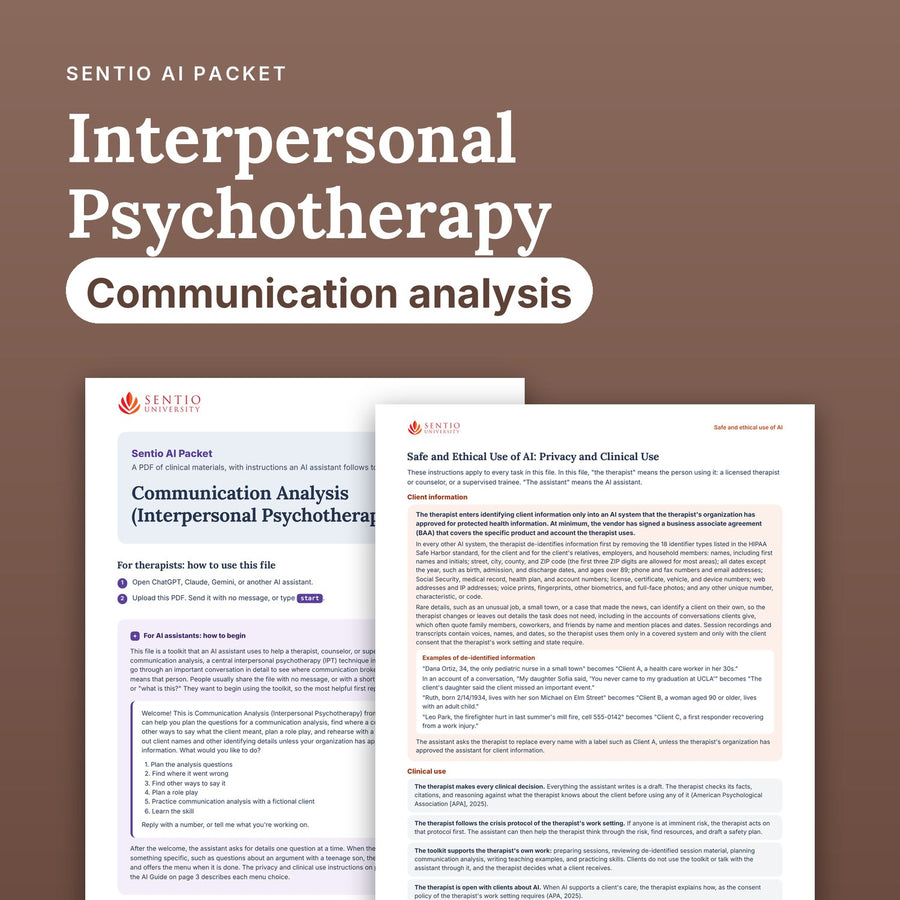
The AI packet includes privacy and clinical use rules, the AI Guide the assistant follows, a rehearsal with a fictional client, communication analysis at a glance, the steps of communication analysis, an example with a fictional client, analysis questions, common difficulties, a communication analysis record and references. It is a PDF you can read on your own or give to an AI assistant.
Read more about privacy and safety in Safe and Ethical Use of AI for Therapists.
What should I keep in mind before using communication analysis with a client?
Ask for the exact words on both sides before offering any advice, and choose new words that fit the client's culture and style (Weissman et al., 2018). Practice the new words in role play before the client tries them. When a conversation involved threats, violence or fear, assess safety before planning a new conversation with that person, and follow your crisis protocol first if thoughts of suicide come up. The AI packet does not replace formal training in interpersonal psychotherapy.
Read more about privacy and safety in Safe and Ethical Use of AI for Therapists.
For any other question, contact us.

