
Sentio AI Packet
AI training for Unified Detachment
- Sharpen your skills.
- Plan sessions faster.
- Use ChatGPT safely.
- ChatGPT
- Claude
- Gemini
- Perplexity
- and more
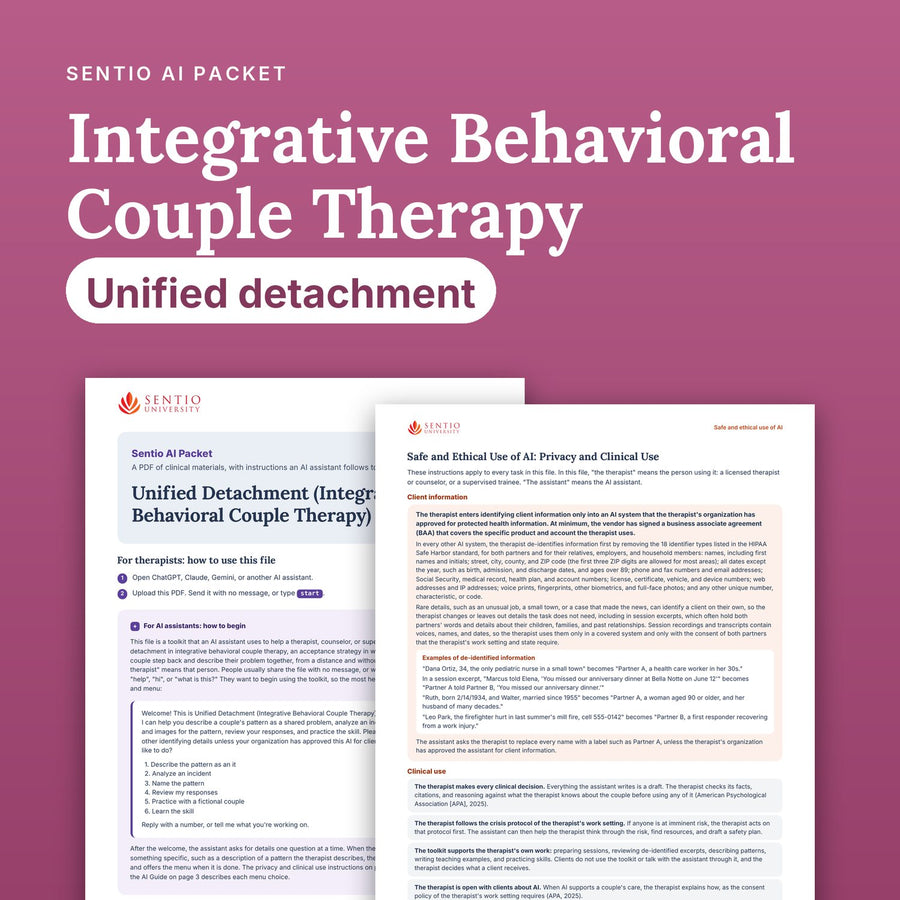
Welcome! This is Unified Detachment (Integrative Behavioral Couple Therapy) from Sentio University Library.
I can help you describe a couple's pattern as a shared problem, analyze an incident step by step, find names and images for the pattern, review your responses, and practice the skill.
Please leave out client names and other identifying details unless your organization has approved this AI for client information. What would you like to do?
- Describe the pattern as an it
- Analyze an incident
- Name the pattern
- Review my responses
- Practice with a fictional couple
- Learn the skill
2. I'm new to IBCT. Help me analyze an incident. Last Friday Partner A came home late from work, Partner B had cooked dinner and said, "Nice of you to show up," and Partner A went to the bedroom and shut the door.
Here is a draft incident analysis for your review, in neutral words, with the parts you haven't told me marked as questions (APA, 2012; Christensen et al., 2014).
- Context: Friday evening, with Partner A home late from work and dinner ready. Ask, "What was going on for each of you before that?"
- Triggers: to confirm. Ask each partner, "What set you off?"
- Sequence: Partner A arrives late, Partner B says, "Nice of you to show up," and Partner A goes to the bedroom and shuts the door. Ask, "And then what happened?"
- Recovery and defusing: ask how each partner tried to recover afterward, and "Where could this have gone differently?"
- Name for the pattern: ask the couple, "What would you call this pattern?"
Open with a descriptive tone, such as "Let's step back and look at Friday together, like two people watching a replay." Would you like me to suggest names for the pattern or change any part?
When we started on Friday in session, they began the same argument all over again.
Retelling an incident can reignite the argument, a common difficulty. Slow the pace, describe what is happening in the room as part of the pattern and return to the sequence (APA, 2012; Christensen et al., 2014). Here is a draft line for your review.
"Let's slow down. It looks like the same pattern is showing up right here with us. Let's go back to Friday. After the door closed, what happened next?"
Partner A keeps asking me to say who was right.
Unified detachment describes the problem with no blame and with responsibility for change on neither partner (Christensen et al., 2014). Describe how each partner experienced the moment, and keep the pattern as the it they both face. Here is a draft reply for your review.
"I'd like to understand how each of you lived that evening. What was Friday like for you? It sounds like this pattern caught you both."
While we retold Friday, Partner B went pale and said, "I get scared when it gets loud at home."
I'm pointing that out for your risk assessment, since fear of a partner calls for a check on safety.
When retelling an incident makes a partner flooded or afraid, slow down or stop, and check safety with each partner separately. Ask each partner alone about fear, violence and threats (APA, 2012; Christensen et al., 2014), and stop acceptance work when a partner describes threats or intimidation. If anyone is at imminent risk, follow your work setting's crisis protocol first.
After that, I can help you think the risk through, find resources and plan the next sessions.
I'll meet with each of them alone first. Can I practice tracing the sequence with a couple who drift into blame?
Yes. That is the intermediate level.
Your fictional couple is Ana, 29, and Ben, 32, together for four years. They came in because their arguments about phones at dinner keep ending in long silences.
You can type Pause, Rewind, Show me, Harder, Easier or End at any time. Start when you're ready.
Let's step back and look at Tuesday's dinner together. What was going on for each of you beforehand?
Ana: I'd had a hard day and wanted to talk. And he was on his phone, as usual.
Ben: [rolls his eyes] As usual. Here we go.
Pause
Out of role. What worked: you set a calm tone and asked about the context first.
One thing to try: describe the moves in neutral words and keep going through the sequence, for example, "So Ana came to dinner after a hard day wanting to talk, and Ben had his phone out. Ana, what did you do next? Ben, and then what did you do?"
Type Rewind to try that moment again.
How this AI packet helps you
- Describe the couple's pattern as an it.
- Analyze one recent incident.
- Find a name for the pattern.
- Review your responses in a session excerpt.
- Rehearse with a fictional couple.
- Identify and address risks such as hopelessness, self-harm and thoughts of suicide.
- Learn to use AI safely and ethically while protecting client privacy.
About the skill
Integrative behavioral couple therapy (IBCT) was developed by Andrew Christensen and the late Neil S. Jacobson (APA, 2012). Unified detachment is one of its acceptance strategies. Partners step back and describe their problem without placing blame, or responsibility for change, on either one (Christensen et al., 2014). The therapist guides a distant, descriptive analysis of the problem (APA, 2012).
What the analysis covers
- The context: where and when the incident happened, and what was going on for each partner
- The triggers: what triggered each partner's reaction
- The sequence: the sequence of actions, and how one event connected to the next
- The recovery: each partner's efforts to recover afterward, and how the conflict might be defused
The therapist describes the problem as a third party, an it the partners can look at together. Unified detachment is used most often with the pattern of interaction in the couple's DEEP analysis (Christensen et al., 2014).

Give this AI packet to AI
Your AI assistant will take it from there.
- ChatGPT
- Claude
- Gemini
- Perplexity
- and more
- Open a popular AI platform like ChatGPT, Claude, Gemini or Perplexity
- Upload this AI packet and type
start
Pricing
For every AI packet and AI kit you buy
- PDF format, ready to download
- 30-day refund, no questions asked
The IBCT AI kit includes all of these skills
You can also buy any skill as a single AI packet.
- The DEEP analysis$15
- The feedback session$15
- Empathic joining$15
- Unified detachmentThis AI packet
- Tolerance building$15
- Dyadic behavioral activation$15
- Communication training$15
- Problem-solving training$15
Frequently asked questions
What is unified detachment in integrative behavioral couple therapy?
Unified detachment is an acceptance strategy in integrative behavioral couple therapy (IBCT). Partners step back and describe their problem without placing blame, or responsibility for change, on either one (Christensen et al., 2014). The therapist guides a distant, descriptive analysis of the problem (APA, 2012).
When do therapists use unified detachment?
Therapists use unified detachment when a couple can look back at an incident or issue and describe it together. It brings recent conflicts back into the room, so the therapist makes sure that retelling them is safe. When the retelling heats up, the therapist slows the pace and returns to the sequence. Acceptance work is for ordinary differences, and it stops when a partner describes violence, threats, intimidation or control.
How does the unified detachment AI packet support safe and ethical use of AI?
The unified detachment AI packet carries the standard privacy and clinical use rules. You enter identifying client details only into an AI system your organization has approved for protected health information, under a business associate agreement covering your product and account, and you de-identify everything else. You follow your organization's crisis protocol first and make every clinical decision, and the AI assistant's pattern descriptions, incident analyses and names for the pattern are drafts for your review. The rehearsal uses fictional clients, and clients do not use the AI packet.
Read more about privacy and safety in Safe and Ethical Use of AI for Therapists.
How can organizations use the unified detachment AI packet?
Military and veterans programs, community mental health centers, family service agencies, group practices and training programs can give their therapists the unified detachment AI packet through the Sentio University Library. Many therapists already use AI, and the AI packet gives them a safer and more ethical way to describe a couple's pattern without blame and analyze an incident. The Organizations page explains how organizations get access.
Read more about privacy and safety in Safe and Ethical Use of AI for Therapists.
How can graduate students use the unified detachment AI packet?
Graduate students learn what the analysis covers, including the context, the triggers and the sequence, and eight steps, from choosing an incident or issue to adding distance. An example with a fictional couple shows a session. The rehearsal offers partners who describe incidents calmly and accept a name for their pattern and partners who drift into blame or reopen the argument while describing it.
How can practicing therapists use the unified detachment AI packet?
Licensed therapists use the AI packet to describe the pattern as an it, analyze an incident, name the pattern and review their own responses. The AI packet includes phrases for unified detachment, a checklist, safety guidance for couple sessions and an incident analysis form for the therapist to fill in.
How can supervisors and faculty use the unified detachment AI packet?
Supervisors can review a trainee's work against the common difficulties, such as a description that slides into judging one partner, a name for the pattern that pokes fun at one partner, or an account that stays general and skips the sequence. Trainees can rehearse slowing a heated account, tracing a sequence or naming the pattern. Faculty can teach what the analysis covers from the at-a-glance page.
In which settings does unified detachment fit?
Unified detachment fits settings where therapists see couples, including military and veterans programs, community mental health centers, family service agencies and group practices. Many therapists in these settings already use AI, and the AI packet's privacy and clinical use rules give them a safer and more ethical way to do it by keeping the details of a couple's recent conflicts inside approved AI systems and by leaving with the therapist the judgment that retelling them is safe.
Read more about privacy and safety in Safe and Ethical Use of AI for Therapists.
Can I use the unified detachment AI packet as a study guide or for exam review?
The AI packet works as a short study guide on unified detachment, with what the analysis covers, the steps, phrases and an example session. The AI assistant can teach any part and quiz you one question at a time. Students reviewing couple therapy for exams can use it alongside the official study materials for their exam.
How do I practice unified detachment with AI?
Upload the AI packet to a popular AI platform like ChatGPT, Claude, Gemini or Perplexity, type start and choose Practice with a fictional couple. You pick what the couple argues about, the pattern they fall into, such as one partner pushing and the other withdrawing, and the step you want to practice. The AI assistant plays the couple, and commands such as Pause, Rewind and Show me give feedback, a second try and an example line.
What does the unified detachment AI packet include?
The AI packet includes privacy and clinical use rules, the AI Guide the assistant follows, a rehearsal with a fictional couple, unified detachment at a glance, eight steps, an example with a fictional couple, phrases for unified detachment, a checklist, common difficulties, safety guidance for couple sessions, an incident analysis form and references. It is a PDF you can read on your own or give to an AI assistant.
Read more about privacy and safety in Safe and Ethical Use of AI for Therapists.
What should I keep in mind before using unified detachment with a couple?
Keep the tone descriptive, trace the sequence step by step and choose a name for the pattern that both partners accept. When partners dispute the facts, describe how each experienced the moment. When a partner describes threats, intimidation, violence, hopelessness or thoughts of suicide, assess safety with each partner separately and follow your organization's crisis protocol first.
Read more about privacy and safety in Safe and Ethical Use of AI for Therapists.
For any other question, contact us.

