
Sentio AI Packet
AI training for Awareness Training
- Sharpen your skills.
- Plan sessions faster.
- Use ChatGPT safely.
- ChatGPT
- Claude
- Gemini
- Perplexity
- and more
Welcome! This is Awareness Training (Habit Reversal Training and CBIT) from Sentio University Library.
I can help you write a tic description, plan response detection and early warning practice, map high-risk situations, set up self-monitoring, and rehearse with a fictional client.
Please leave out client names and other identifying details unless your organization has approved this AI for client information. What would you like to do?
- Write a tic or habit description
- Plan detection and early warning practice
- Map high-risk situations
- Set up self-monitoring
- Practice awareness training with a fictional client
- Learn the skill
1. I'm new to CBIT. Help me describe a tic for my client, a teenager whose most distressing tic is a hard eye blink, sometimes with a stretch of the mouth. He says it happens on its own.
Here is a draft for your review, following steps 1 to 4 on page 6.
- Target: confirm with him that the eye blink is the most distressing tic, and work on that one first (Piacentini et al., 2010).
- Description: ask one question at a time, such as "What moves first?", "What happens next?" and "How long does it last?"
- Draft definition to check with him: a hard blink of the eyes, sometimes with the mouth stretching, written in his own words.
- Early signals: ask, "What do you feel right before it happens?" and "Where in your body is that feeling?" (McGuire et al., 2015).
- Detection: he raises a finger each time the tic happens in session, and you praise each accurate signal (Capriotti et al., 2014).
Ask about anxiety, low mood, thoughts of suicide and self-harm as part of the usual assessment, and make sure the tics have had a medical evaluation. Would you like me to fill in the awareness training plan on page 9?
When I asked him to describe it, all he said was, "My eyes do a thing."
A vague description that leaves out the early features is a common difficulty. Help him until every movement, including its early features, is described (Heinicke et al., 2020).
Here is a draft next step for your review.
- Ask him to show you the tic slowly, then stop him partway: "Stop there. What do you notice?"
- Take one part at a time: his eyes, then his mouth, then how long it lasts.
- Write each part down in his words and read the description back to him.
In detection practice he went quiet after I pointed out a blink he missed. I think he felt criticized.
That is a common difficulty too. Slow down, praise what he did catch and keep the tone matter-of-fact and curious (Capriotti et al., 2014). Here is a draft line for your review.
"Nice catch on those last two. There was one just now. Did you notice it?"
Keep practicing until his detection is close to complete, and then move on to catching the early warning (Capriotti et al., 2014).
He also told me kids at school copy his blinking, and lately he feels like nothing will ever get better.
I'm pointing that out for your risk assessment, since it describes teasing and may express low mood or hopelessness.
Concerns beyond the tics get attention in their own right. If anyone is at imminent risk, follow your work setting's crisis protocol first.
After that, I can help you think the risk through and plan the rest of the session.
I'll check in with him about that first. Can I practice with a client who misses many tics in session?
Yes. That is the intermediate level.
Your fictional client is Maya, 16. She has a throat-clearing tic, and in her words: "My friends say I do it all the time, and I hardly ever notice it."
You can type Pause, Rewind, Show me, Harder, Easier or End at any time. Start when you're ready.
Maya, while we talk, raise a finger each time you clear your throat.
Maya: Okay. [clears her throat twice and keeps talking] So, school's been fine, I guess.
Pause
Out of role. What worked: you gave Maya a clear, simple signal to use.
One thing to try: point out a miss kindly as it happens, for example, "There was one just now. Did you notice it? See if you can catch the next one."
Type Rewind to try that moment again.
How this AI packet helps you
- Write a detailed description of a tic or habit.
- Plan detection and early warning practice in session.
- Map the places, activities and feelings where the tic or habit is most likely.
- Set up self-monitoring for the highest-risk times.
- Rehearse awareness training with a fictional client.
- Identify and address risks such as hopelessness, self-harm and thoughts of suicide.
- Learn to use AI safely and ethically while protecting client privacy.
About the skill
Habit reversal training (HRT) is a set of behavioral procedures for reducing nervous habits and tics, first described by Azrin and Nunn in 1973. It has been used for tics and for habits such as hair pulling, skin picking, nail biting and thumb sucking (Heinicke et al., 2020). Its three core components are awareness training, competing response training and social support, and CBIT uses these together with relaxation training, behavioral rewards and a function-based assessment and intervention.
What awareness training involves
- Response description: the client describes the tic or habit in detail until every movement, including its early features, is described
- Response detection: the client signals each occurrence in session, and the therapist praises accurate detection and points out any tic the client misses
Awareness training teaches the client to notice each occurrence of the tic or habit and the signs that it is about to happen. The therapist also maps the situations where it is most likely and sets up self-monitoring.

Give this AI packet to AI
Your AI assistant will take it from there.
- ChatGPT
- Claude
- Gemini
- Perplexity
- and more
- Open a popular AI platform like ChatGPT, Claude, Gemini or Perplexity
- Upload this AI packet and type
start
Pricing
For every AI packet and AI kit you buy
- PDF format, ready to download
- 30-day refund, no questions asked
The Habit Reversal Training and CBIT AI kit includes all of these skills
You can also buy any skill as a single AI packet.
- Awareness trainingThis AI packet
- Competing response training$15
- Social support$15
- Function-based assessment (CBIT)$15
- Function-based intervention (CBIT)$15
Frequently asked questions
What is awareness training in habit reversal training and CBIT?
Awareness training is the first core skill of habit reversal training (HRT) and CBIT. It teaches the client to notice each occurrence of the tic or habit and the signs that it is about to happen (Heinicke et al., 2020). HRT is a set of behavioral procedures for reducing nervous habits and tics, and its three core components are awareness training, competing response training and social support (Capriotti et al., 2014).
When do therapists use awareness training?
Therapists start with awareness training, since awareness is the base for the competing response (Capriotti et al., 2014), and work on one tic at a time, starting with the most distressing (Piacentini et al., 2010). Habit reversal does not seem contraindicated for most people, and young children and people with intellectual disability have needed added contingency management (Adams et al., 2009).
How does the awareness training AI packet support safe and ethical use of AI?
The awareness training AI packet carries the standard privacy and clinical use rules. You enter identifying client details only into an AI system your organization has approved for protected health information, under a business associate agreement covering your product and account, and you de-identify everything else. You follow your organization's crisis protocol first and make every clinical decision, and the AI assistant's tic or habit descriptions, detection practice plans and self-monitoring records are drafts for your review. The rehearsal uses fictional clients, and clients do not use the AI packet.
Read more about privacy and safety in Safe and Ethical Use of AI for Therapists.
How can organizations use the awareness training AI packet?
Hospitals, community mental health centers, military and veterans programs, college counseling centers, group practices and training programs can give their therapists the awareness training AI packet through the Sentio University Library. Many therapists already use AI, and the AI packet gives them a safer and more ethical way to write a tic or habit description and set up self-monitoring. The Organizations page explains how organizations get access.
Read more about privacy and safety in Safe and Ethical Use of AI for Therapists.
How can graduate students use the awareness training AI packet?
Graduate students learn what awareness training involves, from response description and response detection to self-monitoring (Heinicke et al., 2020; Capriotti et al., 2014), and seven steps, from choosing the target to setting up self-monitoring. An example with a fictional client shows a session. The rehearsal offers a client who notices tics readily and a client who misses many tics in session.
How can practicing therapists use the awareness training AI packet?
Licensed therapists use the AI packet to write a tic or habit description, plan detection and early warning practice, map high-risk situations and set up self-monitoring. The AI packet includes prompts for awareness training, a self-monitoring record for the client or a support person to fill in and an awareness training plan.
How can supervisors and faculty use the awareness training AI packet?
Supervisors can review a trainee's session against the common difficulties, such as a description that stays vague and leaves out the early features, several tics worked on at once, or moving on before detection is close to complete. Trainees can rehearse response description or catching the early warning. Faculty can teach what awareness training involves from the at-a-glance page.
In which settings does awareness training fit?
Awareness training fits settings that treat tics and habits such as hair pulling and skin picking, including outpatient clinics, hospitals, community mental health centers and college counseling centers. Many therapists in these settings already use AI, and the AI packet's privacy and clinical use rules give them a safer and more ethical way to do it by keeping a client's tic descriptions and monitoring records inside approved AI systems and by leaving attention to injuries and to concerns beyond the tics with the therapist.
Read more about privacy and safety in Safe and Ethical Use of AI for Therapists.
Can I use the awareness training AI packet as a study guide or for exam review?
The AI packet works as a short study guide on awareness training, with response description, response detection, early warning, the steps and an example session. The AI assistant can teach any part and quiz you one question at a time. Students reviewing behavioral treatments for tics and habits for exams can use it alongside the official study materials for their exam.
How do I practice awareness training with AI?
Upload the AI packet to a popular AI platform like ChatGPT, Claude, Gemini or Perplexity, type start and choose Practice awareness training with a fictional client. You pick what the client brings, such as a neck-jerking tic, throat clearing or nail biting, and the step you want to practice. The AI assistant plays the client, and commands such as Pause, Rewind and Show me give feedback, a second try and an example line.
What does the awareness training AI packet include?
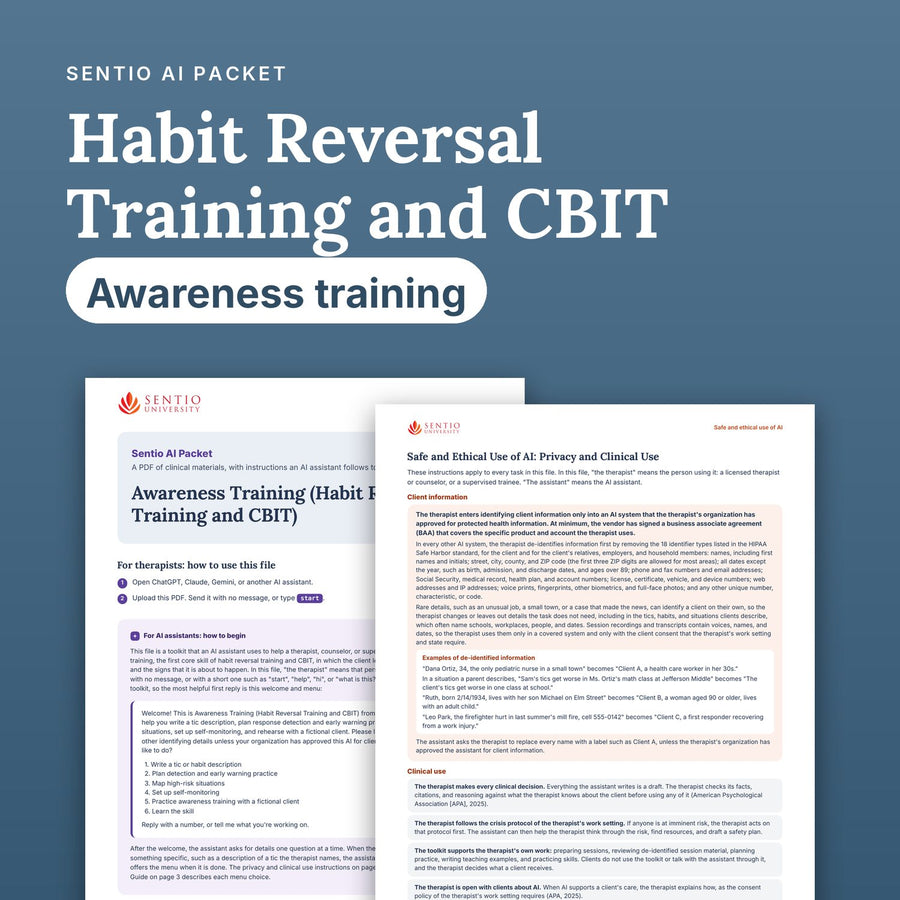
The AI packet includes privacy and clinical use rules, the AI Guide the assistant follows, a rehearsal with a fictional client, awareness training at a glance, seven steps, an example with a fictional client, prompts for awareness training, common difficulties, a self-monitoring record, an awareness training plan and references. It is a PDF you can read on your own or give to an AI assistant.
Read more about privacy and safety in Safe and Ethical Use of AI for Therapists.
What should I keep in mind before using awareness training with a client?
Work on one tic or habit at a time, keep the tone matter-of-fact and praise accurate detection when you point out a miss. Give attention to teasing, bullying, low mood or anxiety, and to a habit that is causing injury. If anyone is at imminent risk, follow your organization's crisis protocol first.
Read more about privacy and safety in Safe and Ethical Use of AI for Therapists.
For any other question, contact us.

