
Sentio AI Packet
AI training for The Three Paths
- Sharpen your skills.
- Plan sessions faster.
- Use ChatGPT safely.
- ChatGPT
- Claude
- Gemini
- Perplexity
- and more
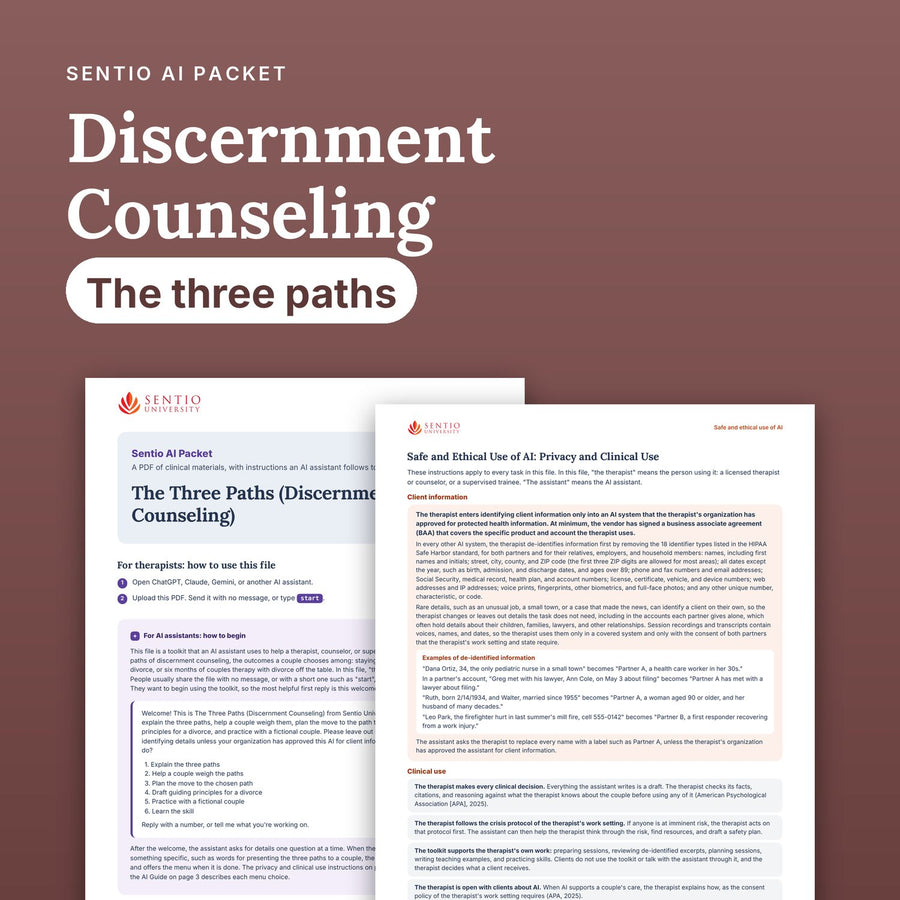
Welcome! This is The Three Paths (Discernment Counseling) from Sentio University Library.
I can help you explain the three paths, help a couple weigh them, plan the move to the path they choose, draft guiding principles for a divorce, and practice with a fictional couple.
Please leave out client names and other identifying details unless your organization has approved this AI for client information. What would you like to do?
- Explain the three paths
- Help a couple weigh the paths
- Plan the move to the chosen path
- Draft guiding principles for a divorce
- Practice with a fictional couple
- Learn the skill
1. I'm new to discernment counseling. In our second session, Partner A, who is leaning out, said, "So it comes down to staying or divorcing." Partner B is leaning in.
Here is a draft for your review, presenting the three paths evenly (Doherty et al., 2016).
- Path 1, status quo: you continue as things have been, without couples therapy for now, and I'm here as a resource later.
- Path 2, separation or divorce: we set guiding principles for the divorce, and I connect you with professionals for a constructive divorce.
- Path 3, reconciliation: you take divorce off the table and commit to six months of couples therapy, starting with a written agenda of the changes each of you wants to make in yourself.
"There are three paths, and each is a real choice. The aim is clarity and confidence, whichever path you choose."
Then explore each path with each partner alone, asking what it would mean for that partner and for the children. Would you like questions for those conversations?
I notice I keep hoping they'll choose Path 3. Partner A said to me, "You think divorce means we failed."
Favoring one path, or treating divorce as a failure, is a common difficulty. The developers do not count divorce as a failure of discernment counseling, and success means clarity and confidence in whichever decision the couple makes (Doherty et al., 2016; Minnesota Couples on the Brink Project, n.d.-a). Here is a draft line for your review.
"Whatever you choose, the aim is to feel clear and confident about it. Each path is a real choice."
If they do choose Path 3, can I start couples therapy at the next session as usual?
Mark the shift out loud, since an unmarked move to couples therapy lets the work blur. Here is a draft plan for your review (Doherty et al., 2016).
- Say that discernment counseling has ended and couples therapy has begun.
- Start with each partner's written agenda for change.
- Refer for other services as needed, such as an alcohol assessment, a couples retreat weekend or personal therapy.
"Today discernment counseling ends, and couples therapy begins. What do you each want to change in yourselves?"
When I met Partner B alone, she said Partner A checks her phone every night and decides who she can see.
I'm pointing that out for your risk assessment, since it may signal coercion.
Discernment counseling is not suitable when there is a danger of domestic violence or when one partner is coercing the other to take part (Minnesota Couples on the Brink Project, n.d.-a; Doherty et al., 2016). Assess safety with each partner separately and follow your work setting's policies. If anyone is at imminent risk, follow your work setting's crisis protocol first.
After that, I can help you think the risk through, find resources and plan what to offer.
I'll assess that with her alone first. Can I practice with partners who lean toward different paths?
Yes. That is the advanced level.
Your fictional couple is Rosa, 47, and Dev, 49, married 20 years with a teenage son. They came in after years of fighting.
You can type Pause, Rewind, Show me, Harder, Easier or End at any time. Start when you're ready.
Rosa, Dev, today I'd like to walk you through three paths you can choose among.
Rosa: I already know. I want the six months of therapy.
Dev: [arms crossed] I'm leaning toward separating. I can't see what six months would change.
Pause
Out of role. What worked: you named three paths at the start.
One thing to try: explore each path with each partner alone, for example, "Dev, when we talk one on one, I'd like to hear what each path would mean for you and for your son."
Type Rewind to try that moment again.
How this AI packet helps you
- Explain the three paths evenly, in plain words.
- Help each partner weigh the paths.
- Plan the move to the chosen path.
- Draft guiding principles for a divorce.
- Rehearse with a fictional couple.
- Identify and address risks such as hopelessness, self-harm and thoughts of suicide.
- Learn to use AI safely and ethically while protecting client privacy.
About the skill
Discernment counseling, developed by William Doherty and Steven Harris, works toward one of three paths, which the counselor presents evenly (Doherty et al., 2016).
The three paths
- Path 1, status quo: the couple continues as things have been, without couples therapy for now, and the counselor offers to be a resource later
- Path 2, separation or divorce: the counselor helps the couple set guiding principles for the divorce and connects them with professionals for a constructive divorce
- Path 3, reconciliation: the partners take divorce off the table and commit to six months of couples therapy, starting with a written agenda of the changes each wants to make in themselves
The counselor helps each partner weigh the paths alone and then plans the move to the path the couple chooses.

Give this AI packet to AI
Your AI assistant will take it from there.
- ChatGPT
- Claude
- Gemini
- Perplexity
- and more
- Open a popular AI platform like ChatGPT, Claude, Gemini or Perplexity
- Upload this AI packet and type
start
Pricing
For every AI packet and AI kit you buy
- PDF format, ready to download
- 30-day refund, no questions asked
The Discernment Counseling AI kit includes all of these skills
You can also buy any skill as a single AI packet.
- Mixed-agenda couples$15
- Separate conversations$15
- The three pathsThis AI packet
- Personal agenda for change$15
- Divorce, repair and reconciliation narratives$15
Frequently asked questions
What are the three paths in discernment counseling?
The three paths are the outcomes a couple chooses among in discernment counseling: staying as things are, separation or divorce, or a course of couples therapy with divorce off the table. The developers present the paths in place of a choice between staying and divorcing (Doherty et al., 2016; Emerson et al., 2021). They do not count divorce as a failure of discernment counseling (Doherty et al., 2016).
When do therapists use the three paths?
Therapists present the three paths and explore each one with each partner alone, and the choice stays with the couple. On Path 3 the partners take divorce off the table and commit to couples therapy, and afterward the couple can decide on a permanent commitment or an ending, having made a full effort (Doherty et al., 2016). The safety guidance applies to every path.
How does the three paths AI packet support safe and ethical use of AI?
The three paths AI packet carries the standard privacy and clinical use rules. You enter identifying client details only into an AI system your organization has approved for protected health information, under a business associate agreement covering your product and account, and you de-identify everything else. You follow your organization's crisis protocol first and make every clinical decision, and the AI assistant's path explanations, path plans and guiding principles for a divorce are drafts for your review. The rehearsal uses fictional clients, and clients do not use the AI packet.
Read more about privacy and safety in Safe and Ethical Use of AI for Therapists.
How can organizations use the three paths AI packet?
Hospitals, community mental health centers, military and veterans programs, college counseling centers, group practices and training programs can give their therapists the three paths AI packet through the Sentio University Library. Many therapists already use AI, and the AI packet gives them a safer and more ethical way to explain the three paths and plan the move to the chosen path. The Organizations page explains how organizations get access.
Read more about privacy and safety in Safe and Ethical Use of AI for Therapists.
How can graduate students use the three paths AI packet?
Graduate students learn the three paths, status quo, separation or divorce, and reconciliation (Doherty et al., 2016; Emerson et al., 2021), and seven steps, from presenting the paths to offering to be a resource. An example session shows the work with a fictional couple. The rehearsal offers partners who weigh the paths calmly and a partner who wants a quick answer.
How can practicing therapists use the three paths AI packet?
Licensed therapists use the AI packet to explain the three paths, help a couple weigh the paths, plan the move to the chosen path and draft guiding principles for a divorce. The AI packet includes phrases for each path, safety guidance for discernment counseling and a path plan.
How can supervisors and faculty use the three paths AI packet?
Supervisors can review a trainee's session against the common difficulties, such as presenting only two choices, favoring one path or treating divorce as a failure, or leaving the move to couples therapy unmarked. Trainees can rehearse presenting the paths or responding when the partners choose differently. Faculty can teach the three paths from the at-a-glance page.
In which settings do the three paths fit?
The three paths fit settings that see couples for whom a breakup is a real possibility, including group practices, community mental health centers, college counseling centers and military and veterans programs. Many therapists in these settings already use AI, and the AI packet's privacy and clinical use rules give them a safer and more ethical way to do it by keeping each partner's leanings and the couple's decision inside approved AI systems and by leaving the choice of path with the couple.
Read more about privacy and safety in Safe and Ethical Use of AI for Therapists.
Can I use the three paths AI packet as a study guide or for exam review?
The AI packet works as a short study guide on the three paths, with a description of each path, phrases for each, the steps and an example session. The AI assistant can teach any part and quiz you one question at a time. Students reviewing couples work and divorce for exams can use it alongside the official study materials for their exam.
How do I practice the three paths with AI?
Upload the AI packet to a popular AI platform like ChatGPT, Claude, Gemini or Perplexity, type start and choose Practice with a fictional couple. You pick what brings the couple in, such as a long-distance strain or years of fighting, and the step you want to practice. The AI assistant plays the partners, and commands such as Pause, Rewind and Show me give feedback, a second try and an example line.
What does the three paths AI packet include?
The AI packet includes privacy and clinical use rules, the AI Guide the assistant follows, a rehearsal with a fictional couple, the three paths at a glance, seven steps, an example session, phrases for each path, common difficulties, safety in discernment counseling, a path plan and references. It is a PDF you can read on your own or give to an AI assistant.
Read more about privacy and safety in Safe and Ethical Use of AI for Therapists.
What should I keep in mind before using the three paths with a couple?
Present all three paths evenly and keep the decision with the couple. Mark the shift when the couple moves to couples therapy, and help a divorcing couple set guiding principles. When a partner reveals fear, coercion or violence, or shows hopelessness or thoughts of suicide as the marriage ends or stalls, follow your organization's crisis protocol first.
Read more about privacy and safety in Safe and Ethical Use of AI for Therapists.
For any other question, contact us.

