
Sentio AI Packet
AI training for Stimulus Discrimination
- Sharpen your skills.
- Plan sessions faster.
- Use ChatGPT safely.
- ChatGPT
- Claude
- Gemini
- Perplexity
- and more
Welcome! This is Stimulus Discrimination (Cognitive Therapy for PTSD) from Sentio University Library.
I can help you find what triggers a client's intrusions, build a then and now table, plan discrimination practice, set homework, and rehearse with a fictional client.
Please leave out client names and other identifying details unless your organization has approved this AI for client information. What would you like to do?
- Find the triggers
- Build a then and now table
- Plan discrimination practice in session
- Set up practice between sessions
- Practice discrimination with a fictional client
- Learn the skill
2. I'm new to CT-PTSD. Help me build a then and now table. My client was attacked by a former partner in her old apartment two years ago. The sound of keys at a door brings the attack back, and she says it feels like it's happening again.
Here is a draft table for your review, following step 3 on page 6. Fill in each "now" from her own details.
- Trigger: the sound of keys at a door.
- Place: then, her old apartment. Now, ask where she hears it these days, such as at home or at work.
- Time: then, ask what time of day it was. Now, the time she hears it.
- People: then, her former partner. Now, ask who is around her.
- Danger: then, being attacked. Now, ask what tells her she is safe.
- Mark each line same or different, and add a line for anything else she notices.
Ask about thoughts of suicide and self-harm as part of the usual assessment, and complete the risk screen on page 10. Would you like me to plan the practice in session next?
Yes. We filled in the table last week, and she still froze at the sound of keys at home.
A table filled in once and never practiced with the trigger present is a common difficulty. Here is a draft plan for your review, following steps 4 and 5 on page 6.
- Present a safe version of the trigger in session, such as a short recording of keys at low volume.
- As she hears it, ask her to name what is different now, using the table.
- Make the differences stronger: she moves about or says today's date aloud, and you change the volume of the sound (Wild et al., 2020).
- Between sessions, she names three differences each time she hears keys and notes them on the then and now record on page 9.
When the trigger overwhelms her, slow down, ground her and start with a milder version (Murray & El-Leithy, 2022).
She also has sudden waves of panic at home with no memory attached, and she can't say what sets them off.
Some triggers bring back only feelings or body sensations, with no memory, and they are handled the same way (Wild et al., 2020). Ask her to keep the intrusion diary on page 9 for a week. Here are draft questions for your review.
- "Where were you when the feeling came?"
- "What did you see, hear or smell just before?"
- "What were you feeling in your body?"
Look in the diary for subtle sensory cues, such as a sound, a smell or a body position, and add each one to the table.
She also told me, "He's been driving past my building at night."
I'm pointing that out for your risk assessment, since it may signal a real, current danger from another person.
Where a threat is real, safety planning comes first, and you assess current risk from others systematically (Murray & El-Leithy, 2022). If anyone is at imminent risk, follow your work setting's crisis protocol first.
After that, I can help you think the risk through and draft a safety plan.
I'll ask her about it today. Can I practice with a client who says the trigger feels exactly like the trauma?
Yes. That is the intermediate level.
Your fictional client is Tomas, 52. He was trapped in an elevator during an earthquake three years ago, and in his words: "When the elevator at work jolts, I'm right back there. It's exactly the same."
You can type Pause, Rewind, Show me, Harder, Easier or End at any time. Start when you're ready.
Tomas, when the elevator jolted at work, where were you, and who was with you?
Tomas: Going up to my office, with two coworkers. [breathes fast] It felt like the whole building was coming down again.
Pause
Out of role. What worked: you asked where he was and who was with him now.
One thing to try: help him turn his attention to one difference while he feels it, for example, "As you picture that jolt, what tells you that the building is standing?"
Type Rewind to try that moment again.
How this AI packet helps you
- Find when and where a client's intrusions happen.
- Build a then and now table for one trigger.
- Plan discrimination practice in session.
- Set up practice between sessions.
- Rehearse discrimination with a fictional client.
- Identify and address risks such as hopelessness, self-harm and thoughts of suicide.
- Learn to use AI safely and ethically while protecting client privacy.
About the skill
Then versus now trigger discrimination is a core intervention of cognitive therapy for PTSD (CT-PTSD). It aims to break the link between present-day triggers and the past trauma (Wild et al., 2020). The worst moments of the trauma memory are easily triggered by matching sensory cues, so present reminders bring back the sense of threat (Murray & El-Leithy, 2022).
Kinds of triggers
- Obvious reminders: places, people, news or events that resemble the trauma
- Subtle sensory cues: a shade of color, a sound, a smell, a taste or a body position
- Emotions and body sensations: some triggers bring back only the feelings or sensations of the trauma, without the memory itself
Therapist and client find the triggers, compare the features of the trauma with the features of the present situation, and practice the comparison in session and as homework.

Give this AI packet to AI
Your AI assistant will take it from there.
- ChatGPT
- Claude
- Gemini
- Perplexity
- and more
- Open a popular AI platform like ChatGPT, Claude, Gemini or Perplexity
- Upload this AI packet and type
start
Pricing
For every AI packet and AI kit you buy
- PDF format, ready to download
- 30-day refund, no questions asked
The Cognitive Therapy for PTSD AI kit includes all of these skills
You can also buy any skill as a single AI packet.
- Reclaiming your life$15
- Updating trauma memories$15
- Stimulus discriminationThis AI packet
- Site visit$15
- Dropping safety behaviors and rumination$15
- Individualized case formulation$15
- Changing problematic appraisals$15
- Blueprint$15
Frequently asked questions
What is stimulus discrimination in cognitive therapy for PTSD?
Stimulus discrimination, also called then versus now discrimination, is a core intervention of cognitive therapy for PTSD (CT-PTSD) that aims to break the link between present-day triggers and the past trauma (Wild et al., 2020). The worst moments of the trauma memory are easily triggered by matching sensory cues, so present reminders bring back the sense of threat (Murray & El-Leithy, 2022). It is used in session and as homework (Wild et al., 2020).
When do therapists use stimulus discrimination?
Therapists use stimulus discrimination when triggers set off intrusions, and a client too triggered to function can start treatment with it (Murray & El-Leithy, 2022). For clients who dissociate in response to trauma reminders, it is part of the early work on dissociation, along with reminders of the here and now (Wild et al., 2020). Some threats are real and current, and those call for a safety plan.
How does the stimulus discrimination AI packet support safe and ethical use of AI?
The stimulus discrimination AI packet carries the standard privacy and clinical use rules. You enter identifying client details only into an AI system your organization has approved for protected health information, under a business associate agreement covering your product and account, and you de-identify everything else. You follow your organization's crisis protocol first and make every clinical decision, and the AI assistant's trigger lists, then and now tables and practice plans are drafts for your review. The rehearsal uses fictional clients, and clients do not use the AI packet.
Read more about privacy and safety in Safe and Ethical Use of AI for Therapists.
How can organizations use the stimulus discrimination AI packet?
Hospitals, community mental health centers, military and veterans programs, college counseling centers, group practices and training programs can give their therapists the stimulus discrimination AI packet through the Sentio University Library. Many therapists already use AI, and the AI packet gives them a safer and more ethical way to find the triggers and build a then and now table. The Organizations page explains how organizations get access.
Read more about privacy and safety in Safe and Ethical Use of AI for Therapists.
How can graduate students use the stimulus discrimination AI packet?
Graduate students learn the kinds of triggers, obvious reminders, subtle sensory cues, and emotions and body sensations (Wild et al., 2020), and six steps, from tracking intrusions to practicing between sessions. An example with a fictional client shows a session. The rehearsal offers a client who notices triggers easily and a client who says the trigger feels exactly like the trauma.
How can practicing therapists use the stimulus discrimination AI packet?
Licensed therapists use the AI packet to find the triggers, build a then and now table, plan discrimination practice in session and set up practice between sessions. The AI packet includes ideas for discrimination practice, an intrusion diary for the client to fill in between sessions and a then and now record.
How can supervisors and faculty use the stimulus discrimination AI packet?
Supervisors can review a trainee's session against the common difficulties, such as listing only obvious reminders, a table that is filled in once and left unpracticed with the trigger present, or a trigger so strong that the client dissociates. Trainees can rehearse tracking an intrusion back to its trigger. Faculty can teach the kinds of triggers from the at-a-glance page.
In which settings does stimulus discrimination fit?
Stimulus discrimination fits settings that treat PTSD, including community mental health centers, hospitals, college counseling centers and military and veterans programs. Many therapists in these settings already use AI, and the AI packet's privacy and clinical use rules give them a safer and more ethical way to do it by keeping a client's triggers and intrusion diary inside approved AI systems and by leaving the judgment about which threats are real and current with the therapist.
Read more about privacy and safety in Safe and Ethical Use of AI for Therapists.
Can I use the stimulus discrimination AI packet as a study guide or for exam review?
The AI packet works as a short study guide on stimulus discrimination, with the kinds of triggers, the then and now table, the steps and an example session. The AI assistant can teach any part and quiz you one question at a time. Students reviewing PTSD and its treatment for exams can use it alongside the official study materials for their exam.
How do I practice stimulus discrimination with AI?
Upload the AI packet to a popular AI platform like ChatGPT, Claude, Gemini or Perplexity, type start and choose Practice discrimination with a fictional client. You pick the concern the client brings, such as panic at the smell of smoke after a fire or fear at the sight of a blue car after a crash, and the step you want to practice. The AI assistant plays the client, and commands such as Pause, Rewind and Show me give feedback, a second try and an example line.
What does the stimulus discrimination AI packet include?
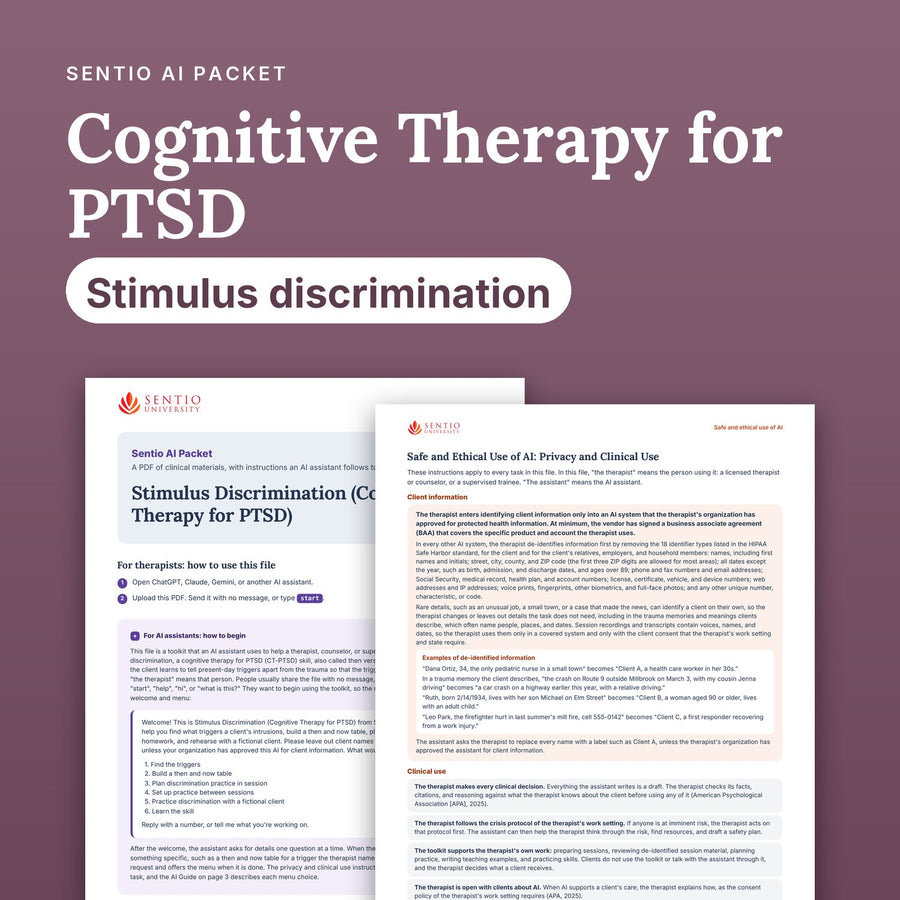
The AI packet includes privacy and clinical use rules, the AI Guide the assistant follows, a rehearsal with a fictional client, stimulus discrimination at a glance, six steps, an example with a fictional client, ideas for discrimination practice, common difficulties, an intrusion diary, a then and now record, safety in CT-PTSD and references. It is a PDF you can read on your own or give to an AI assistant.
Read more about privacy and safety in Safe and Ethical Use of AI for Therapists.
What should I keep in mind before using stimulus discrimination with a client?
Look for subtle sensory cues as well as obvious reminders, bring a safe version of each trigger into the session and practice with the trigger present. Ground a client who dissociates. When a trigger signals a real, current danger, review the safety plan, and when intrusions bring thoughts of suicide or self-harm, follow your organization's crisis protocol first.
Read more about privacy and safety in Safe and Ethical Use of AI for Therapists.
For any other question, contact us.

