
Sentio AI Packet
AI training for Socratic Dialogue for Stuck Points
- Sharpen your skills.
- Plan sessions faster.
- Use ChatGPT safely.
- ChatGPT
- Claude
- Gemini
- Perplexity
- and more
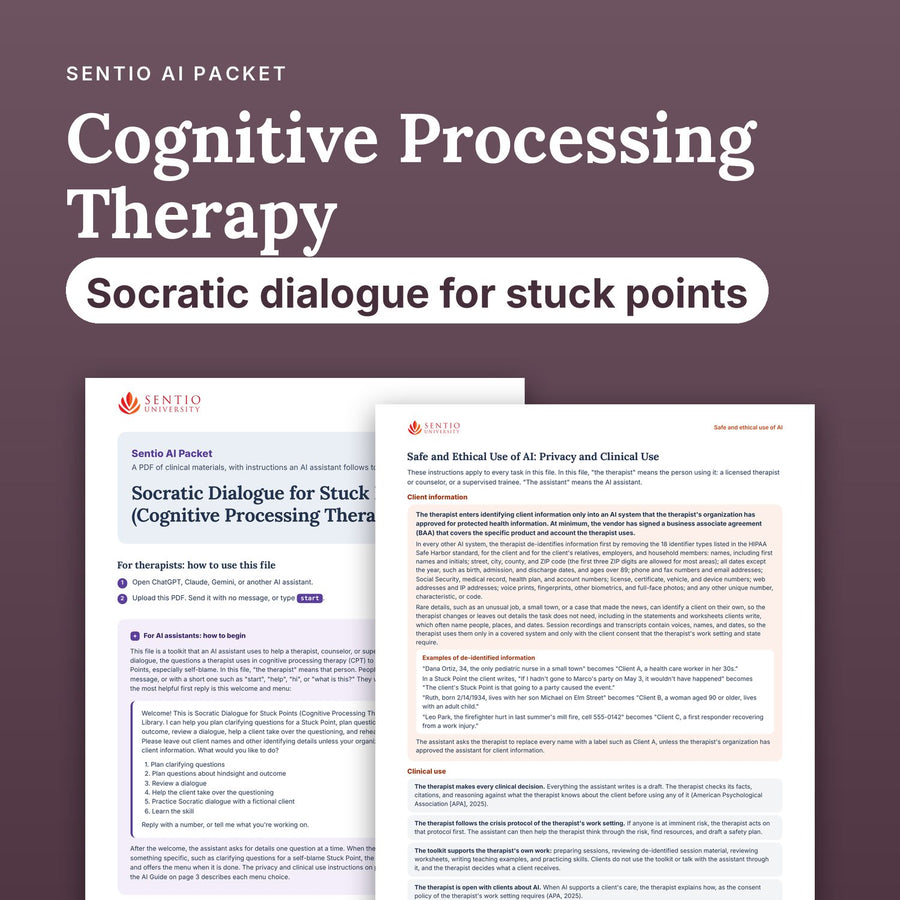
Welcome! This is Socratic Dialogue for Stuck Points (Cognitive Processing Therapy) from Sentio University Library. I can help you plan clarifying questions for a Stuck Point, plan questions about hindsight and outcome, review a dialogue, help a client take over the questioning, and rehearse with a fictional client.
Please leave out client names and other identifying details unless your organization has approved this AI for client information. What would you like to do?
- Plan clarifying questions
- Plan questions about hindsight and outcome
- Review a dialogue
- Help the client take over the questioning
- Practice Socratic dialogue with a fictional client
- Learn the skill
1. I'm new to CPT. My client's younger brother died in a car crash on his way home, and her Stuck Point is "It's my fault. I should have picked him up that night."
Here are draft clarifying questions for your review, in order, about the context and the choices and abilities she had at the time (Resick et al., 2024).
- "What was happening that evening, before he set off?"
- "What did you know at that moment about how he was getting home?"
- "What choices did you have then?"
- "How much time did you have to decide?"
- "What else might you have done? And what might have happened then?"
Ask one question at a time and follow her answers. About 80% to 90% of questions should be clarifying, so ask enough of these before any challenging question (Resick et al., 2017). Would you like questions about hindsight and outcome next?
When I asked what she knew, she said, "I should have known. I always know when something's wrong."
That calls for questions about hindsight: what she knew then, compared with what she knows now. Here are draft questions for your review.
"When did you learn about the crash? Could you have known that evening what you know now?"
Then a question about reasoning from the outcome: "If he had gotten home safely, would you still call it a mistake?"
I keep telling her, "It wasn't your fault," and she shuts down.
Arguing for a new view in place of asking is a common difficulty. Arguing or lecturing usually makes the client hold the Stuck Point more firmly, so go back to clarifying questions, asked with curiosity, and let her put the new view in her own words.
By the end she said, "I guess it wasn't my fault," and she looked as sad as before.
A client who agrees on the surface and still feels the same is a common difficulty. Questions about core beliefs help when the client understands a new thought and does not yet feel it (Resick et al., 2017).
Ask her to put the new view in her own words, and ask how it feels to say it.
She also said, "Some days I think my family would be better off without me."
I'm pointing that remark out for your risk assessment, since it may express thoughts of suicide, which can rise with guilt or shame.
Ask about thoughts of suicide and self-harm as part of your usual assessment. If anyone is at imminent risk, follow your work setting's crisis protocol first.
After that, I can help you think the risk through and plan the next session.
I'll ask her today. Can I practice first, with a client who holds firmly to self-blame?
Yes. That is the intermediate level.
Your fictional client is Tomas, 31. A worker on a job site he supervised was hurt in a fall from a ladder. In his words: "I should have checked that ladder myself."
You can type Pause, Rewind, Show me, Harder, Easier or End at any time. Start when you're ready.
Tomas, what was happening on the site just before the fall?
Tomas: We were behind schedule. Everyone was rushing. I should have stopped it. [shakes his head]
Pause
Out of role. What worked: you opened with a clarifying question about the context.
One thing to try: follow his answer with another clarifying question, for example, "With everyone rushing, what did you know about the ladder at that moment?"
Type Rewind to try that moment again.
How this AI packet helps you
- Plan clarifying questions.
- Plan questions about hindsight and outcome.
- Review a dialogue.
- Help the client take over the questioning.
- Rehearse with a fictional client.
- Identify and address risks such as hopelessness, self-harm and thoughts of suicide.
- Learn to use AI safely and ethically while protecting client privacy.
About the skill
Socratic dialogue is the main way cognitive processing therapy (CPT) works with Stuck Points. The therapist asks as many clarifying questions as possible to establish the context of the index event and the choices and abilities the client had at the time (Resick et al., 2024). The questions help the client find other explanations for self-blame.
Kinds of Socratic questions
- Clarifying questions: the foundation, about the context of the event and the choices and abilities the client actually had
- Questions that challenge assumptions: such as the belief in a just world and hindsight bias
- Questions that weigh the evidence: such as when present danger is overestimated
- Questions about core beliefs: when the client understands a new thought and does not yet feel it
Session 4 uses clarifying questions most, and from Session 5 the client gradually takes over the questioning. CPT usually runs about 12 sessions.

Give this AI packet to AI
Your AI assistant will take it from there.
- ChatGPT
- Claude
- Gemini
- Perplexity
- and more
- Open a popular AI platform like ChatGPT, Claude, Gemini or Perplexity
- Upload this AI packet and type
start
Pricing
For every AI packet and AI kit you buy
- PDF format, ready to download
- 30-day refund, no questions asked
The CPT AI kit includes all of these skills
You can also buy any skill as a single AI packet.
- Overview of PTSD and CPTGet it free
- The Impact Statement$15
- Identifying stuck points$15
- Socratic dialogue for stuck pointsThis AI packet
- ABC Worksheets$15
- Processing the index event$15
- Written trauma account$15
- Exploring questions$15
- Thinking patterns$15
- Alternative thoughts worksheets$15
- Trauma themes$15
- The final Impact Statement$15
Frequently asked questions
What is Socratic dialogue for Stuck Points in cognitive processing therapy?
Socratic dialogue is the main way cognitive processing therapy (CPT) works with Stuck Points. The therapist asks as many clarifying questions as possible to establish the context of the index event and the choices and abilities the client had at the time (Resick et al., 2024). The questions help the client find other explanations for self-blame, and the client gradually takes over the questioning.
When do therapists use Socratic dialogue for Stuck Points?
Therapists use Socratic dialogue whenever a Stuck Point is examined, starting with self-blame about the index event. Questions about alcohol use, clothing or other choices can sound like blame, so the therapist keeps such factors apart from the cause of an event that another person committed and waits for the Safety theme to discuss risk reduction (Resick et al., 2017). The therapist also checks how the client hears the questions.
How does the Socratic dialogue for Stuck Points AI packet support safe and ethical use of AI?
This AI packet carries the standard privacy and clinical use rules. You enter identifying client details only into an AI system your organization has approved for protected health information, under a business associate agreement covering your product and account, and you de-identify everything else. You follow your organization's crisis protocol first and make every clinical decision, and the AI assistant's clarifying questions, questions about hindsight and outcome and reviews of a dialogue are drafts for your review. The rehearsal uses fictional clients, and clients do not use the AI packet.
Read more about privacy and safety in Safe and Ethical Use of AI for Therapists.
How can organizations use the Socratic dialogue for Stuck Points AI packet?
Military and veterans programs, hospitals, community mental health centers, victim service programs with licensed staff and training programs can give their therapists this AI packet through the Sentio University Library. Many therapists already use AI, and the AI packet gives them a safer and more ethical way to plan clarifying questions and review a de-identified dialogue. The Organizations page explains how organizations get access.
Read more about privacy and safety in Safe and Ethical Use of AI for Therapists.
How can graduate students use the Socratic dialogue for Stuck Points AI packet?
Graduate students learn the kinds of Socratic questions, with clarifying questions as the foundation, and seven steps, from choosing the Stuck Point to handing over the questions. An example with a fictional client shows a session. The rehearsal offers a client who answers questions openly and a client who holds firmly to self-blame.
How can practicing therapists use the Socratic dialogue for Stuck Points AI packet?
Licensed therapists use the AI packet to plan clarifying questions, plan questions about hindsight and outcome, review a dialogue and help the client take over the questioning. The AI packet includes questions by kind, a Socratic dialogue planner and two pages of safety and cautions.
How can supervisors and faculty use the Socratic dialogue for Stuck Points AI packet?
Supervisors can review a trainee's dialogue against the common difficulties, such as challenging questions that come before enough clarifying ones, arguing for a new view in place of asking, or a question about the client's choices that sounds like blame. Trainees can rehearse the first clarifying questions or a client who says I should have known. Faculty can teach the kinds of Socratic questions from the at-a-glance page.
In which settings does Socratic dialogue for Stuck Points fit?
Socratic dialogue fits settings that treat adults with PTSD, including military and veterans programs, hospitals and community mental health centers. Many therapists in these settings already use AI, and the AI packet's privacy and clinical use rules give them a safer and more ethical way to do it by keeping the context of a client's trauma inside approved AI systems and by leaving the wording and timing of each question, and the watch for blame, with the therapist.
Read more about privacy and safety in Safe and Ethical Use of AI for Therapists.
Can I use the Socratic dialogue for Stuck Points AI packet as a study guide or for exam review?
The AI packet works as a short study guide on Socratic dialogue in CPT, with the kinds of Socratic questions, the steps, questions by kind and an example session. The AI assistant can teach any part and quiz you one question at a time. Students reviewing CPT for exams can use it alongside the official study materials for their exam.
How do I practice Socratic dialogue for Stuck Points with AI?
Upload the AI packet to a popular AI platform like ChatGPT, Claude, Gemini or Perplexity, type start and choose Practice Socratic dialogue with a fictional client. You pick what the client brings, such as a car crash or a combat event, and the step you want to practice. The AI assistant plays the client, and commands such as Pause, Rewind and Show me give feedback, a second try and an example line.
What does the Socratic dialogue for Stuck Points AI packet include?
The AI packet includes privacy and clinical use rules, the AI Guide the assistant follows, a rehearsal with a fictional client, Socratic dialogue at a glance, seven steps from choosing the Stuck Point to handing over the questions, an example with a fictional client, questions by kind, common difficulties, a Socratic dialogue planner, two pages of safety and cautions and references. It is a PDF you can read on your own or give to an AI assistant.
Read more about privacy and safety in Safe and Ethical Use of AI for Therapists.
What should I keep in mind before using Socratic dialogue with a client?
Ask clarifying questions before challenging ones, let the client reach a new view through the questions and check how the client hears each one. Keep factors such as alcohol use apart from the cause of an event that another person committed. When thoughts of suicide rise with guilt or shame, follow your organization's crisis protocol first.
Read more about privacy and safety in Safe and Ethical Use of AI for Therapists.
For any other question, contact us.

