
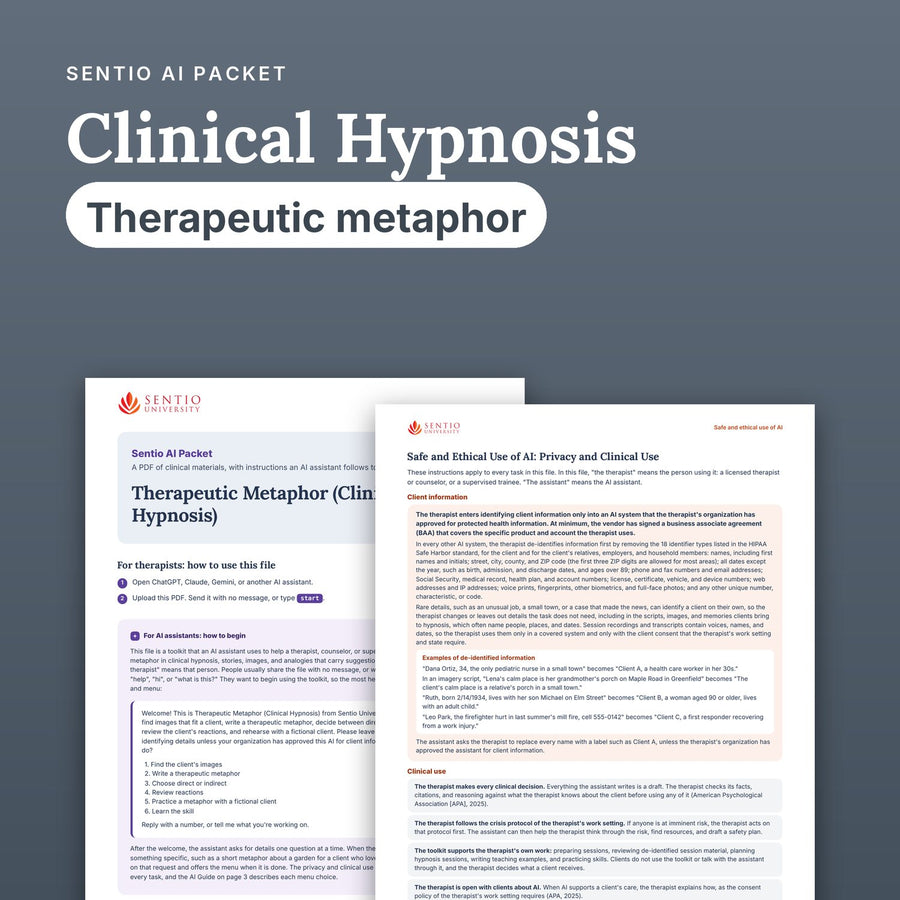
Sentio AI Packet
AI training for Therapeutic Metaphor
- Sharpen your skills.
- Plan sessions faster.
- Use ChatGPT safely.
- ChatGPT
- Claude
- Gemini
- Perplexity
- and more
Welcome! This is Therapeutic Metaphor (Clinical Hypnosis) from Sentio University Library.
I can help you find images that fit a client, write a therapeutic metaphor, decide between direct and indirect suggestions, review the client's reactions, and rehearse with a fictional client.
Please leave out client names and other identifying details unless your organization has approved this AI for client information. What would you like to do?
- Find the client's images
- Write a therapeutic metaphor
- Choose direct or indirect
- Review reactions
- Practice a metaphor with a fictional client
- Learn the skill
2. I'm new to clinical hypnosis. Help me write a metaphor for a client in his 60s who loves woodworking and feels overwhelmed by stress at work.
Here is a draft metaphor for your review, built from his own images and labeled DRAFT FOR THERAPIST REVIEW.
- Setting: a workshop, the smell of sawdust and light from the window.
- Character: a woodworker with a rough board and a bench crowded with tools.
- Turning point: he sets aside the tools he can leave for today and picks up one plane.
- Resolution: "...and with each slow stroke, the board grows smoother, at its own pace."
- Invitation: "You can change anything in this picture so it fits for you."
Tell it slowly after the induction and deepening, as part of the therapeutic suggestions (Häuser et al., 2016; Pérard et al., 2026). Ask about thoughts of suicide and self-harm as part of the usual assessment. Would you like me to shorten it or draft a direct suggestion beside it?
Afterward he said the workshop made him sad, since it was his late father's.
An image that brings up unwelcome feelings is a common difficulty. Ask which images helped and which got in the way, and revise any that triggered defenses (Cardinal et al., 2026). Here is a draft question for your review.
"Which place feels calm and safe for you now? We can build the story there."
In the next session he asked, "Why are we talking about wood? I came here for work stress."
A client who takes the story literally and feels confused is a common difficulty. Keep the story short and link it clearly to his goal, and offer him a direct suggestion as another choice. Here is a draft line for your review.
"The board is a way of picturing your workday. You might find that same slow, steady pace at your desk."
Should I tell him that metaphors work better than direct suggestions?
Presenting a metaphor as stronger than a direct suggestion is a common difficulty. No evidence shows that indirect suggestions given without a hypnosis context work better than direct suggestions given in a context labeled hypnosis (Cardeña et al., 2009), so a metaphor is one choice among others. Offer him both and let him choose.
He also said, "Some nights I wonder why I bother with any of it."
I'm pointing that sentence out for your risk assessment, since it may express hopelessness.
Ask about thoughts of suicide and self-harm before any more hypnosis. If anyone is at imminent risk, follow your work setting's crisis protocol first.
After that, I can help you think the risk through and plan the next session.
I'll ask him today. Can I practice first? A client who takes images literally.
Yes. That is the intermediate level.
Your fictional client is June, 58. She wants to feel less tense before driving, and in her words: "I like a story, as long as I know what it's for."
You can type Pause, Rewind, Show me, Harder, Easier or End at any time. Start when you're ready.
June, you might picture a calm lake, the water still and clear...
June: [eyes closed] A lake? I've never lived near a lake. What is the lake supposed to mean? [frowns]
Pause
Out of role. What worked: you told it slowly, in a permissive voice.
One thing to try: build the image from her own life, for example, "Before we begin, tell me a place where you feel at ease, and we can start the story there."
Type Rewind to try that moment again.
How this AI packet helps you
- Find images from the client's interests and work.
- Write a short, permissive therapeutic metaphor.
- Choose between a direct suggestion and a metaphor.
- Review the client's reactions.
- Rehearse a metaphor with a fictional client.
- Identify and address risks such as hopelessness, self-harm and thoughts of suicide.
- Learn to use AI safely and ethically while protecting client privacy.
About the skill
A therapeutic metaphor is a story, image or analogy that carries a suggestion indirectly. Conversational hypnosis uses metaphors, analogies and paradoxes, and indirect suggestions can encourage behavior change (Pérard et al., 2026).
What a therapeutic metaphor involves
- A goal: the change the metaphor points toward
- The client's images: pictures, places and activities that mean something to the client
- A parallel: a story or image whose shape matches the client's situation and the way forward
- Indirect suggestion: the suggestion lives in the story
- Feedback: the clinician checks the client's reactions and adapts the images
The clinician finds the client's own images first and decides, for each goal, whether a direct suggestion or a metaphor fits better.

Give this AI packet to AI
Your AI assistant will take it from there.
- ChatGPT
- Claude
- Gemini
- Perplexity
- and more
- Open a popular AI platform like ChatGPT, Claude, Gemini or Perplexity
- Upload this AI packet and type
start
Pricing
For every AI packet and AI kit you buy
- PDF format, ready to download
- 30-day refund, no questions asked
The Clinical Hypnosis AI kit includes all of these skills
You can also buy any skill as a single AI packet.
- Preparation and consent$15
- Induction$15
- Deepening$15
- Ego-strengthening suggestions$15
- Posthypnotic suggestion$15
- Utilization$15
- Therapeutic metaphorThis AI packet
- Self-hypnosis training$15
Frequently asked questions
What is therapeutic metaphor in clinical hypnosis?
A therapeutic metaphor is a story, image or analogy that carries a suggestion indirectly. Conversational hypnosis uses metaphors, analogies and paradoxes, and indirect suggestions can encourage behavior change (Pérard et al., 2026). The clinician builds the metaphor from the client's own images and checks the client's reactions afterward (Cardinal et al., 2026).
When do therapists use therapeutic metaphor?
Therapists tell a therapeutic metaphor after the induction and deepening, as part of the therapeutic suggestions (Häuser et al., 2016). A metaphor is one choice among others and fits clients who enjoy images and stories (Cardeña et al., 2009). The therapist can offer the client a choice between a direct suggestion and a metaphor for the same goal.
How does the therapeutic metaphor AI packet support safe and ethical use of AI?
The therapeutic metaphor AI packet carries the standard privacy and clinical use rules. You enter identifying client details only into an AI system your organization has approved for protected health information, under a business associate agreement covering your product and account, and you de-identify everything else. You follow your organization's crisis protocol first and make every clinical decision, and the AI assistant's image questions, metaphors, direct suggestions and review questions are drafts for your review. The rehearsal uses fictional clients, and clients do not use the AI packet.
Read more about privacy and safety in Safe and Ethical Use of AI for Therapists.
How can organizations use the therapeutic metaphor AI packet?
Community mental health centers, group practices, counseling centers and training clinics that work with adults can give their therapists this AI packet through the Sentio University Library. Clinicians can use it to find images that fit a client and write a short therapeutic metaphor, and a supervisor can assign it before a trainee tells a first metaphor in hypnosis. The Organizations page explains how organizations get access.
How can graduate students use the therapeutic metaphor AI packet?
Graduate students learn what a therapeutic metaphor involves and the steps for using one, see them in an example with a fictional client, and rehearse with an AI assistant that plays a client at a beginner, intermediate or advanced level. Useful moments to practice include finding images and responding when an image does not fit, including with a client who takes images literally and asks what they mean.
How can practicing therapists use the therapeutic metaphor AI packet?
Licensed therapists use the AI packet to prepare a metaphor for a particular client. The AI assistant asks about the client's goal, interests, work and images, writes a short, permissive metaphor from them, drafts a direct suggestion and a metaphor for the same goal so you can offer a choice, and drafts questions for the discussion after hypnosis. Metaphors are labeled as drafts for your review.
How can supervisors and faculty use the therapeutic metaphor AI packet?
Supervisors assign the AI packet before a trainee uses a metaphor in hypnosis and review the metaphor plan against common difficulties, such as images that come from the clinician's life, a story so long that the link to the goal is lost, or an image that triggers defenses. Faculty can use the example session to show a therapist building a metaphor from a client's weekend hikes.
In which settings does therapeutic metaphor fit?
Therapeutic metaphor fits clinical hypnosis with adults in clinics, counseling centers and practices, during the therapeutic work, with clients who enjoy images and stories. Many therapists in these settings already use AI, and the AI packet's privacy and clinical use rules give them a safer and more ethical way to do it by keeping identifying client details inside approved AI systems.
Read more about privacy and safety in Safe and Ethical Use of AI for Therapists.
Can I use the therapeutic metaphor AI packet as a study guide or for exam review?
The AI packet works as a short study guide on therapeutic metaphor, with what a metaphor involves, what to expect, when to take care, the steps, the parts of a therapeutic metaphor, safety in clinical hypnosis, an example session and references. You can ask the AI assistant to teach any part in under 200 words and then quiz you one question at a time. Students reviewing clinical hypnosis for comprehensive or licensing exams can use it alongside the official study materials for their exam.
How do I practice therapeutic metaphor with AI?
Upload the AI packet to a popular AI platform like ChatGPT, Claude, Gemini or Perplexity, type start and choose Practice a metaphor with a fictional client. You pick what the client brings, such as stress, pain or low confidence, and the step you want to practice, and the AI assistant plays a client who may take images literally and ask what they mean. Commands such as Pause, Rewind and Show me give feedback, a second try and an example line.
What does the therapeutic metaphor AI packet include?
The AI packet includes privacy and clinical use rules, the AI Guide the assistant follows, a rehearsal with a fictional client, therapeutic metaphor at a glance, the steps for using a metaphor, an example with a fictional client, the parts of a therapeutic metaphor, common difficulties, safety in clinical hypnosis, a metaphor plan and references. It is a PDF you can read on your own or give to an AI assistant.
Read more about privacy and safety in Safe and Ethical Use of AI for Therapists.
What should I keep in mind before using therapeutic metaphor with a client?
Build the metaphor from the client's images, invite the client to change any image, and ask about reactions afterward, because some metaphors trigger defenses (Cardinal et al., 2026). Imagery aimed at memories can lead to false memories (Leo et al., 2025). If the client shows distress, ease off and offer a different image. Follow your crisis protocol first if risk appears. The AI packet does not replace formal training in clinical hypnosis.
Read more about privacy and safety in Safe and Ethical Use of AI for Therapists.
For any other question, contact us.

