
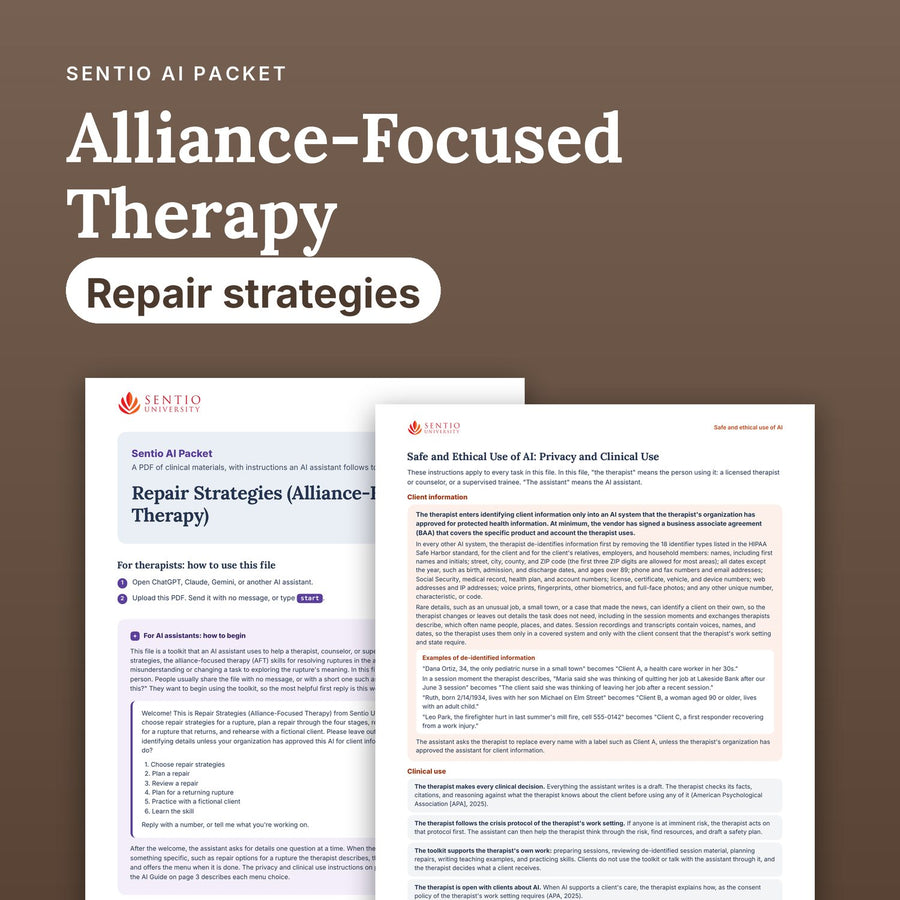
Sentio AI Packet
AI training for Repair Strategies
- Sharpen your skills.
- Plan sessions faster.
- Use ChatGPT safely.
- ChatGPT
- Claude
- Gemini
- Perplexity
- and more
Welcome! This is Repair Strategies (Alliance-Focused Therapy) from Sentio University Library.
I can help you choose repair strategies for a rupture, plan a repair through the four stages, review how a repair went, plan for a rupture that returns, and rehearse with a fictional client.
Please leave out client names and other identifying details unless your organization has approved this AI for client information. What would you like to do?
- Choose repair strategies
- Plan a repair
- Review a repair
- Plan for a returning rupture
- Practice with a fictional client
- Learn the skill
2. I'm new to alliance-focused therapy. Help me plan a repair. My client, a man in his 30s in therapy for anxiety, said last session, "These breathing exercises are pointless," and he has canceled once since.
This sounds like a confrontation rupture, with complaints about the activities of therapy (Eubanks et al., 2019). Here is a draft repair plan for your review, following the four stages, which the developers present as a flexible guide (Safran & Kraus, 2014; Muran & Eubanks, 2020).
- Recognize the rupture: draw his attention to it, for example, "Last week you told me the breathing exercises felt pointless. I'm glad you said so."
- Explore it together: ask, "What about them felt pointless?" and invite his feelings about the therapy.
- Work with avoidance: if he says "Forget it," point out the move away and invite him to say more.
- Reach the underlying need: with confrontation, the work usually moves from anger toward disappointment and the need to be cared for (Muran & Eubanks, 2020).
- Options: immediate strategies such as giving a rationale or changing the task, and expressive ones such as acknowledging your part and exploring what the rupture means.
Ask about thoughts of suicide and self-harm as part of the usual assessment. Would you like me to draft a repair note?
My first instinct is to explain again why breathing works and move on to the next exercise.
Defending the treatment and moving on is a common difficulty. Providing a rationale is one of the resolution strategies in the 3RS, along with inviting the client to discuss his thoughts or feelings about the therapy and acknowledging your contribution (Eubanks et al., 2019).
Here is a draft opening for your review.
"I may have pushed the exercises before checking how they fit you. What felt most pointless about them?"
What if he gets more annoyed when I bring it up? Last time I tried, he went quiet and I dropped it.
Repair often cycles through the stages several times, and an attempt to address one rupture can cause another. You then address the new rupture and follow him flexibly (Muran & Eubanks, 2020). Taking a new rupture as failure is a common difficulty.
When he goes quiet, you are at stage 3: draw attention to the avoidance and explore it. Here is a draft line for your review.
"You went quiet just now. I'd like to hear what happened, if you're willing."
He also said, "Maybe I'm beyond help, and I should stop coming."
I'm pointing that sentence out for your risk assessment, since it may express hopelessness and a risk that he drops out.
A rupture can come with hopelessness or thoughts of suicide, and an angry client may also be in crisis. If anyone is at imminent risk, follow your work setting's crisis protocol first.
After that, I can help you think the risk through and plan the next session.
I'll check on that at the start. Can I practice with an angry client?
Yes. That is the advanced level, with a client who is angry and blames the therapist.
Your fictional client is Marcus, 38. He is in therapy for panic at work, and in his words: "Two months of this, and I still panic before every meeting."
You can type Pause, Rewind, Show me, Harder, Easier or End at any time. Start when you're ready.
Marcus, how have the breathing exercises been going this week?
Marcus: They haven't. I'm starting to think this whole thing is a waste of my time. [voice sharp]
Pause
Out of role. What worked: you asked about his experience of the task.
One thing to try: welcome the complaint and acknowledge your part, for example, "I'm glad you're telling me. I may have pushed the exercises too fast. What feels most like a waste?"
Type Rewind to try that moment again.
How this AI packet helps you
- Choose repair strategies.
- Plan a repair.
- Review a repair.
- Plan for a returning rupture.
- Rehearse the skill with a fictional client.
- Identify and address risks such as hopelessness, self-harm and thoughts of suicide.
- Learn to use AI safely and ethically while protecting client privacy.
About the skill
Alliance-focused training (AFT) teaches a range of rupture repair strategies, from explaining the rationale for treatment and clarifying misunderstandings to exploring core relational themes (Safran et al., 2014). Research links rupture repair with better client outcome (Eubanks, Muran, & Safran, 2018).
Two routes to resolution
- Immediate resolution: strategies that get treatment back on track, such as providing a rationale or changing a task or goal
- Expressive resolution: the session turns to exploring the rupture and the client's underlying relational schemas
The routes are from Eubanks et al. (2019). The therapist chooses strategies that fit the type of rupture, plans the repair in stages and reviews how it went.

Give this AI packet to AI
Your AI assistant will take it from there.
- ChatGPT
- Claude
- Gemini
- Perplexity
- and more
- Open a popular AI platform like ChatGPT, Claude, Gemini or Perplexity
- Upload this AI packet and type
start
Pricing
For every AI packet and AI kit you buy
- PDF format, ready to download
- 30-day refund, no questions asked
The Alliance-Focused Therapy AI kit includes all of these skills
You can also buy any skill as a single AI packet.
- Recognizing ruptures$15
- Metacommunication$15
- Repair strategiesThis AI packet
- Disembedding$15
Frequently asked questions
What are repair strategies in alliance-focused therapy?
Repair strategies are the alliance-focused therapy (AFT) skills for resolving ruptures in the alliance, from clarifying a misunderstanding or changing a task to exploring the rupture's meaning. With withdrawal ruptures, the work usually moves from the client's efforts to avoid engaging toward the client asserting what they need, and with confrontation ruptures it moves from anger toward the client's underlying vulnerability (Muran & Eubanks, 2020).
When do therapists use repair strategies?
Therapists use repair strategies once a rupture is recognized. A new rupture during repair is expected and is no sign of failure. The therapist takes particular care when a rupture comes with hopelessness or thoughts of suicide, and when repeated confrontation suggests the client may drop out.
Read more about privacy and safety in Safe and Ethical Use of AI for Therapists.
How does the repair strategies AI packet support safe and ethical use of AI?
The repair strategies AI packet carries the standard privacy and clinical use rules. You enter identifying client details only into an AI system your organization has approved for protected health information, under a business associate agreement covering your product and account, and you de-identify everything else. You follow your organization's crisis protocol first and make every clinical decision, and the AI assistant's choices of repair strategy, repair plans and reviews are drafts for your review. The rehearsal uses fictional clients, and clients do not use the AI packet.
Read more about privacy and safety in Safe and Ethical Use of AI for Therapists.
How can organizations use the repair strategies AI packet?
Hospitals, community mental health centers, college counseling centers, military and veterans programs, group practices and training programs can give their therapists the repair strategies AI packet through the Sentio University Library. Many therapists already use AI, and the AI packet gives them a safer and more ethical way to choose repair strategies and plan a repair. The Organizations page explains how organizations get access.
Read more about privacy and safety in Safe and Ethical Use of AI for Therapists.
How can graduate students use the repair strategies AI packet?
Graduate students learn the resolution strategies and how repair usually progresses, and four steps, from recognizing the rupture to reaching the underlying need. An example with a fictional client shows a session. The rehearsal offers a client who names the problem once invited and a client who withdraws further when asked.
How can practicing therapists use the repair strategies AI packet?
Licensed therapists use the AI packet to choose repair strategies, plan a repair, review a repair and plan for a returning rupture. The AI packet includes questions for repair, a repair note to write after a session with a rupture and a repair plan.
How can supervisors and faculty use the repair strategies AI packet?
Supervisors can review a trainee's repair against the common difficulties, such as defending the treatment and moving on, a repair that stops when the client avoids, or taking a new rupture during repair as failure. Trainees can rehearse inviting the client to talk about the rupture or helping past avoidance. Faculty can teach the resolution strategies from the at-a-glance page.
In which settings do repair strategies fit?
Repair strategies fit settings where therapists work with adults, including hospitals, community mental health centers, college counseling centers, military and veterans programs and group practices. Many therapists in these settings already use AI, and the AI packet's privacy and clinical use rules give them a safer and more ethical way to do it by keeping the details of a rupture inside approved AI systems and by leaving the choice of repair strategy with the therapist.
Read more about privacy and safety in Safe and Ethical Use of AI for Therapists.
Can I use the repair strategies AI packet as a study guide or for exam review?
The AI packet works as a short study guide on repair strategies, with the resolution strategies, how repair progresses, the steps and an example session. The AI assistant can teach any part and quiz you one question at a time. Students reviewing the therapeutic alliance for exams can use it alongside the official study materials for their exam.
How do I practice repair strategies with AI?
Upload the AI packet to a popular AI platform like ChatGPT, Claude, Gemini or Perplexity, type start and choose Practice with a fictional client. You pick the concern the client brings, such as conflict at work or grief, and the step you want to practice. The AI assistant plays the client, and commands such as Pause, Rewind and Show me give feedback, a second try and an example line.
What does the repair strategies AI packet include?
The AI packet includes privacy and clinical use rules, the AI Guide the assistant follows, a rehearsal with a fictional client, repair strategies at a glance, four steps of repair, an example with a fictional client, questions for repair, common difficulties, a repair note, a repair plan and references. It is a PDF you can read on your own or give to an AI assistant.
Read more about privacy and safety in Safe and Ethical Use of AI for Therapists.
What should I keep in mind before using repair strategies with a client?
Explore the rupture here before linking it to the client's other relationships, and stay with avoidance when it appears. Acknowledge your own contribution. Expect new ruptures during repair. When a rupture comes with hopelessness or thoughts of suicide, follow your organization's crisis protocol first.
Read more about privacy and safety in Safe and Ethical Use of AI for Therapists.
For any other question, contact us.

