
Sentio AI Packet
AI training for Undoing Aloneness
- Sharpen your skills.
- Plan sessions faster.
- Use ChatGPT safely.
- ChatGPT
- Claude
- Gemini
- Perplexity
- and more
Welcome! This is Undoing Aloneness (Accelerated Experiential Dynamic Psychotherapy) from Sentio University Library.
I can help you plan how to show your presence to a client, find words and gestures that make the relationship explicit, plan a mindful self-disclosure, work with a client who keeps you at a distance, and rehearse with a fictional client.
Please leave out client names and other identifying details unless your organization has approved this AI for client information. What would you like to do?
- Plan presence for a session
- Find words of presence
- Plan a self-disclosure
- Work with a client who keeps you out
- Practice undoing aloneness with a fictional client
- Learn the skill
1. I'm new to AEDP. Help me plan presence for my next session. My client cared for her brother through a long illness until he died last spring, and she says she handled it all on her own.
Here is a draft plan for your review, built on what she has carried alone.
- Take an engaged stance: meet her with a warm face and voice and openly affirm her, since AEDP holds that a neutral face is contraindicated (Fosha, 2021).
- Notice what she faces alone: listen for the caregiving and grief she managed by herself, and for any feeling she apologizes for.
- Show presence without words: nod, lean in or use a soft "mmm" when she speaks of him (Prenn et al., 2025).
- Put presence into words: "You carried all of that by yourself. I'm here with you in it now."
- Invite her to take it in: "Can you feel me with you?" (Prenn et al., 2025).
- Stay with what comes next: help her stay with the feeling that follows, so the two of you can process it together (Fosha, 2021).
Ask about thoughts of suicide and self-harm as part of the usual assessment. Would you like me to fill in the session plan or change any step?
Before the session plan, I'm stuck on one moment. Last time her eyes filled and she said, "Sorry, I don't usually do this."
Clients often apologize for their feelings or expect to be shamed for them, and these are the moments where aloneness is undone (Lipton & Fosha, 2011).
Here is a draft response for your review.
- Meet the apology warmly: "There's nothing to be sorry for."
- Share your own experience of her, mindfully: "I feel touched hearing this."
- Invite her to notice it: "What is it like to let me be with you in this?"
Keep the disclosure about your experience of her, so the focus stays on her.
What if she smiles and changes the subject when I lean in?
Some clients have difficulty letting the therapist's presence in, and the work then turns to building the client's capacity to receive it (Prenn et al., 2025).
Meet her reluctance with empathy and compassion and seldom challenge it, since it was her best attempt to survive earlier attachment failures (Lipton & Fosha, 2011). Here is a draft line for your review.
"It makes sense that letting someone in feels risky. Maybe just a little of it, for a moment."
Then ask, "What happens inside when I say I'm with you?"
She also said, "Some days I wonder what the point of going on is without him."
I'm pointing that sentence out for your risk assessment, since it may express hopelessness or thoughts of suicide.
Thoughts of suicide or self-harm can come up as a client opens to painful feelings. Ask her about them directly, and if anyone is at imminent risk, follow your work setting's crisis protocol first.
After that, I can help you think the risk through, find resources and plan the rest of the session.
I'll ask her at the start of the session. Can I practice first? A client who learned early to rely only on herself.
Yes. That is the advanced level.
Your fictional client is Rosa, 52. She is starting over in a new city after her divorce, and in her words: "I've always handled things myself. It's easier that way."
You can type Pause, Rewind, Show me, Harder, Easier or End at any time. Start when you're ready.
Rosa, you've been carrying a lot on your own. What has that been like?
Rosa: It's fine. I'm used to it. [smiles and glances at the clock]
Pause
Out of role. What worked: you named what she has been carrying alone.
One thing to try: make your presence explicit and invite her to notice it, for example, "You don't have to go through this part alone. What is it like to hear me say that?"
Type Rewind to try that moment again.
How this AI packet helps you
- Plan presence for a session.
- Find words of presence.
- Plan a self-disclosure.
- Work with a client who keeps you out.
- Rehearse undoing aloneness with a fictional client.
- Identify and address risks such as hopelessness, self-harm and thoughts of suicide.
- Learn to use AI safely and ethically while protecting client privacy.
About the skill
Accelerated experiential dynamic psychotherapy (AEDP) understands relational trauma as unbearable aloneness in the face of overwhelming emotion (Lipton & Fosha, 2011). Undoing the client's aloneness is the first task of therapy.
What undoing aloneness involves
- Be openly present: the therapist is actively and explicitly affirming, validating and empathic
- Show presence without words: nodding, leaning in and sounds such as "mmm" reinforce presence
- Say it: the therapist conveys that this time the client will not be alone with overwhelming experience
The therapist conveys warmth and emotional availability, and the client is not shamed for needs and reactions (Fosha, 2021).

Give this AI packet to AI
Your AI assistant will take it from there.
- ChatGPT
- Claude
- Gemini
- Perplexity
- and more
- Open a popular AI platform like ChatGPT, Claude, Gemini or Perplexity
- Upload this AI packet and type
start
Pricing
For every AI packet and AI kit you buy
- PDF format, ready to download
- 30-day refund, no questions asked
The AEDP AI kit includes all of these skills
You can also buy any skill as a single AI packet.
- Undoing alonenessThis AI packet
- Dyadic affect regulation$15
- Detecting transformance$15
- Metaprocessing$15
- The four-state map$15
- Privileging the positive$15
Frequently asked questions
What is undoing aloneness in accelerated experiential dynamic psychotherapy?
Undoing aloneness is an accelerated experiential dynamic psychotherapy (AEDP) skill in which the therapist is explicitly and emotionally present so that the client does not face overwhelming feelings alone. AEDP understands relational trauma as unbearable aloneness in the face of overwhelming emotion, so undoing the client's aloneness is the first task of therapy (Lipton & Fosha, 2011; Fosha, 2021).
When do therapists use undoing aloneness?
Therapists undo aloneness from the start of therapy and whenever a client meets feelings the client has carried alone, apologizes for or expects to be shamed for (Lipton & Fosha, 2011). Some clients have difficulty letting the therapist's presence in, and the work then turns to building the client's capacity to receive it. When a client is clearly overwhelmed, the therapist eases the feeling first (Prenn et al., 2025).
How does the undoing aloneness AI packet support safe and ethical use of AI?
The undoing aloneness AI packet carries the standard privacy and clinical use rules. You enter identifying client details only into an AI system your organization has approved for protected health information, under a business associate agreement covering your product and account, and you de-identify everything else. You follow your organization's crisis protocol first and make every clinical decision, and the AI assistant's session plans, words of presence, self-disclosures and gentle invitations are drafts for your review. The rehearsal uses fictional clients, and clients do not use the AI packet.
Read more about privacy and safety in Safe and Ethical Use of AI for Therapists.
How can organizations use the undoing aloneness AI packet?
Community mental health centers, group practices, counseling centers and training clinics that work with adults can give their therapists this AI packet through the Sentio University Library. Clinicians can use it to plan how to show presence to a client and find words that make the relationship explicit, and a supervisor can assign it before a trainee works with a client who has carried painful feelings alone. The Organizations page explains how organizations get access.
How can graduate students use the undoing aloneness AI packet?
Graduate students learn what undoing aloneness involves and its steps, see them in an example with a fictional client, and rehearse with an AI assistant that plays a client at a beginner, intermediate or advanced level. Useful moments to practice include making the relationship explicit and responding when the client says it is easier to handle things alone, including with a client who deflects with humor when the therapist draws close.
How can practicing therapists use the undoing aloneness AI packet?
Licensed therapists use the AI packet to plan presence with a particular client. The AI assistant drafts a session plan from your answers about what the client has faced alone, writes signs of presence, words that make the relationship explicit and invitations to take that presence in, drafts a short, mindful self-disclosure with a question that asks how it lands, and drafts gentle invitations for a client who keeps you at a distance.
How can supervisors and faculty use the undoing aloneness AI packet?
Supervisors assign the AI packet before a trainee works with a client who has carried painful feelings alone and review the presence record against common difficulties, such as a neutral face or flat tone, presence that is implied but never put into words, or a self-disclosure that turns the focus to the therapist's own life. Faculty can use the example session to show a therapist conveying presence without words and then in words.
In which settings does undoing aloneness fit?
Undoing aloneness fits AEDP with adults in clinics, counseling centers and practices, from the first sessions and at each moment a client faces something hard. Many therapists in these settings already use AI, and the AI packet's privacy and clinical use rules give them a safer and more ethical way to do it by keeping identifying client details inside approved AI systems.
Read more about privacy and safety in Safe and Ethical Use of AI for Therapists.
Can I use the undoing aloneness AI packet as a study guide or for exam review?
The AI packet works as a short study guide on undoing aloneness, with what the skill involves, what to expect, the steps of undoing aloneness, words and gestures of presence, an example session and references. You can ask the AI assistant to teach any part in under 200 words and then quiz you one question at a time. Students reviewing accelerated experiential dynamic psychotherapy for comprehensive or licensing exams can use it alongside the official study materials for their exam.
How do I practice undoing aloneness with AI?
Upload the AI packet to a popular AI platform like ChatGPT, Claude, Gemini or Perplexity, type start and choose Practice undoing aloneness with a fictional client. You pick the concern the client brings, such as grief the client has carried alone or shame about a childhood memory, and the step you want to practice, and the AI assistant plays a client who may deflect with humor when you draw close. Commands such as Pause, Rewind and Show me give feedback, a second try and an example line.
What does the undoing aloneness AI packet include?
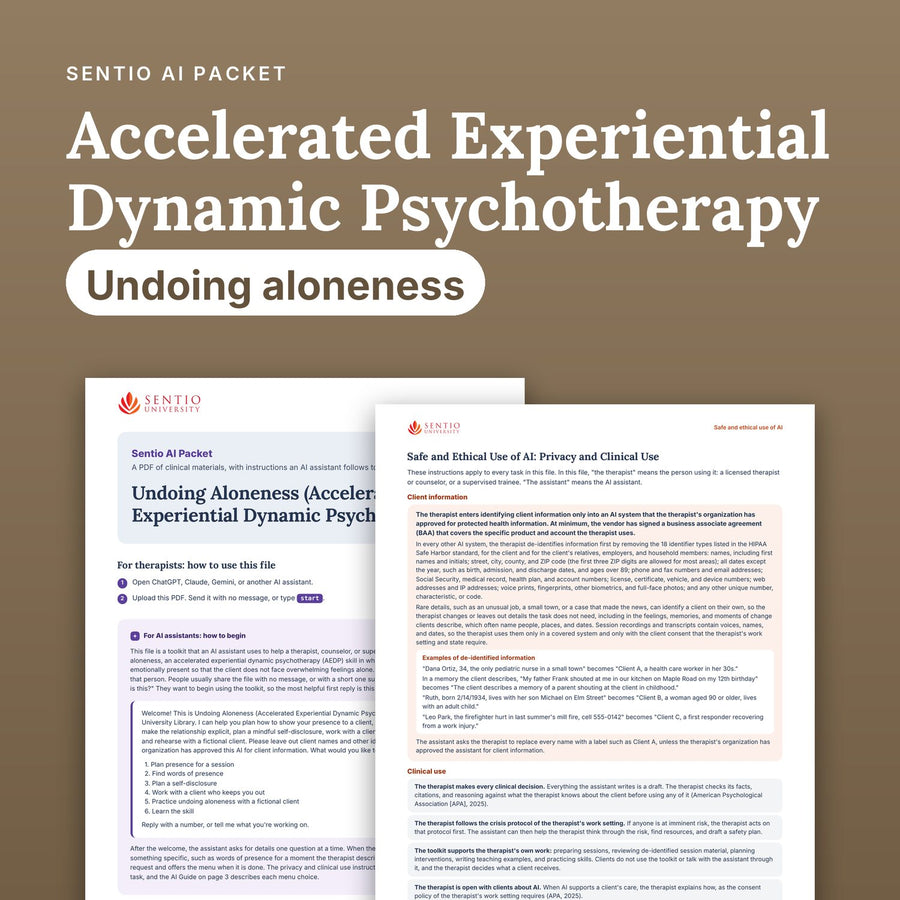
The AI packet includes privacy and clinical use rules, the AI Guide the assistant follows, a rehearsal with a fictional client, undoing aloneness at a glance, the steps of undoing aloneness, an example with a fictional client, words and gestures of presence, common difficulties, a presence record, a session plan and references. It is a PDF you can read on your own or give to an AI assistant.
Read more about privacy and safety in Safe and Ethical Use of AI for Therapists.
What should I keep in mind before using undoing aloneness with a client?
Meet a client's reluctance to let you in with empathy and compassion, since defenses were the client's best attempt to survive earlier attachment failures (Lipton & Fosha, 2011). When a client is clearly overwhelmed, ease the feeling before inviting more (Prenn et al., 2025). Keep any self-disclosure about your experience of the client. Ask about thoughts of suicide and self-harm, and follow your crisis protocol first if risk appears. The AI packet does not replace formal training in accelerated experiential dynamic psychotherapy.
Read more about privacy and safety in Safe and Ethical Use of AI for Therapists.
For any other question, contact us.

